

Ch 30: Electromagnetic Induction
Knight Calc - Physics for Scientists and Engineers 5th Edition
Knight Calc5th EditionPhysics for Scientists and EngineersISBN: 9780137344796당신이 사용하는 게 아니라요?교과서 변경
30장, 문제 19

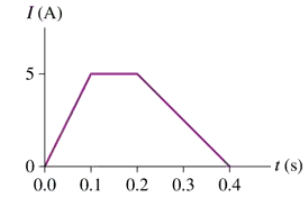
FIGURE EX30.19 shows the current as a function of time through a 20-cm-long, 4.0-cm-diameter solenoid with 400 turns. Draw a graph of the induced electric field strength as a function of time at a point 1.0 cm from the axis of the solenoid.

검증된 단계별 안내
1
Step 1: Understand the problem. The solenoid has a changing current, which induces an electric field. The graph provided shows the current (I) as a function of time (t). The goal is to calculate the induced electric field strength at a point 1.0 cm from the axis of the solenoid and plot it as a function of time.
Step 2: Recall Faraday's Law of Induction. The induced electric field is related to the rate of change of magnetic flux through the solenoid. The magnetic flux (Φ_B) is given by Φ_B = B × A, where B is the magnetic field inside the solenoid and A is the cross-sectional area of the solenoid. The magnetic field inside the solenoid is B = μ₀ × n × I, where μ₀ is the permeability of free space, n is the number of turns per unit length, and I is the current.
Step 3: Calculate the rate of change of magnetic flux. The induced electric field strength (E) at a distance r from the axis is given by E = (1 / (2πr)) × (dΦ_B / dt). To find dΦ_B / dt, differentiate Φ_B with respect to time, using the expression for B and A. Note that A = π × (radius of solenoid)^2.
Step 4: Analyze the graph of current vs. time. The graph shows linear segments where the current increases, remains constant, and decreases. For each segment, calculate dI/dt (rate of change of current) and use it to find dΦ_B / dt. Substitute these values into the formula for E to determine the induced electric field strength at r = 1.0 cm.
Step 5: Plot the graph of E vs. t. Using the calculated values of E for each time interval, draw the graph. The shape of the graph will correspond to the changes in dI/dt: increasing during the rising current, zero during constant current, and decreasing during the falling current.

비슷한 문제에 대한 검증된 영상 답변:

이 영상 해법은 위 문제에 도움이 된다고 튜터들이 추천한 것입니다.
도움이 되었나요?

주요 개념

질문에 올바르게 답하기 위해 반드시 이해해야 하는 핵심 개념들은 다음과 같습니다.

Electromagnetic Induction

Electromagnetic induction is the process by which a changing magnetic field within a closed loop induces an electromotive force (EMF) in the loop. This phenomenon is described by Faraday's Law, which states that the induced EMF is proportional to the rate of change of magnetic flux through the loop. In the context of the solenoid, as the current changes over time, it creates a varying magnetic field that induces an electric field in the surrounding space.
추천 영상:
가이드 코스
05:42
Introduction to Induction

Induced Electric Field

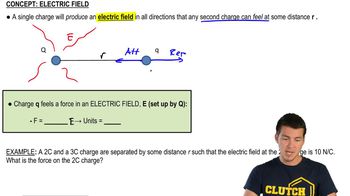
The induced electric field is generated in response to a changing magnetic field, as described by Faraday's Law of Induction. The strength of this electric field can be calculated using the formula E = -dΦ/dt, where E is the electric field strength and Φ is the magnetic flux. The induced electric field circulates around the axis of the solenoid and its strength varies with the distance from the solenoid and the rate of change of current.
추천 영상:
가이드 코스
03:16
Intro to Electric Fields

Solenoid Characteristics

A solenoid is a coil of wire designed to create a uniform magnetic field when an electric current passes through it. The characteristics of a solenoid, such as its length, diameter, and number of turns, influence the strength of the magnetic field it produces. In this case, the solenoid has 400 turns and a specific length and diameter, which will affect the induced electric field at a point 1.0 cm from its axis as the current changes over time.
추천 영상:
가이드 코스
11:47
Toroidal Solenoids aka Toroids
관련 실천
교과서 질문

CALC A 5.0-cm-diameter coil has 20 turns and a resistance of 0.50 Ω. A magnetic field perpendicular to the coil is B = 0.020t + 0.010t2, where B is in tesla and t is in seconds. Find an expression for the induced current I(t) as a function of time.

1948
views
교과서 질문

A 12-cm-diameter, 1.0-m-long solenoid is wound with 2000 turns of superconducting wire. When the magnet is turned on, the current increases from 0 to Imax in 2.5 s. At t = 1.0 s, the induced electric field midway between the axis and the windings is 7.5×10⁻³ V/m. What is the solenoid's steady magnetic field strength?

68
views
교과서 질문

A 1000-turn coil of wire 1.0 cm in diameter is in a magnetic field that increases from 0.10 T to 0.30 T in 10 ms. The axis of the coil is parallel to the field. What is the emf of the coil?

2168
views
교과서 질문

CALC A 5.0-cm-diameter coil has 20 turns and a resistance of 0.50 Ω. A magnetic field perpendicular to the coil is B = 0.020t + 0.010t2, where B is in tesla and t is in seconds. Evaluate I at t = 5 s and t = 10 s.

1272
views
교과서 질문

Electricity is distributed from electrical substations to neighborhoods at 15,000 V. This is a 60 Hz oscillating (AC) voltage. Neighborhood transformers, seen on utility poles, step this voltage down to the 120 V that is delivered to your house. a. How many turns does the primary coil on the transformer have if the secondary coil has 100 turns?

194
views
교과서 질문

The magnetic field inside a 5.0-cm-diameter solenoid is 2.0 T and decreasing at 4.0 T/s. What is the electric field strength inside the solenoid at a point (a) on the axis and (b) 2.0 cm from the axis?

136
views