Ch 30: Electromagnetic Induction
Knight Calc - Physics for Scientists and Engineers 5th Edition
Knight Calc5th EditionPhysics for Scientists and EngineersISBN: 9780137344796당신이 사용하는 게 아니라요?교과서 변경
30장, 문제 2a

INT A 10-cm-long wire is pulled along a U-shaped conducting rail in a perpendicular magnetic field. The total resistance of the wire and rail is 0.20 Ω. Pulling the wire at a steady speed of 4.0 m/s causes 4.0 W of power to be dissipated in the circuit. How big is the pulling force?

검증된 단계별 안내
1
Step 1: Begin by understanding the relationship between power, resistance, and current. The power dissipated in the circuit is given as 4.0 W, and the total resistance is 0.20 Ω. Use the formula for power dissipation in terms of current: P = I²R, where P is power, I is current, and R is resistance. Rearrange the formula to solve for the current: I = √(P / R).
Step 2: Once the current is determined, calculate the induced electromotive force (EMF) in the circuit using Ohm's Law: EMF = I × R. This EMF is generated due to the motion of the wire in the magnetic field.
Step 3: Recall Faraday's Law of Induction, which relates the EMF to the motion of the wire in the magnetic field. The EMF can also be expressed as EMF = B × L × v, where B is the magnetic field strength, L is the length of the wire, and v is the velocity of the wire. Use this formula to find the magnetic field strength (B) if needed.
Step 4: The pulling force required to move the wire at a steady speed can be calculated using the formula F = I × B × L, where F is the force, I is the current, B is the magnetic field strength, and L is the length of the wire. Substitute the values obtained for I, B, and L into this formula.
Step 5: Ensure all units are consistent (e.g., meters for length, seconds for time) and verify the calculations step by step to ensure accuracy. The pulling force is the final result obtained from the formula F = I × B × L.

비슷한 문제에 대한 검증된 영상 답변:

이 영상 해법은 위 문제에 도움이 된다고 튜터들이 추천한 것입니다.
영상 길이:
2m
도움이 되었나요?

주요 개념

질문에 올바르게 답하기 위해 반드시 이해해야 하는 핵심 개념들은 다음과 같습니다.

Electromagnetic Induction

Electromagnetic induction is the process by which a changing magnetic field within a closed loop induces an electromotive force (EMF) in the wire. In this scenario, as the wire moves through the magnetic field, it cuts through magnetic lines of force, generating an EMF that drives current through the circuit.
추천 영상:
가이드 코스
05:42
Introduction to Induction

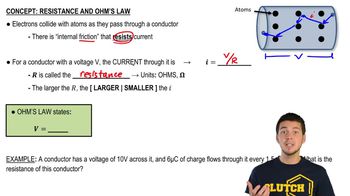
Ohm's Law

Ohm's Law states that the current (I) flowing through a conductor between two points is directly proportional to the voltage (V) across the two points and inversely proportional to the resistance (R) of the conductor. This relationship can be expressed as V = IR, which is essential for calculating the current in the circuit when the power and resistance are known.
추천 영상:
가이드 코스
03:07
Resistance and Ohm's Law

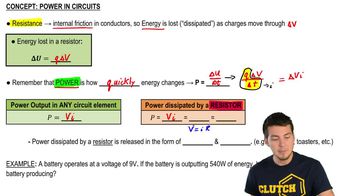
Power in Electrical Circuits

Power (P) in electrical circuits is defined as the rate at which electrical energy is converted to another form of energy, such as heat. It can be calculated using the formula P = IV, where I is the current and V is the voltage. In this case, knowing the power dissipated allows us to find the current flowing through the circuit, which is crucial for determining the pulling force.
추천 영상:
가이드 코스
06:18
Power in Circuits