Ch 32: AC Circuits
Knight Calc - Physics for Scientists and Engineers 5th Edition
Knight Calc5th EditionPhysics for Scientists and EngineersISBN: 9780137344796당신이 사용하는 게 아니라요?교과서 변경
32장, 문제 38

The motor of an electric drill draws a 3.5 A rms current at the power-line voltage of 120 V rms. What is the motor's power if the current lags the voltage by 20°?

검증된 단계별 안내
1
Step 1: Recall the formula for calculating the real power (P) in an AC circuit: \( P = V_{\text{rms}} \cdot I_{\text{rms}} \cdot \cos(\phi) \), where \( V_{\text{rms}} \) is the root mean square voltage, \( I_{\text{rms}} \) is the root mean square current, and \( \phi \) is the phase angle between the current and voltage.
Step 2: Identify the given values from the problem: \( V_{\text{rms}} = 120 \; \text{V} \), \( I_{\text{rms}} = 3.5 \; \text{A} \), and \( \phi = 20^\circ \).
Step 3: Convert the phase angle \( \phi \) from degrees to radians if necessary, as some calculations may require it. Use the conversion formula \( \phi_{\text{radians}} = \phi_{\text{degrees}} \cdot \frac{\pi}{180} \).
Step 4: Substitute the given values into the power formula: \( P = 120 \cdot 3.5 \cdot \cos(20^\circ) \).
Step 5: Use a calculator or trigonometric table to find \( \cos(20^\circ) \), then multiply the values to compute the motor's real power. Ensure the units of the final result are in watts (W).

비슷한 문제에 대한 검증된 영상 답변:

이 영상 해법은 위 문제에 도움이 된다고 튜터들이 추천한 것입니다.
도움이 되었나요?

주요 개념

질문에 올바르게 답하기 위해 반드시 이해해야 하는 핵심 개념들은 다음과 같습니다.

RMS Current and Voltage

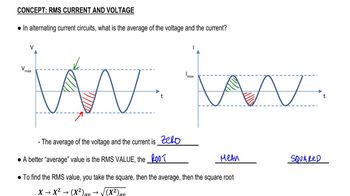
RMS (Root Mean Square) values represent the effective values of alternating current (AC) and voltage. For AC circuits, RMS values allow for the calculation of power as they provide a measure equivalent to a DC value that would deliver the same power. In this case, the drill operates at 3.5 A rms and 120 V rms, which are essential for determining the power consumed.
추천 영상:
가이드 코스
07:14
RMS Current and Voltage

Power Factor

The power factor is a measure of how effectively electrical power is being converted into useful work output. It is defined as the cosine of the phase angle (φ) between the current and voltage waveforms. In this scenario, with a phase lag of 20°, the power factor can be calculated as cos(20°), which is crucial for determining the real power consumed by the motor.
추천 영상:

Real Power Calculation

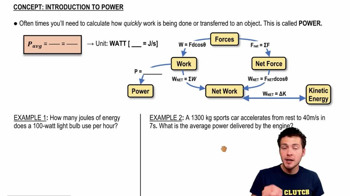
Real power, measured in watts (W), is the actual power consumed by an electrical device to perform work. It can be calculated using the formula P = V_rms * I_rms * power factor. For the electric drill, substituting the given values of voltage, current, and the calculated power factor will yield the motor's real power output.
추천 영상: