
교과서 질문
A diffraction grating produces a first-order maximum at an angle of 20.0°. What is the angle of the second-order maximum?
192
views

 검증된 단계별 안내
 08:44
08:44
 03:47
03:47 05:42
05:42A diffraction grating produces a first-order maximum at an angle of 20.0°. What is the angle of the second-order maximum?
The two most prominent wavelengths in the light emitted by a hydrogen discharge lamp are 656 nm (red) and 486 nm (blue). Light from a hydrogen lamp illuminates a diffraction grating with 500 lines/mm, and the light is observed on a screen 1.50 m behind the grating. What is the distance between the first-order red and blue fringes?
In a single-slit experiment, the slit width is 200 times the wavelength of the light. What is the width (in mm) of the central maximum on a screen 2.0 m behind the slit?
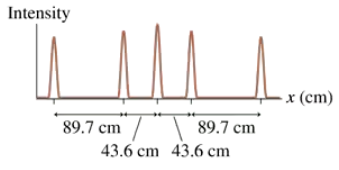
Light of 630 nm wavelength illuminates a single slit of width 0.15 mm. FIGURE EX33.22 shows the intensity pattern seen on a screen behind the slit. What is the distance to the screen?
A double-slit interference pattern is created by two narrow slits spaced 0.25 mm apart. The distance between the first and the fifth minimum on a screen 60 cm behind the slits is 5.5 mm. What is the wavelength (in nm) of the light used in this experiment?
Light of 600 nm wavelength passes through a single slit and creates a 2.0-cm-wide central maximum on a screen behind the slit. What wavelength of light will create a 3.0-cm-wide central maximum on a screen twice as far away?