
Ch 33: Wave Optics
Knight Calc - Physics for Scientists and Engineers 5th Edition
Knight Calc5th EditionPhysics for Scientists and EngineersISBN: 9780137344796당신이 사용하는 게 아니라요?교과서 변경
33장, 문제 67b

Light of wavelength 600 nm passes though two slits separated by 0.20 mm and is observed on a screen 1.0 m behind the slits. The location of the central maximum is marked on the screen and labeled y = 0. A very thin piece of glass is then placed in one slit. Because light travels slower in glass than in air, the wave passing through the glass is delayed by 5.0×10⁻¹⁶ s in comparison to the wave going through the other slit. What fraction of the period of the light wave is this delay?

검증된 단계별 안내
1
Determine the period of the light wave using the relationship between the speed of light, wavelength, and frequency. The formula for frequency is \( f = \frac{c}{\lambda} \), where \( c \) is the speed of light (\( 3.0 \times 10^8 \ \text{m/s} \)) and \( \lambda \) is the wavelength (600 nm or \( 600 \times 10^{-9} \ \text{m} \)). The period \( T \) is the reciprocal of the frequency: \( T = \frac{1}{f} \).
Substitute the given values into the formula \( f = \frac{c}{\lambda} \) to calculate the frequency of the light wave. Then, use \( T = \frac{1}{f} \) to find the period of the wave.
Compare the given time delay (\( 5.0 \times 10^{-16} \ \text{s} \)) to the period of the wave. To find the fraction of the period, divide the time delay by the period: \( \text{Fraction} = \frac{\text{Time Delay}}{T} \).
Simplify the fraction by substituting the calculated value of \( T \) from the previous step.
Interpret the result to express the fraction of the period that corresponds to the given time delay.

비슷한 문제에 대한 검증된 영상 답변:

이 영상 해법은 위 문제에 도움이 된다고 튜터들이 추천한 것입니다.
도움이 되었나요?

주요 개념

질문에 올바르게 답하기 위해 반드시 이해해야 하는 핵심 개념들은 다음과 같습니다.

Wavelength and Frequency

Wavelength is the distance between successive peaks of a wave, while frequency is the number of peaks that pass a point in a given time. For light, these two are related by the speed of light (c = λf), where λ is the wavelength and f is the frequency. Understanding this relationship is crucial for analyzing wave behavior, especially in interference patterns.
추천 영상:
가이드 코스
05:08
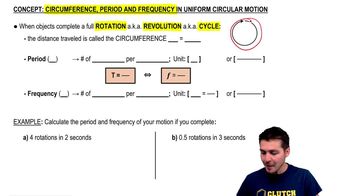
Circumference, Period, and Frequency in UCM

Wave Period

The period of a wave is the time it takes for one complete cycle of the wave to pass a given point. It is the inverse of frequency (T = 1/f). In the context of light waves, knowing the period allows us to relate time delays, such as the one caused by the glass, to the fraction of the wave cycle that is affected.
추천 영상:
가이드 코스
06:28
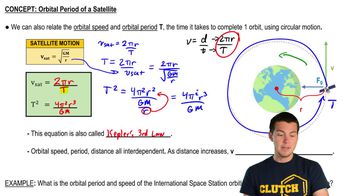
Satellite Period

Phase Difference

Phase difference refers to the difference in the phase of two waves at a given point in time. It is often expressed in terms of fractions of the wavelength or cycles. In this scenario, the delay introduced by the glass results in a phase difference that can affect the interference pattern observed on the screen, making it essential to calculate the fraction of the wave period that corresponds to the time delay.
추천 영상:
가이드 코스
08:59
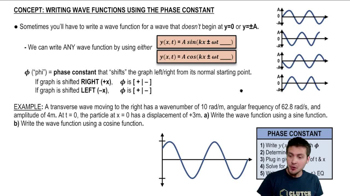
Phase Constant of a Wave Function
관련 실천
교과서 질문

Light of wavelength 600 nm passes though two slits separated by 0.20 mm and is observed on a screen 1.0 m behind the slits. The location of the central maximum is marked on the screen and labeled y = 0. With the glass in place, what is the phase difference Δϕ0 between the two waves as they leave the slits?

112
views
교과서 질문

A helium-neon laser (λ = 633 nm) is built with a glass tube of inside diameter 1.0 mm, as shown in FIGURE P33.62. One mirror is partially transmitting to allow the laser beam out. An electrical discharge in the tube causes it to glow like a neon light. From an optical perspective, the laser beam is a light wave that diffracts out through a 1.0-mm-diameter circular opening. Can a laser beam be perfectly parallel, with no spreading? Why or why not?

102
views
교과서 질문

A radar for tracking aircraft broadcasts a 12 GHz microwave beam from a 2.0-m-diameter circular radar antenna. From a wave perspective, the antenna is a circular aperture through which the microwaves diffract. If the antenna emits 100 kW of power, what is the average microwave intensity at 30 km?

54
views
교과서 질문

A double-slit experiment is set up using a helium-neon laser (λ = 633 nm). Then a very thin piece of glass (n = 1.50) is placed over one of the slits. Afterward, the central point on the screen is occupied by what had been the m = 10 dark fringe. How thick is the glass?

1958
views
교과서 질문

A helium-neon laser (λ = 633 nm) is built with a glass tube of inside diameter 1.0 mm, as shown in FIGURE P33.62. One mirror is partially transmitting to allow the laser beam out. An electrical discharge in the tube causes it to glow like a neon light. From an optical perspective, the laser beam is a light wave that diffracts out through a 1.0-mm-diameter circular opening. What is the diameter (in mm) of the laser beam after it travels 3.0 m? Note that the wave model is appropriate because the spreading, at this distance, is significantly larger than the size of the opening.

74
views
교과서 질문

A Michelson interferometer operating at a 600 nm wavelength has a 2.00-cm-long glass cell in one arm. To begin, the air is pumped out of the cell and mirror M₂ is adjusted to produce a bright spot at the center of the interference pattern. Then a valve is opened and air is slowly admitted into the cell. The index of refraction of air at 1.00 atm pressure is 1.00028. How many bright-dark-bright fringe shifts are observed as the cell fills with air?

100
views