A 1.0-cm-tall object is 10 cm in front of a converging lens that has a 30 cm focal length. Calculate the image position and height. Compare with your ray-tracing answers in part a.
Ch 34: Ray Optics
34장, 문제 30
A goldfish lives in a 50-cm-diameter spherical fish bowl. The fish sees a cat watching it. If the cat's face is 20 cm from the edge of the bowl, how far from the edge does the fish see it as being? (You can ignore the thin glass wall of the bowl.)
검증된 단계별 안내1
Determine the radius of the spherical fish bowl. Since the diameter is given as 50 cm, the radius \( r \) is half of the diameter: \( r = \frac{50}{2} = 25 \, \text{cm} \).
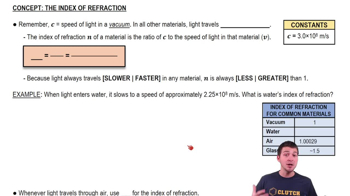
Identify the refractive index of water \( n \), which is approximately \( n = 1.33 \). The refractive index of air is \( n_{\text{air}} = 1.00 \).
Use the formula for refraction at a spherical surface: \( \frac{n_1}{s} + \frac{n_2}{s'} = \frac{n_2 - n_1}{R} \), where \( n_1 \) is the refractive index of the medium the light is coming from (air), \( n_2 \) is the refractive index of the medium the light is entering (water), \( s \) is the object distance (distance of the cat's face from the bowl), \( s' \) is the image distance (distance where the fish sees the cat's face), and \( R \) is the radius of curvature of the spherical surface.
Substitute the known values into the formula: \( \frac{1.00}{20} + \frac{1.33}{s'} = \frac{1.33 - 1.00}{25} \). Simplify the equation to solve for \( s' \), the image distance.
Rearrange the equation to isolate \( \frac{1.33}{s'} \), then take the reciprocal to find \( s' \). This will give the distance from the fish to the image of the cat's face as seen through the water.

비슷한 문제에 대한 검증된 영상 답변:
이 영상 해법은 위 문제에 도움이 된다고 튜터들이 추천한 것입니다.
도움이 되었나요?
주요 개념
질문에 올바르게 답하기 위해 반드시 이해해야 하는 핵심 개념들은 다음과 같습니다.
Refraction of Light
Refraction is the bending of light as it passes from one medium to another, caused by a change in its speed. In this scenario, light travels from air into the water of the fish bowl, altering its path. This bending affects how the fish perceives the position of the cat, making it appear at a different distance than it actually is.
추천 영상:
가이드 코스
Index of Refraction
Spherical Geometry
Spherical geometry deals with figures on the surface of a sphere, where traditional Euclidean rules do not apply. The fish bowl's spherical shape means that the angles and distances perceived by the fish are influenced by the curvature of the bowl, which must be considered when calculating how far the fish sees the cat.
추천 영상:
가이드 코스
Refraction at Spherical Surfaces
Optical Illusion
An optical illusion occurs when the perception of an object differs from its physical reality. In this case, the fish perceives the cat's position differently due to the combined effects of refraction and the spherical shape of the bowl, leading to a misjudgment of distance that is crucial for understanding the fish's perspective.
추천 영상:
가이드 코스
Law of Reflection
관련 실천
교과서 질문
125
views
교과서 질문
Find the focal length of the glass lens in FIGURE EX34.28.
101
views
교과서 질문
An object is 20 cm in front of a converging lens with a focal length of 10 cm. Use ray tracing to determine the location of the image. Is the upright or inverted?
231
views
교과서 질문
Find the focal length of the plano-concave polystyrene plastic lens in FIGURE EX34.25.
138
views
교과서 질문
A laser beam in air is incident on a liquid at an angle of 53° with respect to the normal. The laser beam's angle in the liquid is 35°. What is the liquid's index of refraction?
111
views
교과서 질문
A 1.0-cm-tall candle flame is 60 cm from a lens with a focal length of 20 cm. What are the distance and the height of the flame's image?
97
views