Ch 34: Ray Optics
Knight Calc - Physics for Scientists and Engineers 5th Edition
Knight Calc5th EditionPhysics for Scientists and EngineersISBN: 9780137344796당신이 사용하는 게 아니라요?교과서 변경
34장, 문제 60

Paraxial light rays approach a transparent sphere parallel to an optical axis passing through the center of the sphere. The rays come to a focus on the far surface of the sphere. What is the sphere's index of refraction?

검증된 단계별 안내
1
Understand the problem: Paraxial rays are light rays that make small angles with the optical axis. When these rays pass through a transparent sphere and converge at the far surface, the sphere acts as a lens. The goal is to determine the sphere's index of refraction (n).
Apply the lensmaker's equation for a spherical lens. For a sphere, the focal length (f) is related to the radius of curvature (R) and the index of refraction (n) by the formula: 1f = (n - 1) * (2R).
Recognize that the focal point is located on the far surface of the sphere. This means the focal length (f) is equal to the radius of the sphere (R). Substitute f = R into the lensmaker's equation: 1R = (n - 1) * (2R).
Simplify the equation by canceling out R (since R ≠ 0): 1 = (n - 1) * 2.
Solve for the index of refraction (n): Rearrange the equation to isolate n: n = 32.

비슷한 문제에 대한 검증된 영상 답변:

이 영상 해법은 위 문제에 도움이 된다고 튜터들이 추천한 것입니다.
도움이 되었나요?

주요 개념

질문에 올바르게 답하기 위해 반드시 이해해야 하는 핵심 개념들은 다음과 같습니다.

Refraction

Refraction is the bending of light as it passes from one medium to another with a different density. This phenomenon occurs due to the change in speed of light in different materials, which is quantified by the index of refraction. The degree of bending can be described by Snell's Law, which relates the angles of incidence and refraction to the indices of refraction of the two media.
추천 영상:
03:46
Index of Refraction

Index of Refraction

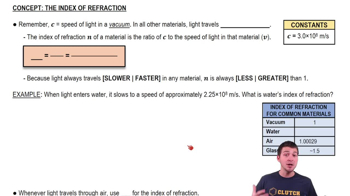
The index of refraction (n) is a dimensionless number that describes how much light slows down in a medium compared to its speed in a vacuum. It is defined as the ratio of the speed of light in vacuum to the speed of light in the medium. A higher index indicates that light travels slower in that medium, which affects how light rays are bent when entering or exiting the material.
추천 영상:
03:46
Index of Refraction

Lens Maker's Equation

The Lens Maker's Equation relates the focal length of a lens to the radii of curvature of its surfaces and the index of refraction. For a spherical surface, this equation helps determine how light rays converge or diverge after passing through the lens. In the context of a transparent sphere, it can be used to find the index of refraction by analyzing the focal point of the light rays as they pass through the sphere.
추천 영상:
가이드 코스
05:38
Lens Maker Equation
관련 실천
교과서 질문

BIO A dentist uses a curved mirror to view the back side of teeth in the upper jaw. Suppose she wants an upright image with a magnification of 1.5 when the mirror is 1.2 cm from a tooth. Should she use a convex or a concave mirror? What focal length should it have?

105
views
교과서 질문

There's one angle of incidence β onto a prism for which the light inside an isosceles prism travels parallel to the base and emerges at angle β. A laboratory measurement finds that β=52.2° for a prism shaped like an equilateral triangle. What is the prism's index of refraction?

80
views
교과서 질문

You're visiting the shark tank at the aquarium when you see a 2.5-m-long shark that appears to be swimming straight toward you at 2.0 m/s. What is the shark's actual speed through the water? You can ignore the glass wall of the tank.

1607
views
교과서 질문

Optical engineers need to know the cone of acceptance of an optical fiber. This is the maximum angle that an entering light ray can make with the axis of the fiber if it is to be guided down the fiber. What is the cone of acceptance of an optical fiber for which the index of refraction of the core is 1.55 while that of the cladding is 1.45? You can model the fiber as a cylinder with a flat entrance face.

155
views
교과서 질문

A 2.0-cm-tall candle flame is 2.0 m from a wall. You happen to have a lens with a focal length of 32 cm. How many places can you put the lens to form a well-focused image of the candle flame on the wall? For each location, what are the height and orientation of the image?

77
views
교과서 질문

BIO A keratometer is an optical device used to measure the radius of curvature of the eye's cornea—its entrance surface. This measurement is especially important when fitting contact lenses, which must match the cornea's curvature. Most light incident on the eye is transmitted into the eye, but some light reflects from the cornea, which, due to its curvature, acts like a convex mirror. The keratometer places a small, illuminated ring of known diameter 7.5 cm in front of the eye. The optometrist, using an eyepiece, looks through the center of this ring and sees a small virtual image of the ring that appears to be behind the cornea. The optometrist uses a scale inside the eyepiece to measure the diameter of the image and calculate its magnification. Suppose the optometrist finds that the magnification for one patient is 0.049. What is the absolute value of the radius of curvature of her cornea?

80
views