


Ch 35: Optical Instruments
Knight Calc - Physics for Scientists and Engineers 5th Edition
Knight Calc5th EditionPhysics for Scientists and EngineersISBN: 9780137344796당신이 사용하는 게 아니라요?교과서 변경
35장, 문제 38

A microscope with a tube length of 180 mm achieves a total magnification of 800x with a 40x objective and a 20x eyepiece. The microscope is focused for viewing with a relaxed eye. Approximately how far is the sample from the objective lens?

검증된 단계별 안내
1
Determine the magnification of the objective lens, which is given as 40x. This means the objective lens magnifies the image by a factor of 40.
Recall the formula for the magnification of the objective lens: \( M_{objective} = \frac{L}{f_{objective}} \), where \( L \) is the tube length (180 mm) and \( f_{objective} \) is the focal length of the objective lens. Rearrange the formula to solve for \( f_{objective} \): \( f_{objective} = \frac{L}{M_{objective}} \).
Substitute the given values into the formula: \( L = 180 \ \text{mm} \) and \( M_{objective} = 40 \). This will give the focal length of the objective lens, \( f_{objective} \).
For a relaxed eye, the sample distance from the objective lens (denoted as \( d_{object} \)) can be approximated using the thin lens equation: \( \frac{1}{f_{objective}} = \frac{1}{d_{object}} + \frac{1}{d_{image}} \). Here, \( d_{image} \) is the distance of the intermediate image formed by the objective lens, which is approximately equal to the tube length \( L \) (180 mm).
Rearrange the thin lens equation to solve for \( d_{object} \): \( d_{object} = \frac{1}{\frac{1}{f_{objective}} - \frac{1}{L}} \). Substitute the values of \( f_{objective} \) and \( L \) to calculate the sample distance from the objective lens.

비슷한 문제에 대한 검증된 영상 답변:

이 영상 해법은 위 문제에 도움이 된다고 튜터들이 추천한 것입니다.
도움이 되었나요?

주요 개념

질문에 올바르게 답하기 위해 반드시 이해해야 하는 핵심 개념들은 다음과 같습니다.

Total Magnification

Total magnification in microscopy is the product of the magnification of the objective lens and the eyepiece. In this case, a 40x objective combined with a 20x eyepiece results in a total magnification of 800x. Understanding this relationship is crucial for determining how the lenses work together to enlarge the image of the sample.
추천 영상:
가이드 코스
05:29
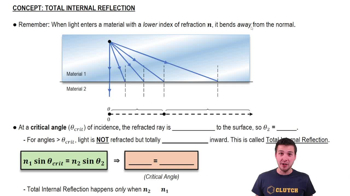
Total Internal Reflection

Lens Formula

The lens formula relates the object distance (distance from the sample to the objective lens), image distance, and focal length of the lens. For microscopes, this formula helps calculate the position of the sample based on the known parameters of the lenses. It is essential for determining how far the sample is from the objective lens in this scenario.
추천 영상:
가이드 코스
05:38
Lens Maker Equation

Relaxed Eye Focus

When a microscope is focused for viewing with a relaxed eye, it means that the image formed by the objective lens is at the focal point of the eyepiece. This condition allows for comfortable viewing without straining the eye. Understanding this concept is important for accurately calculating the distance of the sample from the objective lens, as it influences the effective focal lengths involved.
추천 영상:
가이드 코스
07:49
Ray Diagrams for Convex Mirrors
관련 실천
교과서 질문

A simple and relatively inexpensive microscope eyepiece is the Ramsden eyepiece shown in FIGURE P35.40. Two plano-convex lenses have their curved surfaces facing each other, which a more advanced analysis shows is the orientation that minimizes spherical aberration. That same analysis finds that chromatic aberration is minimized with lens spacing L = 1/2 (f₁ + f₂). Your task is to design a 10x Ramsden eyepiece in which the first lens has a focal length of 30 mm. What are (a) the focal length and (b) the spacing of the second lens?

1510
views
교과서 질문

Mars (6800 km diameter) is viewed through a telescope on a night when it is 1.1 x 10⁸ km from the earth. Its angular size as seen through the eyepiece is 0.50°, the same size as the full moon seen by the naked eye. If the eyepiece focal length is 25 mm, how long is the telescope?

108
views
교과서 질문

The cornea, a boundary between the air and the aqueous humor, has a 3.0 cm focal length when acting alone. What is its radius of curvature?

137
views
교과서 질문

White light is incident onto a 30° prism at the 40° angle shown in FIGURE P35.41. Violet light emerges perpendicular to the rear face of the prism. The index of refraction of violet light in this glass is 2.0% larger than the index of refraction of red light. At what angle Φ does red light emerge from the rear face?

1655
views
교과서 질문

Marooned on a desert island and with a lot of time on your hands, you decide to disassemble your glasses to make a crude telescope with which you can scan the horizon for rescuers. Luckily you’re farsighted, and, like most people, your two eyes have different lens prescriptions. Your left eye uses a lens of power +4.5 D, and your right eye’s lens is +3.0 D. Which lens should you use for the objective and which for the eyepiece? Explain.

100
views
교과서 질문

Modern microscopes are more likely to use a camera than human viewing. This is accomplished by replacing the eyepiece in Figure 35.14 with a photo-ocular that focuses the of the objective to a real on the sensor of a digital camera. Suppose the sensor is 22.5 mm wide, a typical value, with 4.0 μm x 4.0 μm pixels. The photo of a cell is 120 pixels in diameter. What is the cell’s actual diameter, in μm?

79
views