Ch 36: Special Relativity
Knight Calc - Physics for Scientists and Engineers 5th Edition
Knight Calc5th EditionPhysics for Scientists and EngineersISBN: 9780137344796당신이 사용하는 게 아니라요?교과서 변경
36장, 문제 3

A newspaper delivery boy is riding his bicycle down the street at 5.0 m/s. He can throw a paper at a speed of 8.0 m/s. What is the paper's speed relative to the ground if he throws the paper (a) forward, (b) backward, and (c) to the side?

검증된 단계별 안내
1
Step 1: Understand the problem. The problem involves relative velocity, which is the velocity of one object as observed from another. The delivery boy's velocity relative to the ground is 5.0 m/s, and the paper's velocity relative to the boy is 8.0 m/s. We need to calculate the paper's velocity relative to the ground in three different directions: forward, backward, and to the side.
Step 2: Use the concept of vector addition for relative velocity. The velocity of the paper relative to the ground (v_pg) can be expressed as the sum of the velocity of the paper relative to the boy (v_pb) and the velocity of the boy relative to the ground (v_bg). Mathematically: vpg = vpb + vbg .
Step 3: (a) For the forward throw, the paper's velocity relative to the boy is in the same direction as the boy's motion. Add the magnitudes of the velocities: vpg = 8.0 + 5.0 m/s.
Step 4: (b) For the backward throw, the paper's velocity relative to the boy is in the opposite direction to the boy's motion. Subtract the magnitudes of the velocities: vpg = 5.0 - 8.0 m/s. Note that the result may be negative, indicating the paper moves in the opposite direction to the boy's motion.
Step 5: (c) For the side throw, the paper's velocity relative to the boy is perpendicular to the boy's motion. Use the Pythagorean theorem to find the resultant velocity: vpg = vbg^2 + vpb^2 .

비슷한 문제에 대한 검증된 영상 답변:

이 영상 해법은 위 문제에 도움이 된다고 튜터들이 추천한 것입니다.
도움이 되었나요?

주요 개념

질문에 올바르게 답하기 위해 반드시 이해해야 하는 핵심 개념들은 다음과 같습니다.

Relative Velocity

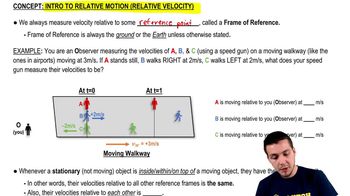
Relative velocity is the velocity of an object as observed from a particular reference frame. In this scenario, the delivery boy's speed and the speed of the paper must be combined vectorially to determine the paper's speed relative to the ground. This concept is crucial for understanding how different frames of reference affect the perceived speed of moving objects.
추천 영상:
가이드 코스
04:27
Intro to Relative Motion (Relative Velocity)

Vector Addition

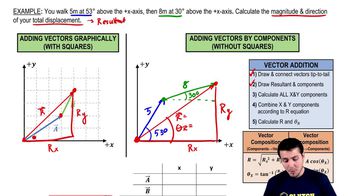
Vector addition is the process of combining two or more vectors to determine a resultant vector. In this case, the velocities of the bicycle and the paper must be added or subtracted based on their directions. Understanding how to perform vector addition is essential for accurately calculating the paper's speed in different scenarios.
추천 영상:
가이드 코스
07:30
Vector Addition By Components

Direction of Motion

The direction of motion refers to the orientation in which an object is moving. In this problem, the paper can be thrown in three different directions: forward, backward, and to the side. Recognizing how these directions interact with the bicycle's velocity is key to determining the resultant speed of the paper relative to the ground.
추천 영상: