
Ch 36: Special Relativity
Knight Calc - Physics for Scientists and Engineers 5th Edition
Knight Calc5th EditionPhysics for Scientists and EngineersISBN: 9780137344796당신이 사용하는 게 아니라요?교과서 변경
36장, 문제 32b

A proton is accelerated to 0.999c. By what factor does the proton's momentum exceed its Newtonian momentum?

검증된 단계별 안내
1
Understand the problem: The question asks us to compare the relativistic momentum of a proton moving at 0.999c (where c is the speed of light) to its classical (Newtonian) momentum. This involves using the relativistic momentum formula and the classical momentum formula.
Write the formula for relativistic momentum: \( p_{rel} = \frac{mv}{\sqrt{1 - \frac{v^2}{c^2}}} \), where \( m \) is the mass of the proton, \( v \) is its velocity, and \( c \) is the speed of light.
Write the formula for Newtonian momentum: \( p_{newt} = mv \), where \( m \) is the mass of the proton and \( v \) is its velocity.
Set up the ratio of relativistic momentum to Newtonian momentum: \( \text{Factor} = \frac{p_{rel}}{p_{newt}} = \frac{\frac{mv}{\sqrt{1 - \frac{v^2}{c^2}}}}{mv} = \frac{1}{\sqrt{1 - \frac{v^2}{c^2}}} \). Notice that the mass \( m \) and velocity \( v \) cancel out.
Substitute \( v = 0.999c \) into the expression \( \text{Factor} = \frac{1}{\sqrt{1 - \frac{v^2}{c^2}}} \) to calculate the factor by which the relativistic momentum exceeds the Newtonian momentum. Simplify the denominator to find the result.

비슷한 문제에 대한 검증된 영상 답변:

이 영상 해법은 위 문제에 도움이 된다고 튜터들이 추천한 것입니다.
도움이 되었나요?

주요 개념

질문에 올바르게 답하기 위해 반드시 이해해야 하는 핵심 개념들은 다음과 같습니다.

Relativistic Momentum

In relativistic physics, momentum is defined as p = γmv, where γ (gamma) is the Lorentz factor, given by γ = 1 / √(1 - v²/c²). As an object's speed approaches the speed of light (c), γ increases significantly, leading to a much larger momentum than predicted by classical mechanics. This concept is crucial for understanding how particles behave at high velocities.
추천 영상:
가이드 코스
05:17
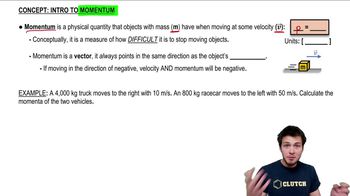
Intro to Momentum

Newtonian Momentum

Newtonian momentum is defined as p = mv, where m is the mass and v is the velocity of an object. This formula applies well at low speeds, where relativistic effects are negligible. However, it fails to accurately describe the behavior of objects moving at speeds close to the speed of light, necessitating the use of relativistic momentum for such scenarios.
추천 영상:
가이드 코스
05:17
Intro to Momentum

Lorentz Factor

The Lorentz factor (γ) is a crucial component in the equations of special relativity, representing the factor by which time, length, and relativistic mass increase as an object approaches the speed of light. It is calculated as γ = 1 / √(1 - v²/c²). Understanding this factor is essential for calculating relativistic effects, including the increase in momentum for particles like protons moving at relativistic speeds.
추천 영상:
가이드 코스
14:16
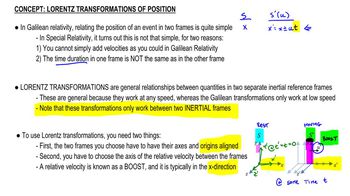
Lorentz Transformations of Position
관련 실천
교과서 질문

An event has spacetime coordinates (x,t) = (1200 m, 2.0 μs) in reference frame S. What are the event's spacetime coordinates (a) in reference frame S' that moves in the positive x-direction at 0.80c and (b) in reference frame S'' that moves in the negative x-direction at 0.80c?

1255
views
교과서 질문

A laboratory experiment shoots an electron to the left at 0.90c. What is the electron's speed, as a fraction of c, relative to a proton moving to the right at 0.90c?

103
views
교과서 질문

What are the rest energy, the kinetic energy, and the total energy of a 1.0 g particle with a speed of 0.80c?

195
views
교과서 질문

A quarter-pound hamburger with all the fixings has a mass of 200 g. The food energy of the hamburger (480 food calories) is 2 MJ. By what factor does the energy equivalent exceed the food energy?

81
views
교과서 질문

A distant quasar is found to be moving away from the earth at 0.80c. A galaxy closer to the earth and along the same line of sight is moving away from us at 0.20c. What is the recessional speed of the quasar, as a fraction of c, as measured by astronomers in the other galaxy?

100
views
교과서 질문

A modest supernova (the explosion of a massive star at the end of its life cycle) releases 1.5 x 10⁴⁴ J of energy in a few seconds. This is enough to outshine the entire galaxy in which it occurs. Suppose a star with the mass of our sun collides with an antimatter star of equal mass, causing complete annihilation. What is the ratio of the energy released in this star-antistar collision to the energy released in the supernova?

87
views