Ch 36: Special Relativity
Knight Calc - Physics for Scientists and Engineers 5th Edition
Knight Calc5th EditionPhysics for Scientists and EngineersISBN: 9780137344796당신이 사용하는 게 아니라요?교과서 변경
36장, 문제 45b

Two events in reference frame S occur 10 μs apart at the same point in space. The distance between the two events is 2400 m in reference frame S'. What is the velocity of S' relative to S?

검증된 단계별 안내
1
Step 1: Identify the key concepts involved in the problem. This is a relativistic problem involving time dilation and length contraction. The relationship between the two reference frames S and S' is governed by the Lorentz transformation equations.
Step 2: Write down the given information. In reference frame S, the time interval between the two events is Δt = 10 μs (10 × 10⁻⁶ s), and the spatial separation is Δx = 0 m (since the events occur at the same point in space). In reference frame S', the spatial separation is Δx' = 2400 m.
Step 3: Use the Lorentz transformation equation for spatial separation: Δx' = γ(Δx - vΔt), where γ = 1 / √(1 - v²/c²) is the Lorentz factor, v is the relative velocity between the frames, and c is the speed of light. Substitute Δx = 0 into the equation to simplify it to Δx' = γ(-vΔt).
Step 4: Rearrange the equation to solve for v. Start by expressing γ in terms of Δx' and Δt: γ = Δx' / (-vΔt). Then use the definition of γ (γ = 1 / √(1 - v²/c²)) to eliminate γ and solve for v.
Step 5: Substitute the known values (Δx' = 2400 m, Δt = 10 × 10⁻⁶ s, and c = 3 × 10⁸ m/s) into the equation derived in Step 4. Perform algebraic manipulations to isolate v and determine the relative velocity of S' with respect to S.

비슷한 문제에 대한 검증된 영상 답변:

이 영상 해법은 위 문제에 도움이 된다고 튜터들이 추천한 것입니다.
도움이 되었나요?

주요 개념

질문에 올바르게 답하기 위해 반드시 이해해야 하는 핵심 개념들은 다음과 같습니다.

Lorentz Transformation

The Lorentz transformation equations relate the space and time coordinates of events as observed in different inertial frames moving relative to each other at a constant velocity. They account for the effects of time dilation and length contraction, which are fundamental in the theory of special relativity. These transformations are essential for understanding how measurements of time and distance change when switching between frames.
추천 영상:
가이드 코스
13:39
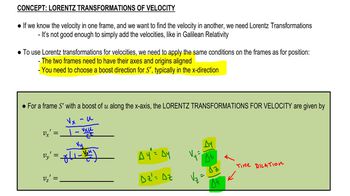
Lorentz Transformations of Velocity

Time Dilation

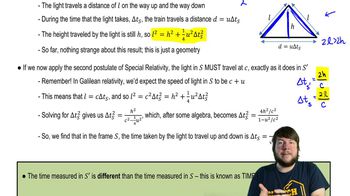
Time dilation is a phenomenon predicted by Einstein's theory of special relativity, where time is observed to pass at different rates in different inertial frames. Specifically, a clock moving relative to an observer will appear to tick slower than a stationary clock. This concept is crucial for analyzing events that occur at different times in different reference frames, as it affects the perceived intervals between events.
추천 영상:

Relative Velocity

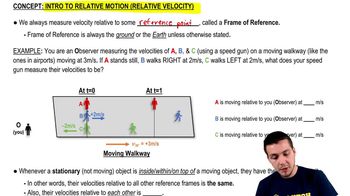
Relative velocity is the velocity of one object as observed from another moving object. In the context of special relativity, it is important to calculate how fast one reference frame is moving relative to another, especially when considering the effects of time and space. Understanding relative velocity helps in determining how events are perceived in different frames, which is key to solving problems involving multiple reference frames.
추천 영상:
가이드 코스
04:27
Intro to Relative Motion (Relative Velocity)
관련 실천
교과서 질문

What are the rest energy, the kinetic energy, and the total energy of a 1.0 g particle with a speed of 0.80c?

195
views

교과서 질문

The star Alpha goes supernova. Ten years later and 100 ly away, as measured by astronomers in the galaxy, star Beta explodes. An alien spacecraft passing through the galaxy finds that the distance between the two explosions is 120 ly. According to the aliens, what is the time between the explosions?

122
views
교과서 질문

A quarter-pound hamburger with all the fixings has a mass of 200 g. The food energy of the hamburger (480 food calories) is 2 MJ. By what factor does the energy equivalent exceed the food energy?

81
views
교과서 질문

The Stanford Linear Accelerator (SLAC) accelerates electrons to v = 0.99999997c in a 3.2-km-long tube. If they travel the length of the tube at full speed (they don’t, because they are accelerating), how long is the tube in the electrons’ reference frame?

107
views
교과서 질문

In an attempt to reduce the extraordinarily long travel times for voyaging to distant stars, some people have suggested traveling at close to the speed of light. Suppose you wish to visit the red giant star Betelgeuse, which is 430 ly away, and that you want your 20,000 kg rocket to move so fast that you age only 20 years during the round trip. How fast, as a fraction of c, must the rocket travel relative to earth?

57
views
교과서 질문

A modest supernova (the explosion of a massive star at the end of its life cycle) releases 1.5 x 10⁴⁴ J of energy in a few seconds. This is enough to outshine the entire galaxy in which it occurs. Suppose a star with the mass of our sun collides with an antimatter star of equal mass, causing complete annihilation. What is the ratio of the energy released in this star-antistar collision to the energy released in the supernova?

87
views