Ch 37: The Foundations of Modern Physics
Knight Calc - Physics for Scientists and Engineers 5th Edition
Knight Calc5th EditionPhysics for Scientists and EngineersISBN: 9780137344796당신이 사용하는 게 아니라요?교과서 변경
37장, 문제 9

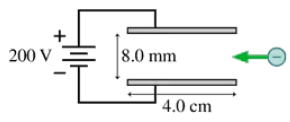
Electrons pass through the parallel electrodes shown in FIGURE EX37.9 with a speed of 5.0×10⁶ m/s. What magnetic field strength and direction will allow the electrons to pass through without being deflected? Assume that the magnetic field is confined to the region between the electrodes.

검증된 단계별 안내
1
Step 1: Understand the problem. Electrons are moving through a region with parallel electrodes, and we need to determine the magnetic field strength and direction that will allow the electrons to pass through without deflection. This means the magnetic force must counteract the electric force acting on the electrons.
Step 2: Recall the forces acting on a charged particle. The electric force is given by \( F_E = qE \), where \( q \) is the charge of the electron and \( E \) is the electric field strength. The magnetic force is given by \( F_B = qvB \), where \( v \) is the velocity of the electron and \( B \) is the magnetic field strength.
Step 3: Set the forces equal to each other for no deflection. Since the electron is not deflected, \( F_E = F_B \). Substituting the formulas, \( qE = qvB \). Simplify to find \( B \): \( B = \frac{E}{v} \).
Step 4: Determine the direction of the magnetic field. Use the right-hand rule for the magnetic force. The magnetic field must be perpendicular to both the velocity of the electrons and the electric field. If the electric field is vertical and the electrons are moving horizontally, the magnetic field will be directed into or out of the plane of the page.
Step 5: Calculate \( E \) if needed. If the electric field strength \( E \) is not provided, it can be determined using the voltage \( V \) across the electrodes and the distance \( d \) between them: \( E = \frac{V}{d} \). Substitute \( E \) and \( v \) into \( B = \frac{E}{v} \) to find the magnetic field strength.

비슷한 문제에 대한 검증된 영상 답변:

이 영상 해법은 위 문제에 도움이 된다고 튜터들이 추천한 것입니다.
도움이 되었나요?

주요 개념

질문에 올바르게 답하기 위해 반드시 이해해야 하는 핵심 개념들은 다음과 같습니다.

Lorentz Force

The Lorentz force describes the force experienced by a charged particle moving through a magnetic field. It is given by the equation F = q(v × B), where F is the force, q is the charge of the particle, v is its velocity, and B is the magnetic field. For an electron to pass through the electrodes without deflection, the magnetic force must balance any electric forces acting on it.
추천 영상:
가이드 코스
13:39
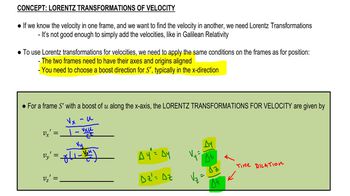
Lorentz Transformations of Velocity

Magnetic Field Direction

The direction of the magnetic field is crucial in determining the behavior of charged particles. According to the right-hand rule, if you point your thumb in the direction of the electron's velocity and curl your fingers in the direction of the magnetic field, your palm will face the direction of the force on a positive charge. For electrons, which are negatively charged, the force will be in the opposite direction, influencing how the magnetic field must be oriented.
추천 영상:
가이드 코스
05:30
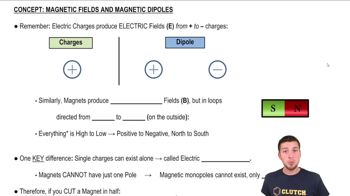
Magnetic Fields and Magnetic Dipoles

Velocity and Magnetic Field Relationship

The relationship between the velocity of charged particles and the magnetic field strength is essential for achieving no deflection. The condition for an electron to pass through without deflection is that the magnetic force equals the electric force acting on it. This requires a specific magnetic field strength, which can be calculated using the equation B = E/v, where E is the electric field strength and v is the velocity of the electrons.
추천 영상:
가이드 코스
05:30
Magnetic Fields and Magnetic Dipoles
관련 실천
교과서 질문

Figure 37.7 identified the wavelengths of four lines in the Balmer series of hydrogen. Predict the wavelength of the fifth line in the spectrum.

108
views

교과서 질문

A 0.80-μm-diameter oil droplet is observed between two parallel electrodes spaced 11 mm apart. The droplet hangs motionless if the upper electrode is 20 V more positive than the lower electrode. The density of the oil is 885 kg/m3. Does the droplet have a surplus or a deficit of electrons? How many?

1556
views
교과서 질문

An electron in a cathode-ray beam passes between 2.5-cm-long parallel-plate electrodes that are 5.0 mm apart. A 2.0 mT, 2.5-cm-wide magnetic field is perpendicular to the electric field between the plates. The electron passes through the electrodes without being deflected if the potential difference between the plates is 600 V. What is the electron's speed?

298
views
교과서 질문

A ceramic cube 3.0 cm on each side radiates heat at 630 W. At what wavelength, in μm, does its emission spectrum peak? Assume e=1.

921
views
교과서 질문

An electron in a cathode-ray beam passes between 2.5-cm-long parallel-plate electrodes that are 5.0 mm apart. A 2.0 mT, 2.5-cm-wide magnetic field is perpendicular to the electric field between the plates. The electron passes through the electrodes without being deflected if the potential difference between the plates is 600 V. If the potential difference between the plates is set to zero, what is the electron's radius of curvature in the magnetic field?

329
views
교과서 질문

A 2.0-cm-diameter metal sphere is glowing red, but a spectrum shows that its emission spectrum peaks at an infrared wavelength of 2.0 μm. How much power does the sphere radiate? Assume e=1 .

1021
views