
Ch 37: The Foundations of Modern Physics
Knight Calc - Physics for Scientists and Engineers 5th Edition
Knight Calc5th EditionPhysics for Scientists and EngineersISBN: 9780137344796당신이 사용하는 게 아니라요?교과서 변경
37장, 문제 48c

Physicists first attempted to understand the hydrogen atom by applying the laws of classical physics. Consider an electron of mass m and charge −e in a circular orbit of radius r around a proton of charge +e. The minimum energy needed to ionize a hydrogen atom (i.e., to remove the electron) is found experimentally to be 13.6 eV. From this information, what are the electron's speed and the radius of its orbit?

검증된 단계별 안내
1
Start by recognizing that the electron is in a circular orbit around the proton, and the centripetal force required to keep the electron in orbit is provided by the electrostatic force between the electron and proton. Use Coulomb's law to express the electrostatic force: Fe = k e2r2, where k is Coulomb's constant, e is the charge of the electron, and r is the radius of the orbit.
Equate the electrostatic force to the centripetal force, which is given by Fc = mv2r, where m is the mass of the electron and v is its speed. This gives the equation: e2r2 = mv2r.
Simplify the equation from step 2 to solve for the speed of the electron, v: v = ke2mr. This expression relates the speed of the electron to the radius of its orbit.
Next, use the fact that the total energy of the electron in the hydrogen atom is the sum of its kinetic and potential energies. The total energy is given by E = -ke22r. The negative sign indicates that the electron is bound to the proton. Set this equal to the experimentally determined ionization energy, -13.6 eV, and solve for r, the radius of the orbit.
Finally, substitute the value of r obtained in step 4 into the expression for v from step 3 to calculate the speed of the electron. This completes the process of determining both the radius of the orbit and the speed of the electron.

비슷한 문제에 대한 검증된 영상 답변:

이 영상 해법은 위 문제에 도움이 된다고 튜터들이 추천한 것입니다.
도움이 되었나요?

주요 개념

질문에 올바르게 답하기 위해 반드시 이해해야 하는 핵심 개념들은 다음과 같습니다.

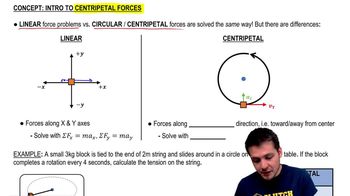
Centripetal Force

In a circular orbit, an object experiences centripetal force, which is directed towards the center of the circle. For an electron orbiting a proton, this force is provided by the electrostatic attraction between the negatively charged electron and the positively charged proton. The balance between this centripetal force and the gravitational force allows us to derive relationships between the electron's speed, radius of orbit, and the charges involved.
추천 영상:
가이드 코스
06:48
Intro to Centripetal Forces

Energy Levels in Atoms

The energy levels of an atom describe the quantized states that electrons can occupy. For hydrogen, the energy required to remove the electron from its ground state is known as the ionization energy, which is 13.6 eV. This energy corresponds to the difference between the energy of the electron in its orbit and the energy of a free electron, providing a basis for calculating the electron's speed and orbital radius.
추천 영상:

Kinetic and Potential Energy

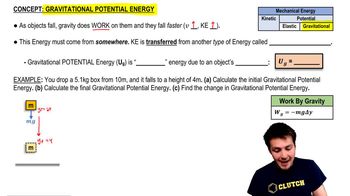
In the context of the hydrogen atom, the total mechanical energy is the sum of kinetic energy (due to the electron's motion) and potential energy (due to the electrostatic interaction between the electron and proton). The kinetic energy can be expressed as (1/2)mv², while the potential energy is given by the formula U = -ke²/r. Understanding these energy forms is crucial for calculating the electron's speed and the radius of its orbit based on the given ionization energy.
추천 영상:
가이드 코스
06:35
Gravitational Potential Energy
관련 실천
교과서 질문

Consider an oil droplet of mass m and charge q. We want to determine the charge on the droplet in a Millikan-type experiment. We will do this in several steps. Assume, for simplicity, that the charge is positive and that the electric field between the plates points upward. An electric field is established by applying a potential difference to the plates. It is found that a field of strength E₀ will cause the droplet to be suspended motionless. Write an expression for the droplet's charge in terms of the suspending field E₀ and the droplet's weight mg.

344
views
교과서 질문

A classical atom that has an electron orbiting at frequency ⨍ would emit electromagnetic waves of frequency ⨍ because the electron's orbit, seen edge-on, looks like an oscillating electric dipole. What is the total mechanical energy of this atom?

44
views
교과서 질문

Consider an oil droplet of mass m and charge q. We want to determine the charge on the droplet in a Millikan-type experiment. We will do this in several steps. Assume, for simplicity, that the charge is positive and that the electric field between the plates points upward. A spherical object of radius r moving slowly through the air is known to experience a retarding force Fdrag = −6πηrv where η is the viscosity of the air. Use this and your answer to part b to show that a spherical droplet of density ρ falling with a terminal velocity vterm has a radius. r=9ηvterm2ρgr = \(\sqrt{\frac{9\eta v_{term}\)}{2\(\rho\) g}}

2071
views
교과서 질문

Physicists first attempted to understand the hydrogen atom by applying the laws of classical physics. Consider an electron of mass m and charge −e in a circular orbit of radius r around a proton of charge +e. Use Newtonian physics to show that the total energy of the atom is E =−e²/8πϵ₀𝓇

56
views
교과서 질문

To initiate a nuclear reaction, an experimental nuclear physicist wants to shoot a proton into a 5.50-fm-diameter ¹²C nucleus. The proton must impact the nucleus with a kinetic energy of 3.00 MeV. Assume the nucleus remains at rest. Through what potential difference must the proton be accelerated from rest to acquire this speed?

38
views