

Ch 37: The Foundations of Modern Physics
Knight Calc - Physics for Scientists and Engineers 5th Edition
Knight Calc5th EditionPhysics for Scientists and EngineersISBN: 9780137344796당신이 사용하는 게 아니라요?교과서 변경
37장, 문제 31

The factor γ appears in many relativistic expressions. A value γ = 1.01 implies that relativity changes the Newtonian values by approximately 1% and that relativistic effects can no longer be ignored. At what kinetic energy, in MeV, is γ = 1.01 for (a) an electron, (b) a proton, and (c) an alpha particle?

검증된 단계별 안내
1
Step 1: Recall the definition of the Lorentz factor γ, which is given by the equation: γ = 1 / √(1 - v²/c²), where v is the velocity of the particle and c is the speed of light. Rearrange this equation to solve for v in terms of γ: v = c √(1 - 1/γ²).
Step 2: The relativistic kinetic energy (K) is given by the equation: K = (γ - 1)mc², where m is the rest mass of the particle. For each particle (electron, proton, and alpha particle), substitute the given γ = 1.01 into this equation.
Step 3: Use the known rest masses of the particles: for an electron, m_e = 0.511 \, \(\text{MeV}\)/c²; for a proton, m_p = 938.27 \, \(\text{MeV}\)/c²; and for an alpha particle, m_\(\alpha\) = 3727.38 \, \(\text{MeV}\)/c². Substitute these values into the kinetic energy equation for each particle.
Step 4: Simplify the kinetic energy equation for each particle. For example, for the electron: K_e = (1.01 - 1)(0.511 \, \(\text{MeV}\)/c²)c². Repeat this process for the proton and the alpha particle.
Step 5: After substituting and simplifying, the resulting kinetic energy values for each particle will be in MeV. These values represent the kinetic energy at which relativistic effects become significant for γ = 1.01.

비슷한 문제에 대한 검증된 영상 답변:

이 영상 해법은 위 문제에 도움이 된다고 튜터들이 추천한 것입니다.
도움이 되었나요?

주요 개념

질문에 올바르게 답하기 위해 반드시 이해해야 하는 핵심 개념들은 다음과 같습니다.

Lorentz Factor (γ)

The Lorentz factor, denoted as γ (gamma), is a crucial component in the theory of relativity that describes how time, length, and relativistic mass change for an object moving relative to an observer. It is defined as γ = 1 / √(1 - v²/c²), where v is the object's velocity and c is the speed of light. A γ value greater than 1 indicates that relativistic effects become significant, affecting measurements of time and space.
추천 영상:
가이드 코스
14:16
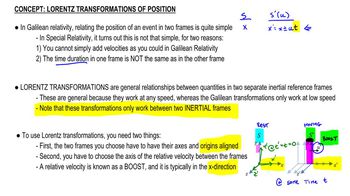
Lorentz Transformations of Position

Kinetic Energy in Relativity

In classical mechanics, kinetic energy (KE) is given by the formula KE = 1/2 mv². However, in relativistic physics, the kinetic energy of an object is expressed as KE = (γ - 1)mc², where m is the rest mass and c is the speed of light. This formula accounts for the increase in energy as an object's speed approaches the speed of light, highlighting the differences between classical and relativistic kinetic energy.
추천 영상:
가이드 코스
06:07
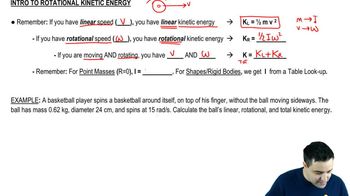
Intro to Rotational Kinetic Energy

Rest Mass vs. Relativistic Mass

Rest mass is the mass of an object measured when it is at rest, while relativistic mass increases with velocity and is given by m' = γm, where m' is the relativistic mass. This distinction is important in relativistic physics, as it affects how we calculate energy and momentum. Understanding the difference helps clarify how objects behave at high speeds and the implications for energy calculations in relativistic scenarios.
추천 영상:
가이드 코스
20:32
Mass Spectrometers
관련 실천
교과서 질문

In one of Thomson’s experiments he placed a thin metal foil in the electron beam and measured its temperature rise. Consider a cathode-ray tube in which electrons are accelerated through a 2000 V potential difference, then strike a 10 mg copper foil. What is the electron-beam current if the foil temperature rises 6.0°C in 10 s? Assume no loss of energy by radiation or other means. The specific heat of copper is 385 J/kg K .

112
views
교과서 질문

A ²²²Rn atom (radon) in a 0.75 T magnetic field undergoes radioactive decay, emitting an alpha particle in a direction perpendicular to B\(\overrightarrow{B}\). The alpha particle begins cyclotron motion with a radius of 45 cm. With what energy, in MeV, was the alpha particle emitted?

1950
views
1
rank
교과서 질문

Consider the gold isotope 197Au. The gold nucleus has a diameter of 14.0 fm. What is the density of matter in a gold nucleus?

108
views
교과서 질문

What is the velocity, as a fraction of c, of an electron with 2.0 GeV total energy? Hint: This problem uses relativity.

68
views
교과서 질문

The fission process n + ²³⁵U → ²³⁶U → ¹⁴⁴Ba + ⁸⁹Kr + 3n converts 0.185 u of mass into the kinetic energy of the fission products. What is the total kinetic energy in MeV?

94
views
교과서 질문

Identify the isotope that is 11 times as heavy as ¹²C and has 18 times as many protons as ⁶Li . Give your answer in the form ᴬS, where S is the symbol for the element. See Appendix C: Atomic and Nuclear Data.

1087
views