Ch 38: Quantization
Knight Calc - Physics for Scientists and Engineers 5th Edition
Knight Calc5th EditionPhysics for Scientists and EngineersISBN: 9780137344796당신이 사용하는 게 아니라요?교과서 변경
38장, 문제 20

The diameter of the nucleus is about 10 fm. What is the kinetic energy, in MeV, of a proton with a de Broglie wavelength of 10 fm?

검증된 단계별 안내
1
Step 1: Understand the relationship between the de Broglie wavelength and the momentum of a particle. The de Broglie wavelength (λ) is given by the formula: λ=hp, where h is Planck's constant and p is the momentum of the particle.
Step 2: Rearrange the formula to solve for the momentum p: p=hλ. Substitute the values for Planck's constant (h=4.1357×10¹⁵ eV·s) and the de Broglie wavelength (λ=10 fm, where 1fm=1015m).
Step 3: Convert the momentum p into kinetic energy using the relativistic energy-momentum relation. For non-relativistic speeds, the kinetic energy K can be approximated as: K=p22m, where m is the mass of the proton (m=938.27 MeV/c2).
Step 4: Substitute the calculated momentum p and the mass of the proton into the kinetic energy formula. Ensure all units are consistent (e.g., converting p to MeV/c if necessary).
Step 5: Simplify the expression to find the kinetic energy K in MeV. This will give the final result for the proton's kinetic energy based on its de Broglie wavelength.

비슷한 문제에 대한 검증된 영상 답변:

이 영상 해법은 위 문제에 도움이 된다고 튜터들이 추천한 것입니다.

주요 개념

질문에 올바르게 답하기 위해 반드시 이해해야 하는 핵심 개념들은 다음과 같습니다.

De Broglie Wavelength

The de Broglie wavelength is a fundamental concept in quantum mechanics that relates the wavelength of a particle to its momentum. It is given by the formula λ = h/p, where λ is the wavelength, h is Planck's constant, and p is the momentum of the particle. This concept illustrates the wave-particle duality of matter, indicating that particles like protons exhibit wave-like properties at small scales.
추천 영상:
가이드 코스
05:42
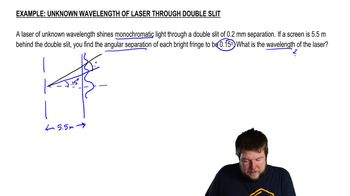
Unknown Wavelength of Laser through Double Slit

Kinetic Energy of a Particle

Kinetic energy is the energy that an object possesses due to its motion, calculated using the formula KE = (1/2)mv², where m is the mass and v is the velocity of the object. In quantum mechanics, the kinetic energy of a particle can also be expressed in terms of its momentum, using the relation KE = p²/(2m). Understanding this relationship is crucial for calculating the kinetic energy of particles at the atomic scale.
추천 영상:
가이드 코스
06:07
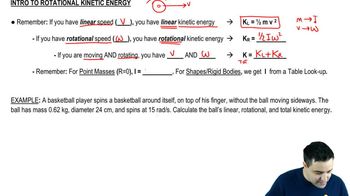
Intro to Rotational Kinetic Energy

Nuclear Scale and Units

The nuclear scale refers to dimensions on the order of femtometers (fm), which are used to measure atomic nuclei. One femtometer is 10^-15 meters, a scale where quantum effects dominate. In nuclear physics, energy is often expressed in mega-electronvolts (MeV), a unit that reflects the energy of particles at this scale. Recognizing these units is essential for converting and interpreting results in nuclear physics problems.
추천 영상:
가이드 코스
03:55
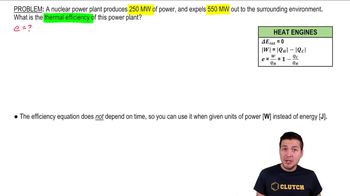
Efficiency of a Nuclear Power Plant