Consider a hydrogen atom in stationary state n. On average, an atom stays in the n = 2 state for 1.6 ns before undergoing a transition to the n = 1 state. On average, how many revolutions does the electron make before the transition?
Ch 38: Quantization
38장, 문제 56
The first three energy levels of the fictitious element X were shown in Figure P38.54. An electron with a speed of 1.4×10⁶ m/s collides with an atom of element X. Shortly afterward, the atom emits a photon with a wavelength of 1240 nm. What was the electron’s speed after the collision? Assume that, because the atom is much more massive than the electron, the recoil of the atom is negligible. Hint: The energy of the photon is not the energy transferred to the atom in the collision.
검증된 단계별 안내1
Step 1: Calculate the energy of the emitted photon using the formula for photon energy: \( E_{photon} = \frac{hc}{\lambda} \), where \( h \) is Planck's constant \( 6.626 \times 10^{-34} \, \text{J·s} \), \( c \) is the speed of light \( 3.00 \times 10^8 \; \text{m/s} \), and \( \lambda \) is the wavelength of the photon \( 1240 \; \text{nm} \). Convert \( \lambda \) to meters before substituting.
Step 2: Determine the energy difference between the energy levels of the atom that corresponds to the emitted photon. This energy difference is equal to the energy of the photon calculated in Step 1. Use the energy level diagram (Figure P38.54) to identify the initial and final energy levels of the atom.
Step 3: Calculate the initial kinetic energy of the electron before the collision using the formula \( KE_{initial} = \frac{1}{2}mv^2 \), where \( m \) is the mass of the electron \( 9.11 \times 10^{-31} \, \text{kg} \) and \( v \) is the initial speed of the electron \( 1.4 \times 10^6 \; \text{m/s} \).
Step 4: Use the principle of conservation of energy to find the kinetic energy of the electron after the collision. The energy transferred to the atom is the energy difference between its initial and final energy levels (calculated in Step 2). Subtract this energy from the initial kinetic energy of the electron to find its final kinetic energy: \( KE_{final} = KE_{initial} - \Delta E_{atom} \).
Step 5: Solve for the final speed of the electron using the relationship between kinetic energy and speed: \( v_{final} = \sqrt{\frac{2KE_{final}}{m}} \). Substitute the values for \( KE_{final} \) and \( m \) to calculate the final speed of the electron.

비슷한 문제에 대한 검증된 영상 답변:
이 영상 해법은 위 문제에 도움이 된다고 튜터들이 추천한 것입니다.
도움이 되었나요?
주요 개념
질문에 올바르게 답하기 위해 반드시 이해해야 하는 핵심 개념들은 다음과 같습니다.
Energy Levels and Photons
In atomic physics, energy levels refer to the specific energies that electrons can have within an atom. When an electron collides with an atom, it can transfer energy, causing the atom to emit a photon. The energy of the emitted photon can be calculated using the formula E = hc/λ, where h is Planck's constant, c is the speed of light, and λ is the wavelength of the photon. This concept is crucial for understanding how energy is exchanged during atomic interactions.
추천 영상:
가이드 코스
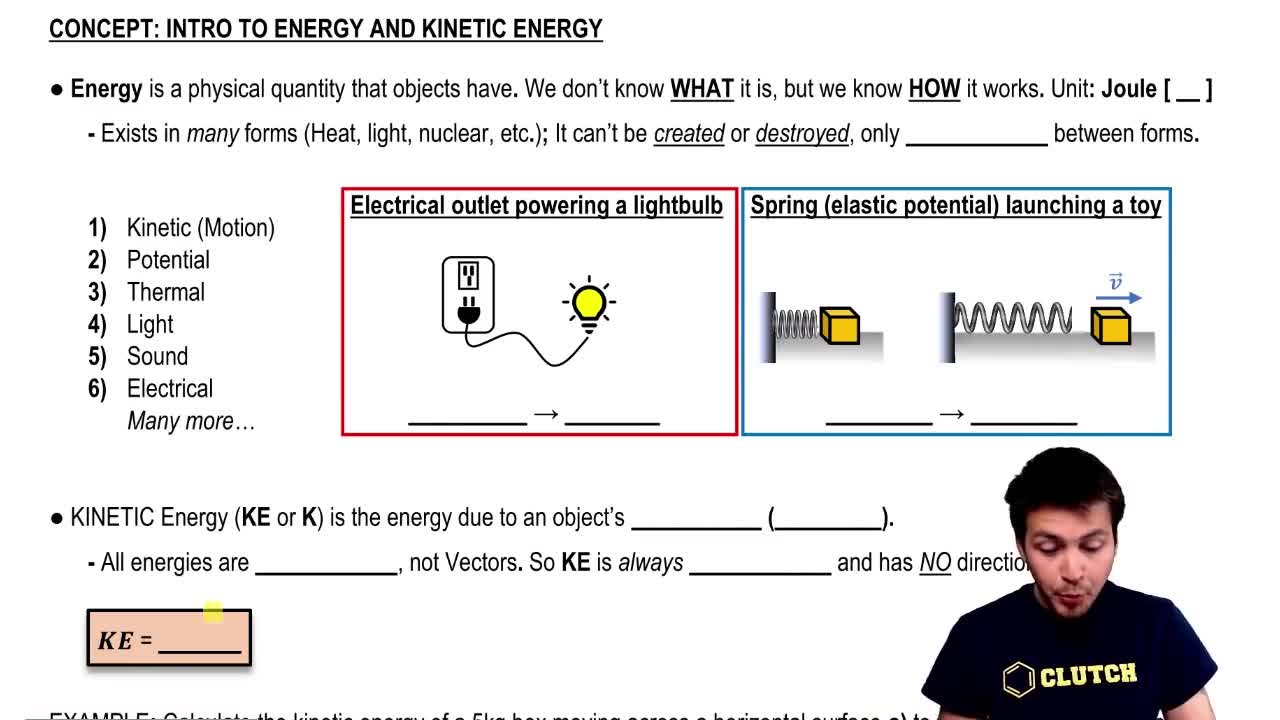
Intro to Energy & Types of Energy
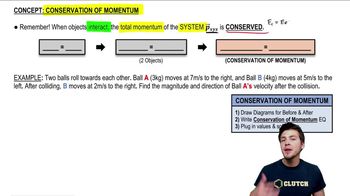
Conservation of Momentum
The principle of conservation of momentum states that the total momentum of a closed system remains constant if no external forces act on it. In the context of the collision between the electron and the atom, the momentum before the collision must equal the momentum after the collision. Since the atom is much more massive than the electron, the change in the atom's velocity is negligible, allowing us to focus on the electron's speed change to solve the problem.
추천 영상:
가이드 코스
Conservation Of Momentum
Kinetic Energy and Collisions
Kinetic energy is the energy an object possesses due to its motion, given by the formula KE = 1/2 mv², where m is mass and v is velocity. In collisions, kinetic energy can be transferred between objects, but not all kinetic energy is conserved in inelastic collisions. In this scenario, the electron's initial kinetic energy is partially converted into the energy of the emitted photon, affecting its final speed after the collision.
추천 영상:
가이드 코스
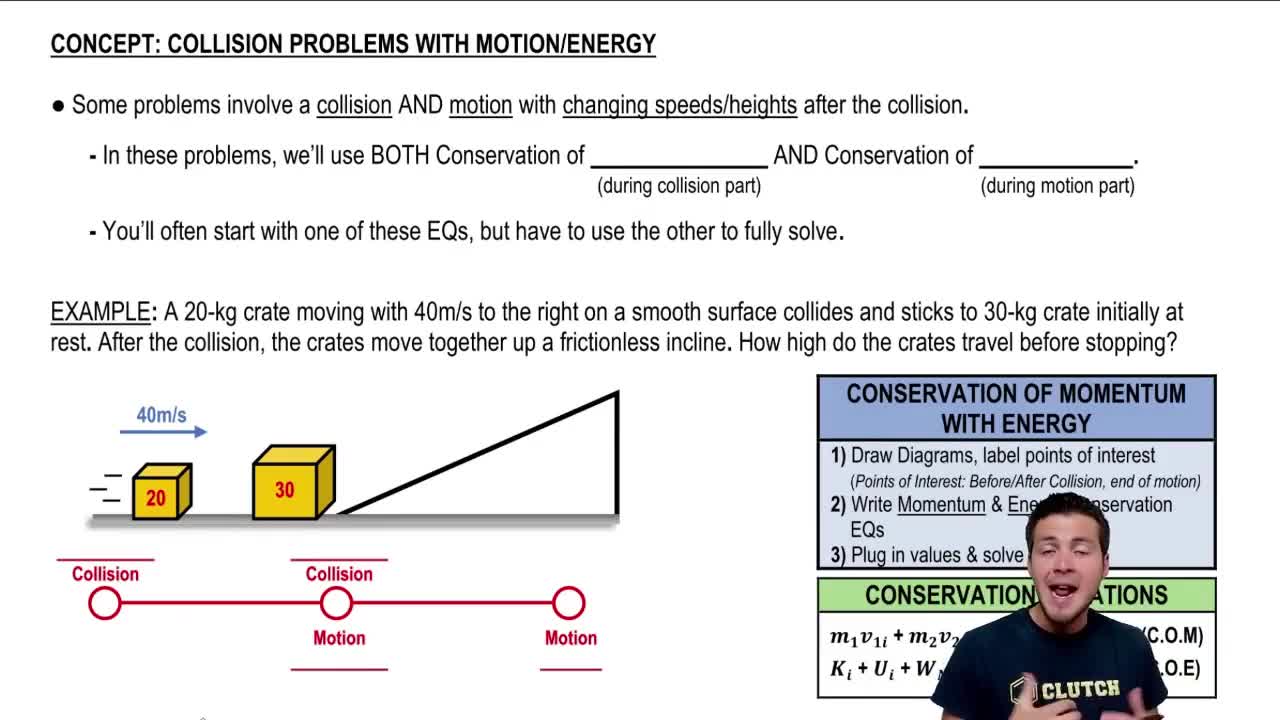
Collision Problems with Motion/Energy
관련 실천
교과서 질문
60
views
교과서 질문
The absorption spectrum of an atom consists of the wavelengths 200 nm, 300 nm, and 500 nm. b. What wavelengths are seen in the atom’s emission spectrum?
1667
views
교과서 질문
What is the difference in the wavelengths emitted in a 199→2 transition and a 200→2 transition?
65
views
교과서 질문
The first three energy levels of the fictitious element X are shown in FIGURE P38.54. What wavelengths are observed in the absorption spectrum of element X? Express your answers in nm.
95
views
교과서 질문
The first three energy levels of the fictitious element X are shown in FIGURE P38.54. What is the ionization energy of element X?
48
views
교과서 질문
What wavelength photon does a hydrogen atom emit in a 200→199 transition?
39
views