Ch 39: Wave Functions and Uncertainty
Knight Calc - Physics for Scientists and Engineers 5th Edition
Knight Calc5th EditionPhysics for Scientists and EngineersISBN: 9780137344796당신이 사용하는 게 아니라요?교과서 변경
39장, 문제 38a

A particle is described by the wave function ψ(x)={cex/Lx0 mmcex/Lx0 mm\(\psi\) (x)=\(\begin{cases}\) ce^{x/L} & x\(\leq\) 0\(\text{ mm}\) \\ ce^{-x/L} & x\(\geq\) 0\(\text{ mm}\) \(\end{cases}\) where L = 2.0 mm. Sketch graphs of both the wave function and the probability density as functions of x.

검증된 단계별 안내
1
Understand the given wave function: The wave function ψ(x) is piecewise-defined, with an exponential form that depends on whether x is less than or greater than 0. The constant c is a normalization constant, and L is given as 2.0 mm. The wave function is ψ(x) = c * e^(x/L) for x ≤ 0 and ψ(x) = c * e^(-x/L) for x ≥ 0.
Normalize the wave function: To ensure the total probability is 1, integrate the square of the wave function over all space and solve for c. The normalization condition is ∫|ψ(x)|² dx = 1, which becomes ∫[c² * e^(2x/L)] dx from -∞ to 0 + ∫[c² * e^(-2x/L)] dx from 0 to ∞ = 1.
Calculate the probability density: The probability density is given by |ψ(x)|². For x ≤ 0, |ψ(x)|² = c² * e^(2x/L), and for x ≥ 0, |ψ(x)|² = c² * e^(-2x/L). These expressions describe how the probability of finding the particle varies with position x.
Sketch the wave function ψ(x): Plot ψ(x) as a function of x. For x ≤ 0, the wave function increases exponentially as x approaches 0, and for x ≥ 0, it decreases exponentially as x moves away from 0. The graph should be continuous at x = 0.
Sketch the probability density |ψ(x)|²: Plot |ψ(x)|² as a function of x. For x ≤ 0, the probability density decreases exponentially as x becomes more negative, and for x ≥ 0, it decreases exponentially as x becomes more positive. The graph is symmetric about x = 0 and peaks at x = 0.

비슷한 문제에 대한 검증된 영상 답변:

이 영상 해법은 위 문제에 도움이 된다고 튜터들이 추천한 것입니다.
도움이 되었나요?

주요 개념

질문에 올바르게 답하기 위해 반드시 이해해야 하는 핵심 개념들은 다음과 같습니다.

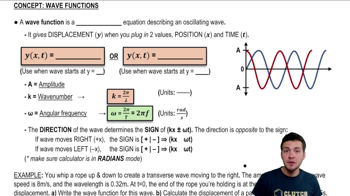
Wave Function

The wave function, denoted as ψ(x), is a fundamental concept in quantum mechanics that describes the quantum state of a particle. It contains all the information about the particle's position and momentum. The square of the wave function's absolute value, |ψ(x)|², gives the probability density of finding the particle at a specific position x.
추천 영상:
가이드 코스
08:30
Intro to Wave Functions

Probability Density

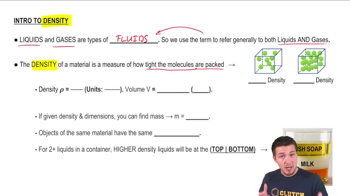
Probability density is derived from the wave function and represents the likelihood of locating a particle within a given region of space. For a one-dimensional wave function, the probability density is calculated as |ψ(x)|². This concept is crucial for interpreting quantum mechanics, as it allows us to predict where a particle is likely to be found upon measurement.
추천 영상:
가이드 코스
8:13
Intro to Density

Exponential Decay

Exponential decay is a mathematical function that describes how a quantity decreases over time or space at a rate proportional to its current value. In the context of the given wave function, the terms eˣ/ᴸ and e−ˣ/ᴸ illustrate how the wave function behaves differently in the regions x ≤ 0 mm and x ≥ 0 mm, leading to distinct probability densities that reflect the particle's confinement and behavior.
추천 영상:
가이드 코스
04:24
Amplitude Decay in an LRC Circuit
관련 실천
교과서 질문

A particle is described by the wave function ψ(x)={cex/Lx0 mmcex/Lx0 mm\(\psi\) (x)=\(\begin{cases}\) ce^{x/L} & x\(\leq\) 0\(\text{ mm}\) \\ ce^{-x/L} & x\(\geq\) 0\(\text{ mm}\) \(\end{cases}\) mm where L = 2.0 mm. Determine the normalization constant c.

55
views

교과서 질문

Consider the electron wave function ψ(x)={c1x2x1 cm0x1 cm\(\psi\) (x)=\(\begin{cases}\) c\(\sqrt{1-x^{2}\)} & \(\left\)|x\(\right\)|\(\leq\) 1\(\text{ cm}\) \\ 0 & \(\left\)|x\(\right\)|\(\geq\) 1\(\text{ cm}\) \(\end{cases}\) where x is in cm. Draw a graph of |ψ(x)|2 over the interval −2 cm ≤ x ≤ 2 cm. Provide numerical scales.

41
views
교과서 질문

Consider the electron wave function ψ(x)={c1x2x1 cm0x1 cm\(\psi\) (x)=\(\begin{cases}\) c\(\sqrt{1-x^{2}\)} & \(\left\)|x\(\right\)|\(\leq\) 1\(\text{ cm}\) \\ 0 & \(\left\)|x\(\right\)|\(\geq\) 1\(\text{ cm}\) \(\end{cases}\) where x is in cm. Draw a graph of ψ(x) over the interval −2 cm ≤ x ≤ 2 cm. Provide numerical scales on both axes.

42
views
교과서 질문

A particle is described by the wave function ψ(x)={cex/Lx0 mmcex/Lx0 mm\(\psi\) (x)=\(\begin{cases}\) ce^{x/L} & x\(\leq\) 0\(\text{ mm}\) \\ ce^{-x/L} & x\(\geq\) 0\(\text{ mm}\) \(\end{cases}\) where L = 2.0 mm. Interpret your answer to part b by shading the region representing this probability on the appropriate graph in part a.

1579
views
교과서 질문

Consider the electron wave function ψ(x)={c1x2x1 cm0x1 cm\(\psi\) (x)=\(\begin{cases}\) c\(\sqrt{1-x^{2}\)} & \(\left\)|x\(\right\)|\(\leq\) 1\(\text{ cm}\) \\ 0 & \(\left\)|x\(\right\)|\(\geq\) 1\(\text{ cm}\) \(\end{cases}\) where x is in cm. Determine the normalization constant c.

57
views
교과서 질문

A particle is described by the wave function ψ(x)={cex/Lx0 mmcex/Lx0 mm\(\psi\) (x)=\(\begin{cases}\) ce^{x/L} & x\(\leq\) 0\(\text{ mm}\) \\ ce^{-x/L} & x\(\geq\) 0\(\text{ mm}\) \(\end{cases}\) where L = 2.0 mm. Calculate the probability of finding the particle within 1.0 mm of the origin.

1579
views