Ch 40: One-Dimensional Quantum Mechanics
Knight Calc - Physics for Scientists and Engineers 5th Edition
Knight Calc5th EditionPhysics for Scientists and EngineersISBN: 9780137344796당신이 사용하는 게 아니라요?교과서 변경
40장, 문제 24

An electron approaches a 1.0-nm-wide potential-energy barrier of height 5.0 eV. What energy electron has a tunneling probability of (a) 10%, (b) 1.0%, and (c) 0.10%?

검증된 단계별 안내
1
Understand the problem: This is a quantum mechanics problem involving quantum tunneling. The tunneling probability is determined by the height and width of the potential-energy barrier, as well as the energy of the electron. The formula for tunneling probability is derived from the Schrödinger equation and is given approximately by: \( T \approx e^{-2 \kappa L} \), where \( \kappa = \sqrt{\frac{2m(U - E)}{\hbar^2}} \), \( L \) is the width of the barrier, \( U \) is the barrier height, \( E \) is the energy of the electron, \( m \) is the mass of the electron, and \( \hbar \) is the reduced Planck's constant.
Identify the given values: The width of the barrier \( L = 1.0 \, \text{nm} = 1.0 \times 10^{-9} \; \text{m} \), the height of the barrier \( U = 5.0 \; \text{eV} \), and the tunneling probabilities \( T \) are given for three cases: 10% (0.1), 1.0% (0.01), and 0.10% (0.001). The mass of the electron \( m = 9.11 \times 10^{-31} \; \text{kg} \), and \( \hbar = 1.055 \times 10^{-34} \; \text{J·s} \).
Rearrange the tunneling probability formula to solve for \( E \): Start with \( T \approx e^{-2 \kappa L} \). Taking the natural logarithm of both sides gives \( \ln(T) = -2 \kappa L \). Solve for \( \kappa \): \( \kappa = -\frac{\ln(T)}{2L} \). Substitute \( \kappa \) into its definition \( \kappa = \sqrt{\frac{2m(U - E)}{\hbar^2}} \) to solve for \( E \): \( E = U - \frac{\hbar^2 \kappa^2}{2m} \).
Substitute the known values into the formula for \( E \): For each tunneling probability \( T \), calculate \( \kappa \) using \( \kappa = -\frac{\ln(T)}{2L} \). Then, substitute \( \kappa \) into \( E = U - \frac{\hbar^2 \kappa^2}{2m} \) to find the energy \( E \) of the electron. Perform this calculation for \( T = 0.1 \), \( T = 0.01 \), and \( T = 0.001 \).
Interpret the results: The calculated energies \( E \) for each tunneling probability represent the energy levels at which the electron has a 10%, 1.0%, and 0.10% chance of tunneling through the barrier. These values demonstrate the relationship between the energy of the electron and its tunneling probability, highlighting the quantum mechanical nature of the problem.

비슷한 문제에 대한 검증된 영상 답변:

이 영상 해법은 위 문제에 도움이 된다고 튜터들이 추천한 것입니다.
도움이 되었나요?

주요 개념

질문에 올바르게 답하기 위해 반드시 이해해야 하는 핵심 개념들은 다음과 같습니다.

Quantum Tunneling

Quantum tunneling is a phenomenon in quantum mechanics where a particle can pass through a potential energy barrier, even if its energy is less than the height of the barrier. This occurs due to the wave-like nature of particles, allowing for a probability of finding the particle on the other side of the barrier. The likelihood of tunneling decreases exponentially with increasing barrier width and height.

Potential Energy Barrier

A potential energy barrier is a region in space where the potential energy of a particle is higher than its total energy, effectively preventing the particle from passing through classically. In this context, the barrier height is given in electron volts (eV), which quantifies the energy required for an electron to overcome the barrier. The width of the barrier also plays a crucial role in determining the tunneling probability.
추천 영상:
가이드 코스
07:24
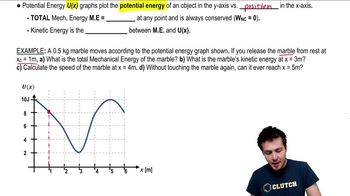
Potential Energy Graphs

Tunneling Probability

Tunneling probability quantifies the likelihood that a particle will tunnel through a potential energy barrier. It is influenced by factors such as the height and width of the barrier, as well as the energy of the particle. The probability can be calculated using quantum mechanical formulas, often resulting in an exponential decay with respect to the barrier parameters, indicating that higher barriers or wider barriers lead to lower tunneling probabilities.
추천 영상:
가이드 코스
04:03
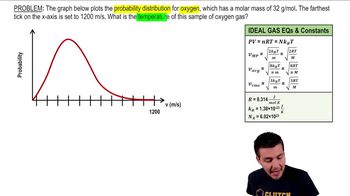
Probability Distribution Graph