Ch 40: One-Dimensional Quantum Mechanics
Knight Calc - Physics for Scientists and Engineers 5th Edition
Knight Calc5th EditionPhysics for Scientists and EngineersISBN: 9780137344796당신이 사용하는 게 아니라요?교과서 변경
40장, 문제 1a

The electrons in a rigid box emit photons of wavelength 1484 nm during the 3→2 transition. What kind of photons are they—infrared, visible, or ultraviolet?

검증된 단계별 안내
1
Determine the energy difference between the two energy levels (n=3 and n=2) using the formula for energy levels in a rigid box: En = n2h2 / 8mL2, where n is the quantum number, h is Planck's constant, m is the mass of the electron, and L is the length of the box. The energy difference is given by ΔE = E3 - E2.
Relate the energy difference to the wavelength of the emitted photon using the equation ΔE = hc / λ, where h is Planck's constant, c is the speed of light, and λ is the wavelength of the photon. Rearrange the equation to find the energy difference: ΔE = (6.626 × 10⁻³⁴ J·s)(3.00 × 10⁸ m/s) / (1484 × 10-9 m).
Convert the energy difference from joules to electronvolts (eV) using the conversion factor 1 eV = 1.602 × 10⁻¹⁹ J. This will give the energy of the photon in eV.
Compare the energy of the photon to the typical energy ranges for infrared, visible, and ultraviolet light. Infrared photons typically have energies less than 1.65 eV, visible photons range from about 1.65 eV to 3.1 eV, and ultraviolet photons have energies greater than 3.1 eV.
Based on the calculated energy, classify the photon as infrared, visible, or ultraviolet. This classification depends on the energy range it falls into.

비슷한 문제에 대한 검증된 영상 답변:

이 영상 해법은 위 문제에 도움이 된다고 튜터들이 추천한 것입니다.

주요 개념

질문에 올바르게 답하기 위해 반드시 이해해야 하는 핵심 개념들은 다음과 같습니다.

Photon Wavelength and Electromagnetic Spectrum

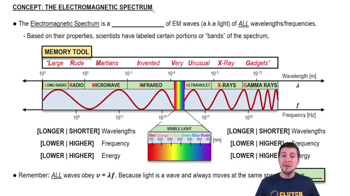
Photons are particles of light that can be characterized by their wavelength, which determines their position in the electromagnetic spectrum. The spectrum ranges from radio waves with long wavelengths to gamma rays with very short wavelengths. Wavelengths in the range of 700 nm to 400 nm correspond to visible light, while wavelengths longer than 700 nm are classified as infrared.
추천 영상:
가이드 코스
06:06
The Electromagnetic Spectrum

Energy Levels in Atoms

Electrons in an atom occupy specific energy levels, and transitions between these levels result in the emission or absorption of photons. When an electron moves from a higher energy level to a lower one, it emits a photon with energy equal to the difference between the two levels. The wavelength of the emitted photon can be calculated using the energy-wavelength relationship, which is inversely proportional.
추천 영상:

Identifying Photon Types

To classify photons based on their wavelength, one must refer to the electromagnetic spectrum. Photons with wavelengths longer than 700 nm are considered infrared, while those between 400 nm and 700 nm are visible light, and wavelengths shorter than 400 nm fall into the ultraviolet range. The specific wavelength of 1484 nm indicates that the emitted photons from the electron transition are in the infrared range.
추천 영상:
가이드 코스
05:19
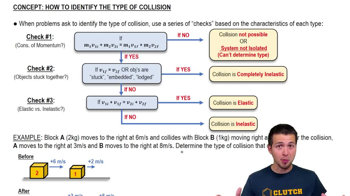
How to Identify the Type of Collision