Ch 40: One-Dimensional Quantum Mechanics
Knight Calc - Physics for Scientists and Engineers 5th Edition
Knight Calc5th EditionPhysics for Scientists and EngineersISBN: 9780137344796당신이 사용하는 게 아니라요?교과서 변경
40장, 문제 15a

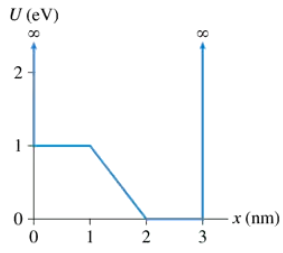
The graph in FIGURE EX40.15 shows the potential-energy function U(x) of a particle. Solution of the Schrödinger equation finds that the n = 3 level has E3 = 0.5 eV and that the n = 6 level has E6 = 2.0 eV. Redraw this figure and add to it the energy lines for the n = 3 and n = 6 states.

검증된 단계별 안내
1
Step 1: Understand the problem. The graph provided shows the potential-energy function U(x) of a particle. The task is to redraw the graph and add horizontal lines representing the energy levels for n=3 (E₃ = 0.5 eV) and n=6 (E₆ = 2.0 eV). These energy levels correspond to the solutions of the Schrödinger equation.
Step 2: Identify the axes of the graph. Typically, the x-axis represents the position (x), and the y-axis represents the potential energy U(x). Ensure you understand the shape of the potential-energy curve provided in the figure.
Step 3: Draw the potential-energy curve U(x) as shown in the original figure. Carefully replicate the curve's features, such as peaks, valleys, or flat regions, to ensure accuracy.
Step 4: Add horizontal lines to represent the energy levels. For n=3, draw a horizontal line at E₃ = 0.5 eV. For n=6, draw another horizontal line at E₆ = 2.0 eV. These lines should be parallel to the x-axis and positioned at the corresponding energy values on the y-axis.
Step 5: Label the energy levels on the graph. Clearly mark the lines as 'n=3, E₃ = 0.5 eV' and 'n=6, E₆ = 2.0 eV' to indicate their significance. Ensure the graph is neat and all elements are properly labeled for clarity.

비슷한 문제에 대한 검증된 영상 답변:

이 영상 해법은 위 문제에 도움이 된다고 튜터들이 추천한 것입니다.
도움이 되었나요?

주요 개념

질문에 올바르게 답하기 위해 반드시 이해해야 하는 핵심 개념들은 다음과 같습니다.

Potential Energy Function

The potential energy function U(x) describes how the potential energy of a particle varies with its position x. In quantum mechanics, this function is crucial for determining the behavior of particles in a potential well, influencing their allowed energy levels and wave functions. Understanding the shape of U(x) helps visualize how particles can be confined or allowed to move freely within certain regions.
추천 영상:
07:24
Potential Energy Graphs

Schrödinger Equation

The Schrödinger equation is a fundamental equation in quantum mechanics that describes how the quantum state of a physical system changes over time. It allows for the calculation of wave functions, which provide information about the probability of finding a particle in a particular state or position. The solutions to this equation yield quantized energy levels, such as E₃ and E₆ in the question, which correspond to specific states of the system.
추천 영상:
08:25
Kinematics Equations

Quantum Energy Levels

Quantum energy levels refer to the discrete energy states that a quantum system, such as an electron in an atom, can occupy. These levels arise from the quantization of energy due to boundary conditions imposed by the potential energy function. In the context of the question, E₃ and E₆ represent the energy values for the n=3 and n=6 states, respectively, indicating that the particle can only exist at these specific energy levels within the potential well.
추천 영상:
04:10
Intro to Energy & Types of Energy