
Ch 02: Motion Along a Straight Line
Young & Freedman Calc - University Physics 14th Edition
Young & Freedman Calc14th EditionUniversity PhysicsISBN: 9780321973610당신이 사용하는 게 아니라요?교과서 변경
2장, 문제 30b

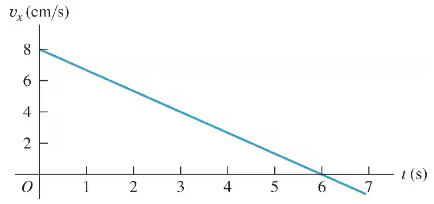
A cat walks in a straight line, which we shall call the xx-axis, with the positive direction to the right. As an observant physicist, you make measurements of this cat's motion and construct a graph of the feline's velocity as a function of time (Fig. E2.302.30). What is the cat's acceleration at t=3.0t = 3.0 s? At t=6.0t = 6.0 s? At t=7.0t = 7.0 s?
Velocity-time graph showing a linear decrease from 8 cm/s at 0s to 0 cm/s at 6s, continuing to -2 cm/s at 7s.

검증된 단계별 안내
1
To find the acceleration at a specific time, we need to determine the slope of the velocity-time graph at that time. The slope of the graph represents the acceleration.
Identify the points on the graph at t = 3.0 s, t = 6.0 s, and t = 7.0 s. From the graph, at t = 3.0 s, the velocity v is -2 m/s; at t = 6.0 s, v is 1 m/s; and at t = 7.0 s, v is 2 m/s.
Calculate the slope of the graph between two points to find the acceleration. The formula for the slope (acceleration) is: \( a = \frac{\Delta v}{\Delta t} \), where \( \Delta v \) is the change in velocity and \( \Delta t \) is the change in time.
For t = 3.0 s, use the points (2.0 s, -3 m/s) and (4.0 s, -1 m/s) to calculate the slope: \( a = \frac{-1 - (-3)}{4.0 - 2.0} \).
For t = 6.0 s and t = 7.0 s, observe that the graph is a straight line, indicating constant acceleration. Use any two points on the line to calculate the slope, such as (5.0 s, 0 m/s) and (7.0 s, 2 m/s): \( a = \frac{2 - 0}{7.0 - 5.0} \).

비슷한 문제에 대한 검증된 영상 답변:

이 영상 해법은 위 문제에 도움이 된다고 튜터들이 추천한 것입니다.
영상 길이:
3m
도움이 되었나요?

주요 개념

질문에 올바르게 답하기 위해 반드시 이해해야 하는 핵심 개념들은 다음과 같습니다.

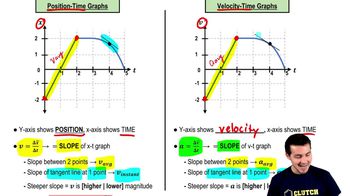
Velocity-Time Graph

A velocity-time graph represents an object's velocity over time, with velocity on the y-axis and time on the x-axis. The slope of the graph indicates acceleration, as it shows how velocity changes with time. A straight line suggests constant acceleration, while a curved line indicates changing acceleration.
추천 영상:
가이드 코스
05:59
Velocity-Time Graphs & Acceleration

Acceleration

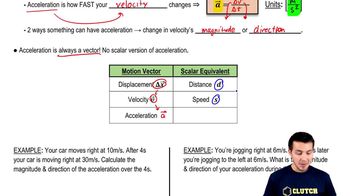
Acceleration is the rate of change of velocity with respect to time. It is calculated as the slope of the velocity-time graph, which is the change in velocity divided by the change in time. Positive acceleration indicates increasing velocity, while negative acceleration indicates decreasing velocity.
추천 영상:
가이드 코스
05:47
Intro to Acceleration

Slope Calculation

To find the acceleration at specific times, calculate the slope of the velocity-time graph at those points. The slope is determined by the rise over run, or the change in velocity divided by the change in time between two points on the graph. This provides the acceleration value at any given time.
추천 영상:
관련 실천
교과서 질문

A car sits on an entrance ramp to a freeway, waiting for a break in the traffic. Then the driver accelerates with constant acceleration along the ramp and onto the freeway. The car starts from rest, moves in a straight line, and has a speed of 2020 m/s (4545 mi/h) when it reaches the end of the 120120-m-long ramp. How much time does it take the car to travel the length of the ramp?

1992
views
2
rank
교과서 질문

A cat walks in a straight line, which we shall call the xx-axis, with the positive direction to the right. As an observant physicist, you make measurements of this cat's motion and construct a graph of the feline's velocity as a function of time (Fig. E2.302.30). What distance does the cat move during the first 4.54.5 s? From t=0 t = 0 to t=7.5t = 7.5 s?

1902
views
교과서 질문

A cat walks in a straight line, which we shall call the xx-axis, with the positive direction to the right. As an observant physicist, you make measurements of this cat's motion and construct a graph of the feline's velocity as a function of time (Fig. E2.302.30). Find the cat's velocity at t=4.0t = 4.0 s and at t=7.0t = 7.0 s.

2857
views
교과서 질문

A small block has constant acceleration as it slides down a frictionless incline. The block is released from rest at the top of the incline, and its speed after it has traveled 6.806.80 m to the bottom of the incline is 3.803.80 m/s. What is the speed of the block when it is 3.403.40 m from the top of the incline?

5186
views
1
rank
교과서 질문

A cat walks in a straight line, which we shall call the xx-axis, with the positive direction to the right. As an observant physicist, you make measurements of this cat's motion and construct a graph of the feline's velocity as a function of time (Fig. E2.302.30). Assuming that the cat started at the origin, sketch clear graphs of the cat's acceleration and position as functions of time.

2674
views
교과서 질문

At launch a rocket ship weighs 4.54.5 million pounds. When it is launched from rest, it takes 8.008.00 s to reach 161161 km/h; at the end of the first 1.001.00 min, its speed is 16101610 km/h. What is the average acceleration (in m/s2) of the rocket (i) during the first 8.008.00 s and (ii) between 8.008.00 s and the end of the first 1.001.00 min?

1956
views