
Ch 02: Motion Along a Straight Line
Young & Freedman Calc - University Physics 14th Edition
Young & Freedman Calc14th EditionUniversity PhysicsISBN: 9780321973610당신이 사용하는 게 아니라요?교과서 변경
2장, 문제 29a

At launch a rocket ship weighs 4.54.5 million pounds. When it is launched from rest, it takes 8.008.00 s to reach 161161 km/h; at the end of the first 1.001.00 min, its speed is 16101610 km/h. What is the average acceleration (in m/s2) of the rocket (i) during the first 8.008.00 s and (ii) between 8.008.00 s and the end of the first 1.001.00 min?

검증된 단계별 안내
1
Convert the initial and final speeds from km/h to m/s for both time intervals. Use the conversion factor: 1 km/h = 0.27778 m/s.
For the first 8.00 s, calculate the initial speed (0 km/h) and final speed (161 km/h) in m/s. Then, use the formula for average acceleration: a = (v_f - v_i) / t, where v_f is the final velocity, v_i is the initial velocity, and t is the time interval.
For the time interval between 8.00 s and 1.00 min (60 s), calculate the initial speed (161 km/h) and final speed (1610 km/h) in m/s. The time interval for this part is 60 s - 8 s = 52 s.
Use the average acceleration formula again for the second time interval: a = (v_f - v_i) / t, where v_f is the final velocity at 1.00 min, v_i is the velocity at 8.00 s, and t is the time interval (52 s).
Ensure all units are consistent throughout the calculations, particularly converting all speeds to m/s and time to seconds, to find the average acceleration in m/s² for both intervals.

비슷한 문제에 대한 검증된 영상 답변:

이 영상 해법은 위 문제에 도움이 된다고 튜터들이 추천한 것입니다.
영상 길이:
2m
도움이 되었나요?

주요 개념

질문에 올바르게 답하기 위해 반드시 이해해야 하는 핵심 개념들은 다음과 같습니다.

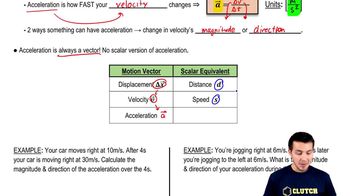
Acceleration

Acceleration is the rate of change of velocity of an object with respect to time. It is a vector quantity, meaning it has both magnitude and direction. In this problem, average acceleration can be calculated using the formula: a = (v_f - v_i) / t, where v_f is the final velocity, v_i is the initial velocity, and t is the time interval.
추천 영상:
가이드 코스
05:47
Intro to Acceleration

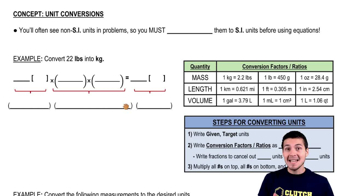
Unit Conversion

Unit conversion is the process of converting a quantity expressed in one set of units to another. In this problem, velocities are given in km/h and need to be converted to m/s for consistency with the SI unit system. The conversion factor is 1 km/h = 0.27778 m/s, which is crucial for accurate calculations of acceleration.
추천 영상:
가이드 코스
07:46
Unit Conversions

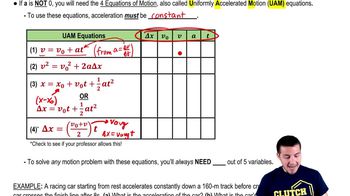
Kinematics

Kinematics is the branch of mechanics that deals with the motion of objects without considering the forces that cause the motion. It involves parameters such as displacement, velocity, and acceleration. Understanding kinematics is essential for solving this problem, as it involves calculating the rocket's acceleration over specified time intervals using its velocity changes.
추천 영상:
가이드 코스
08:25
Kinematics Equations
관련 실천
교과서 질문

A car sits on an entrance ramp to a freeway, waiting for a break in the traffic. Then the driver accelerates with constant acceleration along the ramp and onto the freeway. The car starts from rest, moves in a straight line, and has a speed of 2020 m/s (4545 mi/h) when it reaches the end of the 120120-m-long ramp. How much time does it take the car to travel the length of the ramp?

1992
views
2
rank
교과서 질문

A cat walks in a straight line, which we shall call the xx-axis, with the positive direction to the right. As an observant physicist, you make measurements of this cat's motion and construct a graph of the feline's velocity as a function of time (Fig. E2.302.30). What distance does the cat move during the first 4.54.5 s? From t=0 t = 0 to t=7.5t = 7.5 s?

1902
views
교과서 질문

A car sits on an entrance ramp to a freeway, waiting for a break in the traffic. Then the driver accelerates with constant acceleration along the ramp and onto the freeway. The car starts from rest, moves in a straight line, and has a speed of 2020 m/s (4545 mi/h) when it reaches the end of the 120120-m-long ramp. What is the acceleration of the car?

2908
views
교과서 질문

A pilot who accelerates at more than 4g4g begins to 'gray out' but doesn't completely lose consciousness. How far would the plane travel during this period of acceleration? (Use 331331 m/s for the speed of sound in cold air.)

2320
views
교과서 질문

A cat walks in a straight line, which we shall call the xx-axis, with the positive direction to the right. As an observant physicist, you make measurements of this cat's motion and construct a graph of the feline's velocity as a function of time (Fig. E2.302.30). What is the cat's acceleration at t=3.0t = 3.0 s? At t=6.0t = 6.0 s? At t=7.0t = 7.0 s?

2095
views
교과서 질문

A cat walks in a straight line, which we shall call the xx-axis, with the positive direction to the right. As an observant physicist, you make measurements of this cat's motion and construct a graph of the feline's velocity as a function of time (Fig. E2.302.30). Find the cat's velocity at t=4.0t = 4.0 s and at t=7.0t = 7.0 s.

2857
views