
Ch 02: Motion Along a Straight Line
Young & Freedman Calc - University Physics 14th Edition
Young & Freedman Calc14th EditionUniversity PhysicsISBN: 9780321973610당신이 사용하는 게 아니라요?교과서 변경
2장, 문제 62b

A small rocket burns 0.0500 kg of fuel per second, ejecting it as a gas with a velocity relative to the rocket of magnitude 1600 m/s. Would the rocket operate in outer space where there is no atmosphere? If so, how would you steer it? Could you brake it?

검증된 단계별 안내
1
The rocket operates based on the principle of conservation of momentum, specifically Newton's Third Law of Motion. When the rocket ejects fuel at high velocity, it generates an equal and opposite reaction force that propels the rocket forward. This principle works regardless of the presence of an atmosphere, so the rocket would indeed operate in outer space.
To steer the rocket in outer space, the rocket would need to use directional thrusters or gimbaled engines. By changing the direction of the ejected fuel (or using small side thrusters), the rocket can create torque, allowing it to rotate and change its orientation.
Braking the rocket in outer space is possible by firing the main engine or retro-thrusters in the direction opposite to the rocket's motion. This would reduce its velocity by applying a force in the opposite direction of travel.
The absence of an atmosphere in outer space means there is no air resistance to assist in braking or steering. All maneuvers must rely solely on the controlled ejection of fuel to generate the necessary forces.
In summary, the rocket can operate, steer, and brake in outer space by utilizing the controlled ejection of fuel, as the principles of conservation of momentum and Newton's laws are independent of the presence of an atmosphere.

비슷한 문제에 대한 검증된 영상 답변:

이 영상 해법은 위 문제에 도움이 된다고 튜터들이 추천한 것입니다.
영상 길이:
1m
도움이 되었나요?

주요 개념

질문에 올바르게 답하기 위해 반드시 이해해야 하는 핵심 개념들은 다음과 같습니다.

Newton's Third Law of Motion

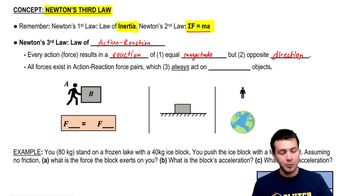
Newton's Third Law states that for every action, there is an equal and opposite reaction. This principle is fundamental in understanding how rockets operate; as the rocket expels gas downwards, it experiences an upward thrust. This law explains why rockets can function in the vacuum of space, where there is no atmosphere.
추천 영상:
08:01
Newton's Third Law & Action-Reaction Pairs

Rocket Propulsion

Rocket propulsion relies on the principle of conservation of momentum, where the mass of the expelled fuel and its velocity create thrust. The rocket's ability to burn fuel and eject it at high speeds allows it to accelerate in the absence of atmospheric pressure. This mechanism is crucial for maneuvering in space, as it enables the rocket to change velocity and direction.
추천 영상:
03:36
Liftoff!

Steering and Braking in Space

In space, steering a rocket is achieved by adjusting the direction of the thrust produced by the engines or using reaction control systems (RCS) that expel small amounts of gas. Braking is accomplished by reversing the thrust direction or using retro-rockets to slow down. Both actions rely on the principles of momentum and thrust, allowing for precise control in a vacuum.
추천 영상:
03:40
Entropy Increase When Braking
관련 실천
교과서 질문

High-speed motion pictures (35003500 frames/second) of a jumping, 210μg210–μg flea yielded the data used to plot the graph in Fig. E2.542.54. (See 'The Flying Leap of the Flea' by M. Rothschild, Y. Schlein, K. Parker, C. Neville, and S. Sternberg in the November 19731973 Scientific American.) This flea was about 22 mm long and jumped at a nearly vertical takeoff angle. Use the graph to answer this question: Is the acceleration of the flea ever zero? If so, when? Justify your answer.

1616
views
교과서 질문

High-speed motion pictures (35003500 frames/second) of a jumping, 210μg210–μg flea yielded the data used to plot the graph in Fig. E2.542.54. (See 'The Flying Leap of the Flea' by M. Rothschild, Y. Schlein, K. Parker, C. Neville, and S. Sternberg in the November 19731973 Scientific American.) This flea was about 22 mm long and jumped at a nearly vertical takeoff angle. Use the graph to answer this question: Find the flea's acceleration at 0.50.5 ms, 1.01.0 ms, and 1.51.5 ms.


1487
views
교과서 질문

High-speed motion pictures (35003500 frames/second) of a jumping, 210μg210–μg flea yielded the data used to plot the graph in Fig. E2.542.54. (See 'The Flying Leap of the Flea' by M. Rothschild, Y. Schlein, K. Parker, C. Neville, and S. Sternberg in the November 19731973 Scientific American.) This flea was about 22 mm long and jumped at a nearly vertical takeoff angle. Use the graph to answer this question: Find the maximum height the flea reached in the first 2.52.5 ms.

1755
views