
Ch 02: Motion Along a Straight Line
Young & Freedman Calc - University Physics 14th Edition
Young & Freedman Calc14th EditionUniversity PhysicsISBN: 9780321973610당신이 사용하는 게 아니라요?교과서 변경
2장, 문제 54c

High-speed motion pictures (35003500 frames/second) of a jumping, 210μg210–μg flea yielded the data used to plot the graph in Fig. E2.542.54. (See 'The Flying Leap of the Flea' by M. Rothschild, Y. Schlein, K. Parker, C. Neville, and S. Sternberg in the November 19731973 Scientific American.) This flea was about 22 mm long and jumped at a nearly vertical takeoff angle. Use the graph to answer this question: Find the flea's acceleration at 0.50.5 ms, 1.01.0 ms, and 1.51.5 ms.


Speed-time graph of a flea's jump, with time in ms and speed in cm/s.

검증된 단계별 안내
1
To find the flea's acceleration at specific times, we need to determine the slope of the velocity-time graph at those times. Acceleration is the rate of change of velocity with respect to time.
Examine the graph provided. The graph shows velocity (in cm/s) on the y-axis and time (in ms) on the x-axis. We need to find the slope of the graph at 0.5 ms, 1.0 ms, and 1.5 ms.
At 0.5 ms, identify the velocity from the graph. The slope at this point is the change in velocity divided by the change in time. Use the formula: \( a = \frac{\Delta v}{\Delta t} \). Calculate the slope using the velocities at points slightly before and after 0.5 ms.
Repeat the process for 1.0 ms. Find the velocity at 1.0 ms from the graph, and calculate the slope using the velocities at points slightly before and after 1.0 ms.
Finally, repeat the process for 1.5 ms. Find the velocity at 1.5 ms from the graph, and calculate the slope using the velocities at points slightly before and after 1.5 ms. This will give you the acceleration at each of these times.

비슷한 문제에 대한 검증된 영상 답변:

이 영상 해법은 위 문제에 도움이 된다고 튜터들이 추천한 것입니다.
영상 길이:
5m
도움이 되었나요?

주요 개념

질문에 올바르게 답하기 위해 반드시 이해해야 하는 핵심 개념들은 다음과 같습니다.

Acceleration

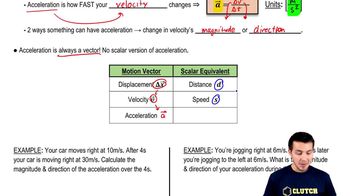
Acceleration is the rate of change of velocity over time. It is a vector quantity, meaning it has both magnitude and direction. In the context of the flea's jump, acceleration can be determined by analyzing the change in speed over specific time intervals, which can be derived from the speed-time graph provided.
추천 영상:
05:47
Intro to Acceleration

Speed-Time Graph

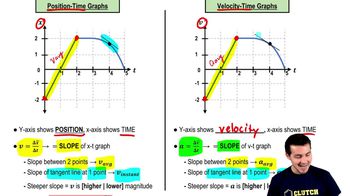
A speed-time graph visually represents an object's speed as a function of time. The slope of the graph indicates acceleration; a steeper slope means greater acceleration. In this case, the graph shows how the flea's speed increases rapidly at first and then levels off, indicating a change in acceleration over time.
추천 영상:
05:59
Velocity-Time Graphs & Acceleration

Instantaneous Speed

Instantaneous speed refers to the speed of an object at a specific moment in time. It can be determined from the speed-time graph by reading the speed value at a given time. For the flea's jump, finding the instantaneous speed at 0.5 ms, 1.0 ms, and 1.5 ms will help in calculating the corresponding accelerations.
추천 영상:
07:59
Speed Distribution & Special Speeds of Ideal Gases
관련 실천
교과서 질문

High-speed motion pictures (35003500 frames/second) of a jumping, 210μg210–μg flea yielded the data used to plot the graph in Fig. E2.542.54. (See 'The Flying Leap of the Flea' by M. Rothschild, Y. Schlein, K. Parker, C. Neville, and S. Sternberg in the November 19731973 Scientific American.) This flea was about 22 mm long and jumped at a nearly vertical takeoff angle. Use the graph to answer this question: Is the acceleration of the flea ever zero? If so, when? Justify your answer.

1616
views
교과서 질문

High-speed motion pictures (35003500 frames/second) of a jumping, 210μg210–μg flea yielded the data used to plot the graph in Fig. E2.542.54. (See 'The Flying Leap of the Flea' by M. Rothschild, Y. Schlein, K. Parker, C. Neville, and S. Sternberg in the November 19731973 Scientific American.) This flea was about 22 mm long and jumped at a nearly vertical takeoff angle. Use the graph to answer this question: Find the maximum height the flea reached in the first 2.52.5 ms.

1755
views
교과서 질문

A small rocket burns 0.0500 kg of fuel per second, ejecting it as a gas with a velocity relative to the rocket of magnitude 1600 m/s. Would the rocket operate in outer space where there is no atmosphere? If so, how would you steer it? Could you brake it?

1508
views
교과서 질문

A rocket starts from rest and moves upward from the surface of the earth. For the first 10.010.0 s of its motion, the vertical acceleration of the rocket is given by ay=(2.80a_{y}=(2.80 m/s3)t)t, where the +y+y-direction is upward. What is the speed of the rocket when it is 325325 m above the surface of the earth?

1936
views