Ch 02: Motion Along a Straight Line
Young & Freedman Calc - University Physics 14th Edition
Young & Freedman Calc14th EditionUniversity PhysicsISBN: 9780321973610당신이 사용하는 게 아니라요?교과서 변경
2장, 문제 15e

A turtle crawls along a straight line, which we will call the xx-axis with the positive direction to the right. The equation for the turtle's position as a function of time is x(t)=50.0x(t) = 50.0 cm + (2.002.00 cm/s)tt − (0.06250.0625 cm/s2)t2t^2. Sketch graphs of xx versus tt, vxv_{x} versus tt, and axa_{x} versus tt, for the time interval t=0t = 0 to t=40t = 40 s.

검증된 단계별 안내
1
Understand the given position function: x(t) = 50.0 cm + (2.00 cm/s)t − (0.0625 cm/s²)t². This is a quadratic equation in terms of time, t, which describes the turtle's position along the x-axis.
To sketch the graph of x versus t, identify the type of curve. Since the equation is quadratic, the graph will be a parabola. Determine the vertex and intercepts by analyzing the coefficients and solving for x when t = 0 and when x = 0.
Find the velocity function, υx(t), by taking the first derivative of the position function x(t) with respect to time t. This will give you υx(t) = d(x(t))/dt = 2.00 cm/s − 2(0.0625 cm/s²)t.
Sketch the graph of υx versus t. The velocity function is linear, so the graph will be a straight line. Determine the slope and intercept by analyzing the coefficients of the velocity function.
Find the acceleration function, ax(t), by taking the derivative of the velocity function υx(t) with respect to time t. This will give you ax(t) = d(υx(t))/dt = −2(0.0625 cm/s²). Since the acceleration is constant, the graph of ax versus t will be a horizontal line.

비슷한 문제에 대한 검증된 영상 답변:

이 영상 해법은 위 문제에 도움이 된다고 튜터들이 추천한 것입니다.
영상 길이:
6m
도움이 되었나요?

주요 개념

질문에 올바르게 답하기 위해 반드시 이해해야 하는 핵심 개념들은 다음과 같습니다.

Kinematics Equations

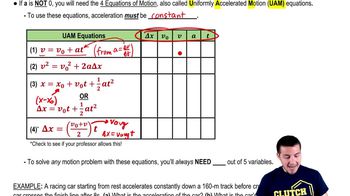
Kinematics involves the study of motion without considering the forces that cause it. The position equation x(t) = 50.0 cm + (2.00 cm/s)t − (0.0625 cm/s²)t² describes the turtle's motion along the x-axis. This equation is a quadratic function of time, indicating that the turtle's motion includes both constant velocity and constant acceleration components.
추천 영상:
가이드 코스
08:25
Kinematics Equations

Velocity and Acceleration

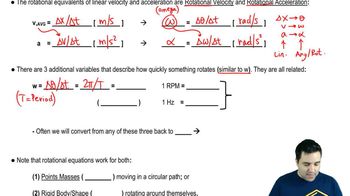
Velocity is the rate of change of position with respect to time, and acceleration is the rate of change of velocity. For the given position function, the velocity function υx(t) can be found by differentiating x(t) with respect to time, resulting in υx(t) = 2.00 cm/s - (0.125 cm/s²)t. Similarly, the acceleration ax(t) is the derivative of velocity, yielding a constant ax(t) = -0.125 cm/s².
추천 영상:
가이드 코스
11:21
Rotational Velocity & Acceleration

Graphical Representation of Motion

Graphing the position, velocity, and acceleration as functions of time provides a visual understanding of the turtle's motion. The position graph x versus t is a parabola opening downwards, indicating deceleration. The velocity graph υx versus t is a straight line with a negative slope, and the acceleration graph ax versus t is a horizontal line, reflecting constant negative acceleration.
추천 영상:
가이드 코스
05:58
Subtracting Vectors Graphically
관련 실천
교과서 질문

A car's velocity as a function of time is given byvx(t)=α+βt2 v_x(t) = α + βt^2, where α=3.00α = 3.00 m/s and β=0.100β = 0.100 m/s3. Draw vxv_x-tt and axa_x-tt graphs for the car's motion between t=0 t = 0 and t=5.00t = 5.00 s.

2372
views
교과서 질문

An astronaut has left the International Space Station to test a new space scooter. Her partner measures the following velocity changes, each taking place in a 1010-s interval. What are the magnitude, the algebraic sign, and the direction of the average acceleration in each interval? Assume that the positive direction is to the right.

(a) At the beginning of the interval, the astronaut is moving toward the right along the xx-axis at 15.015.0 m/s, and at the end of the interval she is moving toward the right at 5.05.0 m/s.

(b) At the beginning she is moving toward the left at 5.05.0 m/s, and at the end she is moving toward the left at 15.015.0 m/s.

(c) At the beginning she is moving toward the right at 15.015.0 m/s, and at the end she is moving toward the left at 15.015.0 m/s.

2172
views
교과서 질문

A race car starts from rest and travels east along a straight and level track. For the first 5.05.0 s of the car's motion, the eastward component of the car's velocity is given by vx(t)=v_{x}(t)= (0.8600.860 m/s3)t2. What is the acceleration of the car when vx=12.0v_{x}=12.0 m/s?

4406
views
2
rank
교과서 질문

A turtle crawls along a straight line, which we will call the xx-axis with the positive direction to the right. The equation for the turtle's position as a function of time is x(t)=50.0x(t) = 50.0 cm + (2.002.00 cm/s)tt − (0.06250.0625 cm/s2)t2t^2. At what time tt is the velocity of the turtle zero?

89
views
교과서 질문

A car's velocity as a function of time is given byvx(t)=α+βt2 v_x(t) = α + βt^2, where α=3.00α = 3.00 m/s and β=0.100β = 0.100 m/s3. Calculate the average acceleration for the time interval t=0t = 0 to t=5.00t = 5.00 s.

3631
views
1
rank
교과서 질문

A turtle crawls along a straight line, which we will call the xx-axis with the positive direction to the right. The equation for the turtle's position as a function of time is x(t)=50.0x(t) = 50.0 cm + (2.002.00 cm/s)tt − (0.06250.0625 cm/s2)t2t^2. Find the turtle's initial velocity, initial position, and initial acceleration.

2780
views