Ch 06: Work & Kinetic Energy
Young & Freedman Calc - University Physics 14th Edition
Young & Freedman Calc14th EditionUniversity PhysicsISBN: 9780321973610당신이 사용하는 게 아니라요?교과서 변경
6장, 문제 33a

A surgeon is using material from a donated heart to repair a patient's damaged aorta and needs to know the elastic characteristics of this aortal material. Tests performed on a 16.016.0-cm strip of the donated aorta reveal that it stretches 3.753.75 cm when a 1.501.50-N pull is exerted on it. What is the force constant of this strip of aortal material?

검증된 단계별 안내
1
Step 1: Understand the problem. The force constant (k) is a measure of the stiffness of the material and is defined by Hooke's Law: \( F = k \Delta x \), where \( F \) is the applied force, \( \Delta x \) is the extension, and \( k \) is the force constant. We need to calculate \( k \) using the given values.
Step 2: Identify the given values. The applied force \( F \) is 1.50 N, the original length of the strip is 16.0 cm, and the extension \( \Delta x \) is 3.75 cm. Note that \( \Delta x \) is the change in length, not the total length.
Step 3: Convert units if necessary. Since the force constant \( k \) is typically expressed in \( \text{N/m} \), convert the extension \( \Delta x \) from centimeters to meters. Use the conversion factor: \( 1 \, \text{cm} = 0.01 \, \text{m} \). Thus, \( \Delta x = 3.75 \, \text{cm} \times 0.01 \, \text{m/cm} = 0.0375 \, \text{m} \).
Step 4: Rearrange Hooke's Law to solve for \( k \). The formula becomes \( k = \frac{F}{\Delta x} \). Substitute the values of \( F \) and \( \Delta x \) into the equation.
Step 5: Perform the calculation. Divide the force \( F \) (1.50 N) by the extension \( \Delta x \) (0.0375 m) to find the force constant \( k \). The result will be in \( \text{N/m} \).

비슷한 문제에 대한 검증된 영상 답변:

이 영상 해법은 위 문제에 도움이 된다고 튜터들이 추천한 것입니다.
영상 길이:
3m
도움이 되었나요?

주요 개념

질문에 올바르게 답하기 위해 반드시 이해해야 하는 핵심 개념들은 다음과 같습니다.

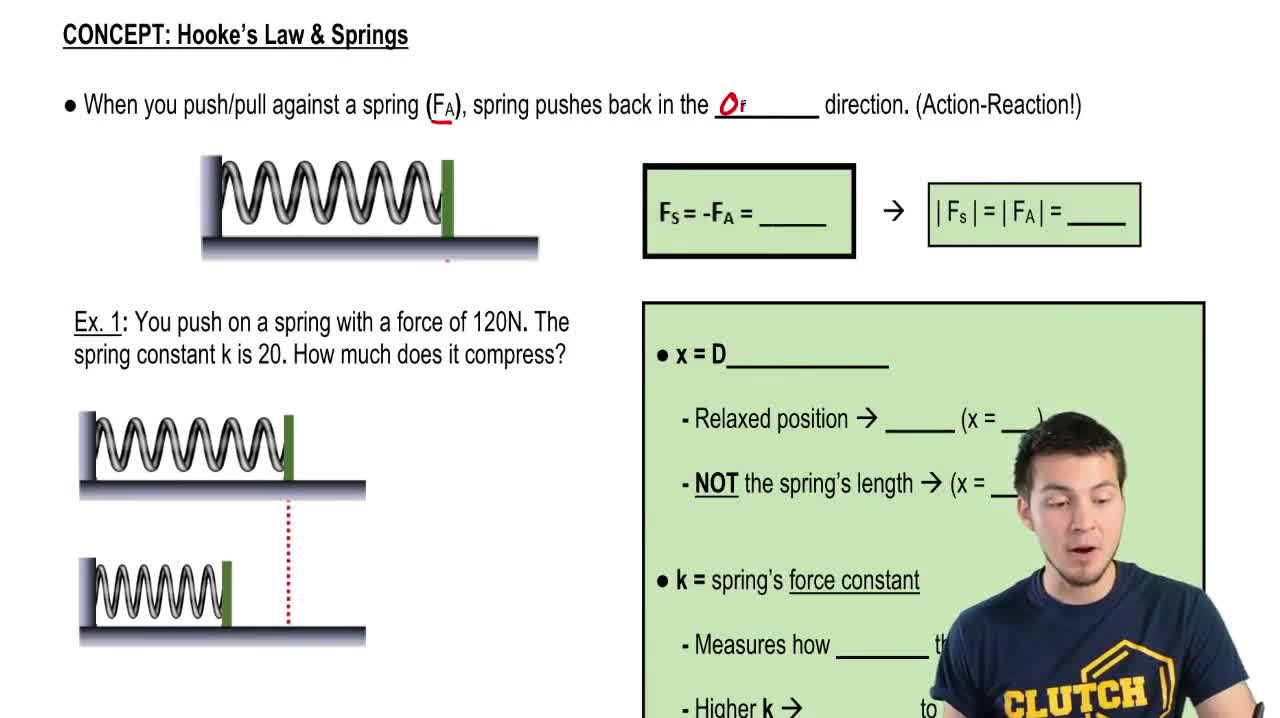
Hooke's Law

Hooke's Law states that the force exerted by a spring (or elastic material) is directly proportional to the amount it is stretched or compressed, as long as the elastic limit is not exceeded. Mathematically, it is expressed as F = kx, where F is the force applied, k is the spring constant (or force constant), and x is the displacement from the equilibrium position. This principle is fundamental in understanding how materials deform under stress.
추천 영상:
가이드 코스
05:27
Spring Force (Hooke's Law)

Elasticity

Elasticity is the property of a material that enables it to return to its original shape after being deformed by an external force. It is quantified by the material's elastic modulus, which measures the stiffness of the material. In the context of the aorta, understanding its elasticity is crucial for determining how it will behave under physiological conditions and how it can withstand the forces exerted by blood flow.
추천 영상:
가이드 코스
08:56
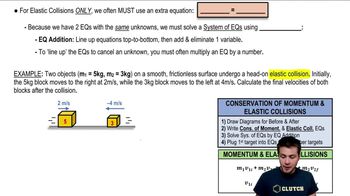
Intro To Elastic Collisions

Force Constant

The force constant, often denoted as k, is a measure of the stiffness of an elastic material. It is defined as the ratio of the force applied to the displacement produced, as described by Hooke's Law. A higher force constant indicates a stiffer material that requires more force to achieve the same amount of stretch, which is particularly important in medical applications where material properties can affect the success of surgical repairs.
추천 영상:
가이드 코스
08:59
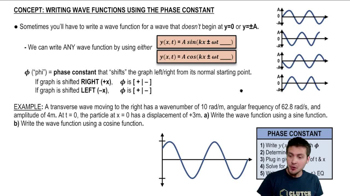
Phase Constant of a Wave Function
관련 실천
교과서 질문

A 6.06.0-kg box moving at 3.03.0 m/s on a horizontal, frictionless surface runs into a light spring of force constant 7575 N/cm. Use the work–energy theorem to find the maximum compression of the spring.

3052
views

교과서 질문

You throw a 3.003.00-N rock vertically into the air from ground level. You observe that when it is 15.015.0 m above the ground, it is traveling at 25.025.0 m/s upward. Use the work–energy theorem to find its maximum height.

2713
views
교과서 질문

A surgeon is using material from a donated heart to repair a patient's damaged aorta and needs to know the elastic characteristics of this aortal material. Tests performed on a 16.016.0-cm strip of the donated aorta reveal that it stretches 3.753.75 cm when a 1.501.50-N pull is exerted on it. If the maximum distance it will be able to stretch when it replaces the aorta in the damaged heart is 1.141.14 cm, what is the greatest force it will be able to exert there?

1229
views
교과서 질문

A 20.020.0-kg rock is sliding on a rough, horizontal surface at 8.008.00 m/s and eventually stops due to friction. The coefficient of kinetic friction between the rock and the surface is 0.2000.200. What average power is produced by friction as the rock stops?

5130
views
교과서 질문

You throw a 3.003.00-N rock vertically into the air from ground level. You observe that when it is 15.015.0 m above the ground, it is traveling at 25.025.0 m/s upward. Use the work–energy theorem to find the rock's speed just as it left the ground.

7228
views
9
rank
교과서 질문

Is it reasonable that a 3030-kg child could run fast enough to have 100100 J of kinetic energy?

2410
views