Ch 06: Work & Kinetic Energy
Young & Freedman Calc - University Physics 14th Edition
Young & Freedman Calc14th EditionUniversity PhysicsISBN: 9780321973610당신이 사용하는 게 아니라요?교과서 변경
6장, 문제 24b

You throw a 3.003.00-N rock vertically into the air from ground level. You observe that when it is 15.015.0 m above the ground, it is traveling at 25.025.0 m/s upward. Use the work–energy theorem to find its maximum height.

검증된 단계별 안내
1
Step 1: Start by identifying the given values and the work-energy theorem. The work-energy theorem states that the net work done on an object is equal to its change in kinetic energy. Here, the rock has a weight of 3.00 N, an initial velocity of 25.0 m/s at a height of 15.0 m, and we need to find its maximum height.
Step 2: Calculate the mass of the rock using its weight and the acceleration due to gravity. The formula is \( m = \frac{W}{g} \), where \( W \) is the weight (3.00 N) and \( g \) is the acceleration due to gravity (9.8 m/s²).
Step 3: Use the work-energy theorem to relate the kinetic energy and potential energy at the given height (15.0 m) to the maximum height. The total mechanical energy at any point is conserved, so \( KE_{initial} + PE_{initial} = PE_{max} \). Kinetic energy is given by \( KE = \frac{1}{2}mv^2 \), and potential energy is given by \( PE = mgh \).
Step 4: Substitute the known values into the equations. At 15.0 m, calculate the kinetic energy using \( KE = \frac{1}{2}mv^2 \) and the potential energy using \( PE = mgh \). Add these to find the total mechanical energy.
Step 5: At the maximum height, the rock's velocity is zero, so all the mechanical energy is converted into potential energy. Use \( PE_{max} = mgh_{max} \) and solve for \( h_{max} \) by rearranging the equation to \( h_{max} = \frac{E_{total}}{mg} \).

비슷한 문제에 대한 검증된 영상 답변:

이 영상 해법은 위 문제에 도움이 된다고 튜터들이 추천한 것입니다.
영상 길이:
7m
도움이 되었나요?

주요 개념

질문에 올바르게 답하기 위해 반드시 이해해야 하는 핵심 개념들은 다음과 같습니다.

Work-Energy Theorem

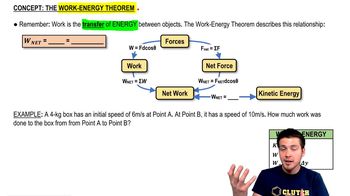
The work-energy theorem states that the work done on an object is equal to the change in its kinetic energy. In this context, the work done by the gravitational force as the rock ascends can be calculated, and this work will equal the difference between the kinetic energy at the height of 15.0 m and the kinetic energy at the maximum height.
추천 영상:
가이드 코스
04:10
The Work-Energy Theorem

Kinetic Energy

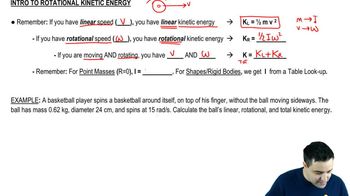
Kinetic energy is the energy an object possesses due to its motion, calculated using the formula KE = 0.5 * m * v^2, where m is mass and v is velocity. In this problem, the rock's kinetic energy at 15.0 m can be determined using its speed of 25.0 m/s, which will help in applying the work-energy theorem to find the maximum height.
추천 영상:
가이드 코스
06:07
Intro to Rotational Kinetic Energy

Potential Energy

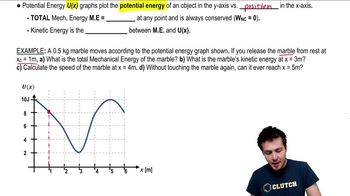
Potential energy, particularly gravitational potential energy, is the energy stored in an object due to its height above a reference point, calculated as PE = m * g * h, where g is the acceleration due to gravity and h is the height. As the rock rises, its potential energy increases, and at its maximum height, all kinetic energy will have converted into potential energy.
추천 영상:
가이드 코스
07:24
Potential Energy Graphs
관련 실천
교과서 질문

A 6.06.0-kg box moving at 3.03.0 m/s on a horizontal, frictionless surface runs into a light spring of force constant 7575 N/cm. Use the work–energy theorem to find the maximum compression of the spring.

3052
views

교과서 질문

A 1.501.50-kg book is sliding along a rough horizontal surface. At point AA it is moving at 3.213.21 m/s, and at point BB it has slowed to 1.251.25 m/s. How much work was done on the book between AA and BB?

3384
views
교과서 질문

A surgeon is using material from a donated heart to repair a patient's damaged aorta and needs to know the elastic characteristics of this aortal material. Tests performed on a 16.016.0-cm strip of the donated aorta reveal that it stretches 3.753.75 cm when a 1.501.50-N pull is exerted on it. What is the force constant of this strip of aortal material?

1578
views
교과서 질문

A surgeon is using material from a donated heart to repair a patient's damaged aorta and needs to know the elastic characteristics of this aortal material. Tests performed on a 16.016.0-cm strip of the donated aorta reveal that it stretches 3.753.75 cm when a 1.501.50-N pull is exerted on it. If the maximum distance it will be able to stretch when it replaces the aorta in the damaged heart is 1.141.14 cm, what is the greatest force it will be able to exert there?

1229
views
교과서 질문

You throw a 3.003.00-N rock vertically into the air from ground level. You observe that when it is 15.015.0 m above the ground, it is traveling at 25.025.0 m/s upward. Use the work–energy theorem to find the rock's speed just as it left the ground.

7228
views
9
rank
교과서 질문

Is it reasonable that a 3030-kg child could run fast enough to have 100100 J of kinetic energy?

2410
views