
Ch 09: Rotation of Rigid Bodies
Young & Freedman Calc - University Physics 14th Edition
Young & Freedman Calc14th EditionUniversity PhysicsISBN: 9780321973610당신이 사용하는 게 아니라요?교과서 변경
9장, 문제 8b

A wheel is rotating about an axis that is in the z-direction. The angular velocity ωz is -6.00 rad/s at t = 0, increases linearly with time, and is +4.00 rad/s at t = 7.00 s. We have taken counterclockwise rotation to be positive. During what time interval is the speed of the wheel increasing? Decreasing?

검증된 단계별 안내
1
Step 1: Understand the problem. The angular velocity ω_z changes linearly with time, meaning it follows a straight-line relationship. The angular velocity starts at -6.00 rad/s at t = 0 and ends at +4.00 rad/s at t = 7.00 s. Counterclockwise rotation is positive, and we need to determine the intervals during which the speed (magnitude of angular velocity) is increasing and decreasing.
Step 2: Write the equation for angular velocity as a function of time. Since ω_z changes linearly, it can be expressed as ω_z = m * t + b, where m is the slope (rate of change of angular velocity) and b is the initial angular velocity. Calculate the slope m using the formula m = (ω_z_final - ω_z_initial) / (t_final - t_initial).
Step 3: Determine the time at which the angular velocity crosses zero. The speed of the wheel is the magnitude of ω_z, |ω_z|. The speed increases when the magnitude of ω_z moves away from zero and decreases when it moves toward zero. Solve for t when ω_z = 0 using the linear equation derived in Step 2.
Step 4: Analyze the intervals. From t = 0 to the time when ω_z = 0, the angular velocity is negative and moving toward zero, meaning the speed is decreasing. From the time when ω_z = 0 to t = 7.00 s, the angular velocity is positive and moving away from zero, meaning the speed is increasing.
Step 5: Summarize the intervals. The speed of the wheel is decreasing during the interval from t = 0 to the time when ω_z = 0, and increasing during the interval from the time when ω_z = 0 to t = 7.00 s. Use the calculated time from Step 3 to specify these intervals.

비슷한 문제에 대한 검증된 영상 답변:

이 영상 해법은 위 문제에 도움이 된다고 튜터들이 추천한 것입니다.
영상 길이:
6m
도움이 되었나요?

주요 개념

질문에 올바르게 답하기 위해 반드시 이해해야 하는 핵심 개념들은 다음과 같습니다.

Angular Velocity

Angular velocity is a vector quantity that represents the rate of rotation of an object around an axis. It is measured in radians per second (rad/s) and indicates both the speed and direction of rotation. In this question, the angular velocity changes from -6.00 rad/s to +4.00 rad/s, indicating a transition from clockwise to counterclockwise rotation.
추천 영상:
가이드 코스
06:18
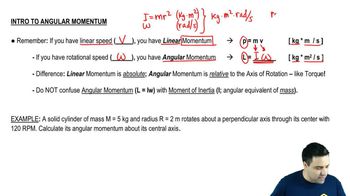
Intro to Angular Momentum

Angular Acceleration

Angular acceleration is the rate of change of angular velocity over time, typically expressed in radians per second squared (rad/s²). It determines whether the speed of rotation is increasing or decreasing. In this scenario, since the angular velocity is increasing from a negative to a positive value, the angular acceleration is positive, indicating that the wheel's speed is increasing during this time.
추천 영상:
가이드 코스
12:12
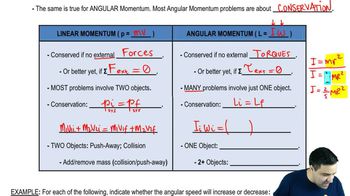
Conservation of Angular Momentum

Direction of Rotation

The direction of rotation is crucial in determining whether the speed of the wheel is increasing or decreasing. In this problem, counterclockwise rotation is defined as positive, while clockwise is negative. The change in angular velocity from negative to positive signifies a shift in direction, which affects the interpretation of speed changes during the specified time interval.
추천 영상:
가이드 코스
14:03
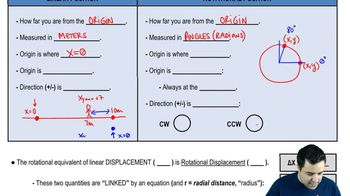
Rotational Position & Displacement
관련 실천
교과서 질문

A wheel is rotating about an axis that is in the z-direction. The angular velocity ωz is -6.00 rad/s at t = 0, increases linearly with time, and is +4.00 rad/s at t = 7.00 s. We have taken counterclockwise rotation to be positive. What is the angular displacement of the wheel at t = 7.00 s?

2174
views
교과서 질문

The angle θ through which a disk drive turns is given by θ(t) = a + bt - ct3, where a, b, and c are constants, t is in seconds, and θ is in radians. When t = 0, θ = π/4 rad and the angular velocity is 2.00 rad/s. When t = 1.50 s, the angular acceleration is 1.25 rad/s2. What are θ and the angular velocity when the angular acceleration is 3.50 rad/s2?

2103
views
교과서 질문

A bicycle wheel has an initial angular velocity of 1.50 rad/s. (a) If its angular acceleration is constant and equal to 0.200 rad/s2, what is its angular velocity at t = 2.50 s? (b) Through what angle has the wheel turned between t = 0 and t = 2.50 s?

1564
views
교과서 질문

A wheel is rotating about an axis that is in the z-direction. The angular velocity ωz is -6.00 rad/s at t = 0, increases linearly with time, and is +4.00 rad/s at t = 7.00 s. We have taken counterclockwise rotation to be positive. Is the angular acceleration during this time interval positive or negative?

2621
views
교과서 질문

An electric fan is turned off, and its angular velocity decreases uniformly from 500 rev/min to 200 rev/min in 4.00 s. Find the angular acceleration in rev/s2 and the number of revolutions made by the motor in the 4.00-s interval.

2773
views
교과서 질문

The angle θ through which a disk drive turns is given by θ(t) = a + bt - ct3, where a, b, and c are constants, t is in seconds, and θ is in radians. When t = 0, θ = π/4 rad and the angular velocity is 2.00 rad/s. When t = 1.50 s, the angular acceleration is 1.25 rad/s2. (b) What is the angular acceleration when θ = π/4 rad?

2865
views