
Ch 09: Rotation of Rigid Bodies
Young & Freedman Calc - University Physics 14th Edition
Young & Freedman Calc14th EditionUniversity PhysicsISBN: 9780321973610당신이 사용하는 게 아니라요?교과서 변경
9장, 문제 7b

The angle θ through which a disk drive turns is given by θ(t) = a + bt - ct3, where a, b, and c are constants, t is in seconds, and θ is in radians. When t = 0, θ = π/4 rad and the angular velocity is 2.00 rad/s. When t = 1.50 s, the angular acceleration is 1.25 rad/s2. (b) What is the angular acceleration when θ = π/4 rad?

검증된 단계별 안내
1
Step 1: Start by understanding the given equation for the angle θ(t) = a + bt - ct^3, where a, b, and c are constants. The angular velocity ω(t) and angular acceleration α(t) can be derived by differentiating θ(t) with respect to time.
Step 2: Differentiate θ(t) to find the angular velocity ω(t). Using the derivative, ω(t) = dθ/dt = b - 3ct^2. This equation will help us find the angular velocity at any given time.
Step 3: Differentiate ω(t) to find the angular acceleration α(t). Using the derivative, α(t) = dω/dt = -6ct. This equation will help us find the angular acceleration at any given time.
Step 4: Use the initial conditions to solve for the constants a, b, and c. When t = 0, θ = π/4 rad, so substitute t = 0 into θ(t) to find a. Similarly, when t = 0, ω = 2.00 rad/s, substitute t = 0 into ω(t) to find b. Finally, use the condition that α = 1.25 rad/s² when t = 1.50 s to solve for c.
Step 5: Once the constants a, b, and c are determined, substitute θ = π/4 rad into the equation for α(t) = -6ct to find the angular acceleration at that specific angle. This will give the desired result.

비슷한 문제에 대한 검증된 영상 답변:

이 영상 해법은 위 문제에 도움이 된다고 튜터들이 추천한 것입니다.
영상 길이:
5m
도움이 되었나요?

주요 개념

질문에 올바르게 답하기 위해 반드시 이해해야 하는 핵심 개념들은 다음과 같습니다.

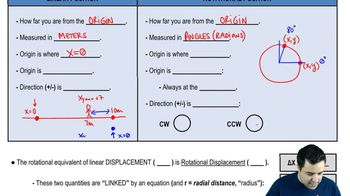
Angular Displacement

Angular displacement refers to the angle through which an object rotates about a fixed point, measured in radians. In this context, θ(t) represents the angular position of the disk drive as a function of time, indicating how far it has turned from its initial position. Understanding angular displacement is crucial for analyzing rotational motion and determining other related quantities like angular velocity and acceleration.
추천 영상:
가이드 코스
14:03
Rotational Position & Displacement

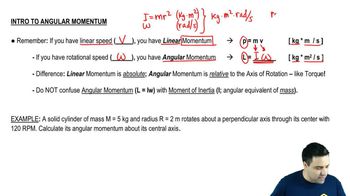
Angular Velocity

Angular velocity is the rate of change of angular displacement with respect to time, typically expressed in radians per second (rad/s). It provides insight into how quickly an object is rotating. In the given problem, the angular velocity can be derived by differentiating the angular displacement function θ(t) with respect to time, which is essential for finding the angular acceleration at specific points in time.
추천 영상:
가이드 코스
06:18
Intro to Angular Momentum

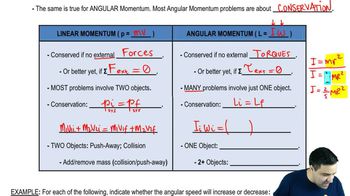
Angular Acceleration

Angular acceleration is the rate of change of angular velocity over time, measured in radians per second squared (rad/s²). It indicates how quickly the rotational speed of an object is changing. In this scenario, calculating angular acceleration involves differentiating the angular velocity function, which is itself derived from the angular displacement function. This concept is vital for understanding the dynamics of rotational motion and solving for specific conditions in the problem.
추천 영상:
가이드 코스
12:12
Conservation of Angular Momentum
관련 실천
교과서 질문

The angle θ through which a disk drive turns is given by θ(t) = a + bt - ct3, where a, b, and c are constants, t is in seconds, and θ is in radians. When t = 0, θ = π/4 rad and the angular velocity is 2.00 rad/s. When t = 1.50 s, the angular acceleration is 1.25 rad/s2. What are θ and the angular velocity when the angular acceleration is 3.50 rad/s2?

2103
views
교과서 질문

A wheel is rotating about an axis that is in the z-direction. The angular velocity ωz is -6.00 rad/s at t = 0, increases linearly with time, and is +4.00 rad/s at t = 7.00 s. We have taken counterclockwise rotation to be positive. Is the angular acceleration during this time interval positive or negative?

2621
views
교과서 질문

A wheel is rotating about an axis that is in the z-direction. The angular velocity ωz is -6.00 rad/s at t = 0, increases linearly with time, and is +4.00 rad/s at t = 7.00 s. We have taken counterclockwise rotation to be positive. During what time interval is the speed of the wheel increasing? Decreasing?

1818
views
교과서 질문

A fan blade rotates with angular velocity given by ωz(t) = g - bt2, where g = 5.00 rad/s and b = 0.800 rad/s3. Calculate the angular acceleration as a function of time.

1766
views
교과서 질문

A fan blade rotates with angular velocity given by ωz(t) = g - bt2, where g = 5.00 rad/s and b = 0.800 rad/s3. Calculate the instantaneous angular acceleration αz at t = 3.00 s and the average angular acceleration αav-z for the time interval t = 0 to t = 3.00 s. How do these two quantities compare? If they are different, why?

2133
views
교과서 질문

The angle θ through which a disk drive turns is given by θ(t) = a + bt - ct3, where a, b, and c are constants, t is in seconds, and θ is in radians. When t = 0, θ = π/4 rad and the angular velocity is 2.00 rad/s. When t = 1.50 s, the angular acceleration is 1.25 rad/s2. Find a, b, and c, including their units.

1733
views