
Ch 10: Dynamics of Rotational Motion
Young & Freedman Calc - University Physics 14th Edition
Young & Freedman Calc14th EditionUniversity PhysicsISBN: 9780321973610당신이 사용하는 게 아니라요?교과서 변경
10장, 문제 40c

A small block on a frictionless, horizontal surface has a mass of 0.0250 kg. It is attached to a massless cord passing through a hole in the surface (Fig. E10.40). The block is originally revolving at a distance of 0.300 m from the hole with an angular speed of 2.85 rad/s. The cord is then pulled from below, shortening the radius of the circle in which the block revolves to 0.150 m. Model the block as a particle. Find the change in kinetic energy of the block.

검증된 단계별 안내
1
Identify the initial and final conditions of the system. Initially, the block is revolving at a radius of 0.300 m with an angular speed of 2.85 rad/s. The final radius is 0.150 m.
Use the conservation of angular momentum to find the final angular speed. The initial angular momentum (L_i) is given by L_i = m * r_i^2 * ω_i, where m is the mass, r_i is the initial radius, and ω_i is the initial angular speed. The final angular momentum (L_f) is L_f = m * r_f^2 * ω_f, where r_f is the final radius and ω_f is the final angular speed. Set L_i = L_f to solve for ω_f.
Calculate the initial kinetic energy (KE_i) using the formula KE_i = 0.5 * m * (r_i * ω_i)^2.
Calculate the final kinetic energy (KE_f) using the formula KE_f = 0.5 * m * (r_f * ω_f)^2, where ω_f is obtained from the conservation of angular momentum.
Determine the change in kinetic energy by finding the difference ΔKE = KE_f - KE_i. This will give you the change in kinetic energy of the block as the radius changes.

비슷한 문제에 대한 검증된 영상 답변:

이 영상 해법은 위 문제에 도움이 된다고 튜터들이 추천한 것입니다.
영상 길이:
8m
도움이 되었나요?

주요 개념

질문에 올바르게 답하기 위해 반드시 이해해야 하는 핵심 개념들은 다음과 같습니다.

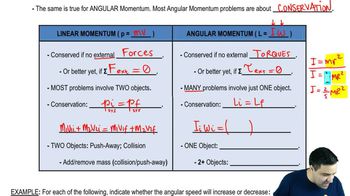
Conservation of Angular Momentum

Angular momentum is conserved in a system where no external torques are acting. For a particle revolving in a circle, the angular momentum is given by L = mvr, where m is mass, v is tangential velocity, and r is the radius. As the radius changes, the velocity must adjust to keep the angular momentum constant, which is crucial for solving this problem.
추천 영상:
12:12
Conservation of Angular Momentum

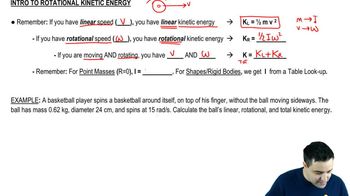
Kinetic Energy in Rotational Motion

Kinetic energy in rotational motion is given by KE = 0.5 * m * v^2, where m is mass and v is tangential velocity. As the radius of the circle changes, the velocity changes due to conservation of angular momentum, affecting the kinetic energy. Understanding how kinetic energy depends on velocity is essential for calculating the change in kinetic energy.
추천 영상:
06:07
Intro to Rotational Kinetic Energy

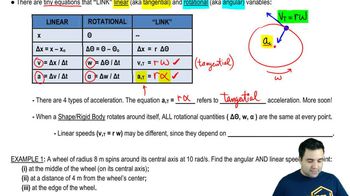
Relationship Between Linear and Angular Velocity

The relationship between linear velocity (v) and angular velocity (ω) is v = ωr, where r is the radius of the circle. As the radius changes, the angular velocity remains constant, but the linear velocity changes. This relationship helps in determining how the velocity changes when the radius is altered, impacting the kinetic energy calculation.
추천 영상:
11:10
Converting Between Linear & Rotational
관련 실천
교과서 질문

Under some circumstances, a star can collapse into an extremely dense object made mostly of neutrons and called a neutron star. The density of a neutron star is roughly 101410^{14} times as great as that of ordinary solid matter. Suppose we represent the star as a uniform, solid, rigid sphere, both before and after the collapse. The star's initial radius was 7.0×10⁵ km7.0\(\times\)10^5\(\text{ km}\) (comparable to our sun); its final radius is 16 km. If the original star rotated once in 3030 days, find the angular speed of the neutron star.

3967
views
1
rank
교과서 질문

A small block on a frictionless, horizontal surface has a mass of 0.0250 kg. It is attached to a massless cord passing through a hole in the surface (Fig. E10.40). The block is originally revolving at a distance of 0.300 m from the hole with an angular speed of 2.85 rad/s. The cord is then pulled from below, shortening the radius of the circle in which the block revolves to 0.150 m. Model the block as a particle. How much work was done in pulling the cord?

1949
views
교과서 질문

A small block on a frictionless, horizontal surface has a mass of 0.0250 kg. It is attached to a massless cord passing through a hole in the surface (Fig. E10.40). The block is originally revolving at a distance of 0.300 m from the hole with an angular speed of 2.85 rad/s. The cord is then pulled from below, shortening the radius of the circle in which the block revolves to 0.150 m. Model the block as a particle. What is the new angular speed?

1045
views
교과서 질문

The Spinning Figure Skater. The outstretched hands and arms of a figure skater preparing for a spin can be considered a slender rod pivoting about an axis through its center (Fig. E10.43). When the skater's hands and arms are brought in and wrapped around his body to execute the spin, the hands and arms can be considered a thinwalled, hollow cylinder. His hands and arms have a combined mass of 8.0 kg. When outstretched, they span 1.8 m; when wrapped, they form a cylinder of radius 25 cm. The moment of inertia about the rotation axis of the remainder of his body is constant and equal to 0.40 kg m2 . If his original angular speed is 0.40 rev/s, what is his final angular speed?

4889
views
교과서 질문

A hollow, thin-walled sphere of mass 12.0kg12.0\(\operatorname{kg}\) and diameter 48.0 cm48.0\(\text{ cm}\) is rotating about an axle through its center. The angle (in radians) through which it turns as a function of time (in seconds) is given by θ(t)=At2+Bt4θ(t) = At^2 + Bt^4, where A has numerical value 1.501.50 and B has numerical value 1.101.10. What are the units of the constants A and B?

2685
views
교과서 질문

A small block on a frictionless, horizontal surface has a mass of 0.0250 kg. It is attached to a massless cord passing through a hole in the surface (Fig. E10.40). The block is originally revolving at a distance of 0.300 m from the hole with an angular speed of 2.85 rad/s. The cord is then pulled from below, shortening the radius of the circle in which the block revolves to 0.150 m. Model the block as a particle. Is the angular momentum of the block conserved? Why or why not?

1338
views