
Ch 10: Dynamics of Rotational Motion
Young & Freedman Calc - University Physics 14th Edition
Young & Freedman Calc14th EditionUniversity PhysicsISBN: 9780321973610당신이 사용하는 게 아니라요?교과서 변경
10장, 문제 40a

A small block on a frictionless, horizontal surface has a mass of 0.0250 kg. It is attached to a massless cord passing through a hole in the surface (Fig. E10.40). The block is originally revolving at a distance of 0.300 m from the hole with an angular speed of 2.85 rad/s. The cord is then pulled from below, shortening the radius of the circle in which the block revolves to 0.150 m. Model the block as a particle. Is the angular momentum of the block conserved? Why or why not?

검증된 단계별 안내
1
Identify the system: The block is revolving on a frictionless surface, attached to a cord that passes through a hole. The system is isolated in terms of horizontal forces.
Understand angular momentum conservation: Angular momentum is conserved in a system if there is no external torque acting on it. In this scenario, the only forces acting are internal (tension in the cord), and there is no external torque.
Express the initial angular momentum: The initial angular momentum (L_initial) can be expressed as L_initial = m * r_initial^2 * ω_initial, where m is the mass, r_initial is the initial radius, and ω_initial is the initial angular speed.
Express the final angular momentum: Similarly, the final angular momentum (L_final) is L_final = m * r_final^2 * ω_final, where r_final is the final radius and ω_final is the final angular speed.
Conclude on conservation: Since there is no external torque, L_initial = L_final, confirming that the angular momentum of the block is conserved as the radius changes.

비슷한 문제에 대한 검증된 영상 답변:

이 영상 해법은 위 문제에 도움이 된다고 튜터들이 추천한 것입니다.
영상 길이:
2m
도움이 되었나요?

주요 개념

질문에 올바르게 답하기 위해 반드시 이해해야 하는 핵심 개념들은 다음과 같습니다.

Angular Momentum

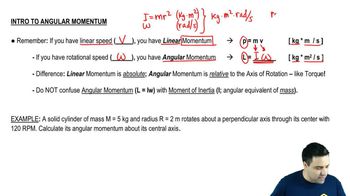
Angular momentum is a measure of the rotational motion of an object and is given by the product of the moment of inertia and angular velocity. For a particle moving in a circle, it is calculated as L = mvr, where m is mass, v is tangential velocity, and r is the radius of the circle. In a closed system with no external torques, angular momentum is conserved.
추천 영상:
06:18
Intro to Angular Momentum

Conservation of Angular Momentum

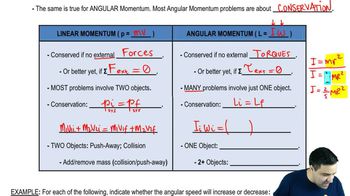
The conservation of angular momentum states that if no external torque acts on a system, the total angular momentum of the system remains constant. This principle is crucial in analyzing systems where the radius of rotation changes, such as in this problem, where the block's radius is halved, affecting its angular speed to conserve angular momentum.
추천 영상:
12:12
Conservation of Angular Momentum

Torque and External Forces

Torque is the rotational equivalent of force and is responsible for changes in angular momentum. It is calculated as the product of force and the lever arm distance. In this scenario, the absence of external torques (since the surface is frictionless and the cord is massless) implies that the angular momentum of the block is conserved, as no external forces are acting to change it.
추천 영상:
12:54
Force and Torque on Current Loops
관련 실천
교과서 질문

A small block on a frictionless, horizontal surface has a mass of 0.0250 kg. It is attached to a massless cord passing through a hole in the surface (Fig. E10.40). The block is originally revolving at a distance of 0.300 m from the hole with an angular speed of 2.85 rad/s. The cord is then pulled from below, shortening the radius of the circle in which the block revolves to 0.150 m. Model the block as a particle. Find the change in kinetic energy of the block.

4375
views
1
rank
교과서 질문

A woman with mass 50 kg is standing on the rim of a large disk that is rotating at 0.80 rev/s about an axis through its center. The disk has mass 110 kg and radius 4.0 m. Calculate the magnitude of the total angular momentum of the woman–disk system. (Assume that you can treat the woman as a point.)

3467
views
교과서 질문

A small block on a frictionless, horizontal surface has a mass of 0.0250 kg. It is attached to a massless cord passing through a hole in the surface (Fig. E10.40). The block is originally revolving at a distance of 0.300 m from the hole with an angular speed of 2.85 rad/s. The cord is then pulled from below, shortening the radius of the circle in which the block revolves to 0.150 m. Model the block as a particle. How much work was done in pulling the cord?

1949
views
교과서 질문

Calculate the magnitude of the angular momentum of the earth in a circular orbit around the sun. Is it reasonable to model it as a particle? Consult Appendix E and the astronomical data in Appendix F

1636
views
교과서 질문

A small block on a frictionless, horizontal surface has a mass of 0.0250 kg. It is attached to a massless cord passing through a hole in the surface (Fig. E10.40). The block is originally revolving at a distance of 0.300 m from the hole with an angular speed of 2.85 rad/s. The cord is then pulled from below, shortening the radius of the circle in which the block revolves to 0.150 m. Model the block as a particle. What is the new angular speed?

1045
views
교과서 질문

A hollow, thin-walled sphere of mass 12.0kg12.0\(\operatorname{kg}\) and diameter 48.0 cm48.0\(\text{ cm}\) is rotating about an axle through its center. The angle (in radians) through which it turns as a function of time (in seconds) is given by θ(t)=At2+Bt4θ(t) = At^2 + Bt^4, where A has numerical value 1.501.50 and B has numerical value 1.101.10. What are the units of the constants A and B?

2685
views