
Ch 13: Gravitation
Young & Freedman Calc - University Physics 14th Edition
Young & Freedman Calc14th EditionUniversity PhysicsISBN: 9780321973610당신이 사용하는 게 아니라요?교과서 변경
13장, 문제 35

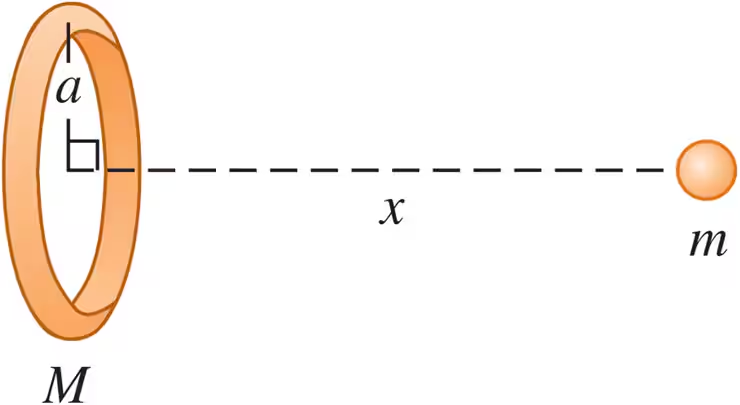
Consider the ringshaped body of Fig. E13.35. A particle with mass m is placed a distance x from the center of the ring, along the line through the center of the ring and perpendicular to its plane. (a) Calculate the gravitational potential energy U of this system. Take the potential energy to be zero when the two objects are far apart. (b) Show that your answer to part (a) reduces to the expected result when x is much larger than the radius a of the ring. (c) Use Fx = -dU/dx to find the magnitude and direction of the force on the particle (see Section 7.4). (d) Show that your answer to part (c) reduces to the expected result when x is much larger than a. (e) What are the values of U and Fx when x = 0? Explain why these results make sense.

검증된 단계별 안내
1
Step 1: To calculate the gravitational potential energy U of the system, consider the gravitational potential energy due to each infinitesimal mass element dm of the ring. The potential energy dU due to dm is given by dU = -G * m * dm / r, where G is the gravitational constant and r is the distance from the mass element to the particle.
Step 2: Integrate dU over the entire ring to find the total potential energy U. The distance r can be expressed in terms of x and the radius a of the ring using the Pythagorean theorem: r = sqrt(x^2 + a^2). Therefore, U = -G * m * M / sqrt(x^2 + a^2), where M is the total mass of the ring.
Step 3: For part (b), consider the limit where x is much larger than the radius a. In this case, the expression for U simplifies to U ≈ -G * m * M / x, which is the expected result for a point mass at a distance x from another point mass.
Step 4: To find the force Fx on the particle, use the relation Fx = -dU/dx. Differentiate the expression for U with respect to x to find Fx. This involves applying the chain rule to the expression U = -G * m * M / sqrt(x^2 + a^2).
Step 5: For part (d), consider the limit where x is much larger than a again. The expression for Fx simplifies to Fx ≈ -G * m * M / x^2, which is the expected result for the gravitational force between two point masses. For part (e), when x = 0, U is at its minimum value, and Fx is zero because the particle is at the center of symmetry of the ring, where the gravitational forces from all parts of the ring cancel out.

비슷한 문제에 대한 검증된 영상 답변:

이 영상 해법은 위 문제에 도움이 된다고 튜터들이 추천한 것입니다.
영상 길이:
8m
도움이 되었나요?

주요 개념

질문에 올바르게 답하기 위해 반드시 이해해야 하는 핵심 개념들은 다음과 같습니다.

Gravitational Potential Energy

Gravitational potential energy (U) is the energy an object possesses due to its position in a gravitational field. It is calculated as U = -G * (m1 * m2) / r, where G is the gravitational constant, m1 and m2 are the masses involved, and r is the distance between their centers. In this problem, the potential energy is considered zero when the objects are infinitely far apart.
추천 영상:
가이드 코스
06:35
Gravitational Potential Energy

Force from Potential Energy

The force on an object in a potential field can be derived from the potential energy function using the relation Fx = -dU/dx. This means the force is the negative gradient of the potential energy with respect to position, indicating that the force acts in the direction of decreasing potential energy. This concept is crucial for determining the force on the particle in the gravitational field of the ring.
추천 영상:
가이드 코스
07:24
Potential Energy Graphs

Limit Behavior in Physics

In physics, analyzing the behavior of a system as a parameter approaches a limit (e.g., x much larger than a) helps verify the consistency of results with known laws. For instance, when x is much larger than the radius a, the system should behave like a point mass, simplifying calculations and confirming the validity of derived expressions. This approach is used to ensure that complex models reduce to simpler, expected forms under certain conditions.
추천 영상:
가이드 코스
07:59
Magnetic Field due to Finite Wire
관련 실천
교과서 질문

You decide to visit Santa Claus at the north pole to put in a good word about your splendid behavior throughout the year. While there, you notice that the elf Sneezy, when hanging from a rope, produces a tension of 395.0 N in the rope. If Sneezy hangs from a similar rope while delivering presents at the earth's equator, what will the tension in it be? (Recall that the earth is rotating about an axis through its north and south poles.)

2770
views
1
comments
교과서 질문

Astronomers have observed a small, massive object at the center of our Milky Way galaxy. A ring of material orbits this massive object; the ring has a diameter of about 15 light-years and an orbital speed of about 200 km/s. Observations of stars, as well as theories of the structure of stars, suggest that it is impossible for a single star to have a mass of more than about 50 solar masses. Can this massive object be a single, ordinary star?

2420
views
교과서 질문

A thin, uniform rod has length L and mass M. A small uniform sphere of mass m is placed a distance x from one end of the rod, along the axis of the rod (Fig. E13.34). Calculate the gravitational potential energy of the rod–sphere system. Take the potential energy to be zero when the rod and sphere are infinitely far apart. Show that your answer reduces to the expected result when x is much larger than L.

730
views
교과서 질문

A thin, uniform rod has length L and mass M. A small uniform sphere of mass m is placed a distance x from one end of the rod, along the axis of the rod (Fig. E13.34). Use Fx = -dU/dx to find the magnitude and direction of the gravitational force exerted on the sphere by the rod (see Section 7.4). Show that your answer reduces to the expected result when x is much larger than L.

2352
views
1
rank
교과서 질문

A uniform, solid, 1000.0-kg sphere has a radius of 5.00 m. Find the gravitational force this sphere exerts on a 2.00-kg point mass placed at the following distances from the center of the sphere: (i) 5.01 m, (ii) 2.50 m.

1256
views
교과서 질문

Cosmologists have speculated that black holes the size of a proton could have formed during the early days of the Big Bang when the universe began. If we take the diameter of a proton to be 1.0 × 10⁻¹⁵ m, what would be the mass of a mini black hole?

2047
views