Ch 13: Gravitation
Young & Freedman Calc - University Physics 14th Edition
Young & Freedman Calc14th EditionUniversity PhysicsISBN: 9780321973610당신이 사용하는 게 아니라요?교과서 변경
13장, 문제 24

In its orbit each day, the International Space Station makes 15.65 revolutions around the earth. Assuming a circular orbit, how high is this satellite above the surface of the earth?

검증된 단계별 안내
1
First, understand that the International Space Station (ISS) completes 15.65 revolutions around the Earth in one day. This information can be used to find the orbital period (T) of the ISS.
Calculate the orbital period (T) by dividing the total time in one day (24 hours) by the number of revolutions (15.65). Convert the time into seconds for consistency in units.
Use Kepler's Third Law, which relates the orbital period (T) to the radius of the orbit (r). The formula is: T2=4π2GMr3, where G is the gravitational constant and M is the mass of the Earth.
Rearrange the formula to solve for the radius (r) of the orbit: r=GMT24π213.
Finally, subtract the Earth's radius from the calculated orbital radius to find the height of the ISS above the Earth's surface. The Earth's average radius is approximately 6,371 kilometers.

비슷한 문제에 대한 검증된 영상 답변:

이 영상 해법은 위 문제에 도움이 된다고 튜터들이 추천한 것입니다.
영상 길이:
4m
도움이 되었나요?

주요 개념

질문에 올바르게 답하기 위해 반드시 이해해야 하는 핵심 개념들은 다음과 같습니다.

Orbital Mechanics

Orbital mechanics involves the study of the motion of objects in space under the influence of gravitational forces. For a satellite like the International Space Station (ISS), understanding its orbit requires knowledge of how gravitational forces from Earth dictate its path and speed, ensuring it remains in a stable orbit.
추천 영상:
가이드 코스
04:45
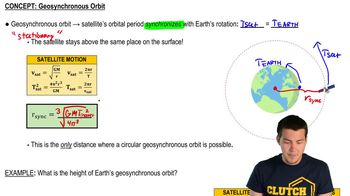
Geosynchronous Orbits

Circular Orbit

A circular orbit is a type of orbit where the satellite maintains a constant distance from the center of the Earth, resulting in a circular path. This simplifies calculations as the radius of the orbit remains constant, allowing for easier determination of orbital parameters such as altitude and velocity.
추천 영상:
가이드 코스
9:11
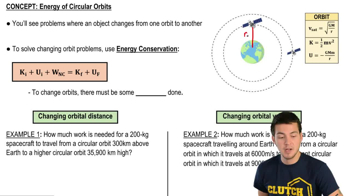
Energy of Circular Orbits

Gravitational Force

Gravitational force is the attractive force between two masses, such as the Earth and the ISS. It is crucial for maintaining the satellite's orbit, as it provides the necessary centripetal force to keep the ISS moving in its circular path. The strength of this force depends on the mass of the Earth and the distance between the Earth and the satellite.
추천 영상:
가이드 코스
05:41
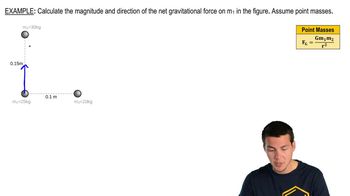
Gravitational Forces in 2D
관련 실천
교과서 질문

The dwarf planet Pluto has an elliptical orbit with a semimajor axis of 5.91 × 10¹² m and eccentricity 0.249. During Pluto's orbit around the sun, what are its closest and farthest distances from the sun?

3031
views

교과서 질문

Two satellites are in circular orbits around a planet that has radius 9.00 × 10⁶ m. One satellite has mass 68.0 kg, orbital radius 7.00 × 10⁷ m, and orbital speed 4800 m/s. The second satellite has mass 84.0 kg and orbital radius 3.00 × 10⁷ m. What is the orbital speed of this second satellite?

3195
views
교과서 질문

For a satellite to be in a circular orbit 890 km above the surface of the earth, what orbital speed must it be given?

1967
views
교과서 질문

On July 15, 2004, NASA launched the Aura spacecraft to study the earth's climate and atmosphere. This satellite was injected into an orbit 705 km above the earth's surface. Assume a circular orbit. How many hours does it take this satellite to make one orbit?

2708
views
교과서 질문

The star Rho1 Cancri is 57 light-years from the earth and has a mass 0.85 times that of our sun. A planet has been detected in a circular orbit around Rho1 Cancri with an orbital radius equal to 0.11 times the radius of the earth's orbit around the sun. What are (a) the orbital speed and (b) the orbital period of the planet of Rho1 Cancri?

2678
views
교과서 질문

In March 2006, two small satellites were discovered orbiting Pluto, one at a distance of 48,000 km and the other at 64,000 km. Pluto already was known to have a large satellite Charon, orbiting at 19,600 km with an orbital period of 6.39 days. Assuming that the satellites do not affect each other, find the orbital periods of the two small satellites without using the mass of Pluto.

2108
views