Ch 13: Gravitation
Young & Freedman Calc - University Physics 14th Edition
Young & Freedman Calc14th EditionUniversity PhysicsISBN: 9780321973610당신이 사용하는 게 아니라요?교과서 변경
13장, 문제 31

On October 15, 2001, a planet was discovered orbiting around the star HD 68988. Its orbital distance was measured to be 10.5 million kilometers from the center of the star, and its orbital period was estimated at 6.3 days. What is the mass of HD 68988? Express your answer in kilograms and in terms of our sun's mass.

검증된 단계별 안내
1
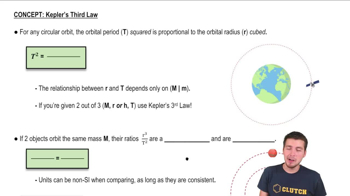
Start by understanding Kepler's Third Law, which relates the orbital period and distance of a planet to the mass of the star it orbits. The formula is: \( T^2 = \frac{4\pi^2}{G M} r^3 \), where \( T \) is the orbital period, \( r \) is the orbital radius, \( G \) is the gravitational constant, and \( M \) is the mass of the star.
Convert the given orbital distance from kilometers to meters. Since 1 kilometer equals 1000 meters, multiply 10.5 million kilometers by 1000 to get the distance in meters.
Convert the orbital period from days to seconds. There are 86400 seconds in a day, so multiply 6.3 days by 86400 to get the period in seconds.
Rearrange Kepler's Third Law to solve for the mass of the star: \( M = \frac{4\pi^2 r^3}{G T^2} \). Substitute the values for \( r \), \( T \), and \( G \) (which is approximately \( 6.674 \times 10^{-11} \) m³/kg/s²) into the equation.
To express the mass of HD 68988 in terms of our sun's mass, divide the calculated mass by the mass of the sun, which is approximately \( 1.989 \times 10^{30} \) kg.

비슷한 문제에 대한 검증된 영상 답변:

이 영상 해법은 위 문제에 도움이 된다고 튜터들이 추천한 것입니다.
영상 길이:
3m
도움이 되었나요?

주요 개념

질문에 올바르게 답하기 위해 반드시 이해해야 하는 핵심 개념들은 다음과 같습니다.

Kepler's Third Law

Kepler's Third Law states that the square of the orbital period of a planet is directly proportional to the cube of the semi-major axis of its orbit. This law is crucial for determining the mass of a star when the orbital characteristics of a planet are known. It can be expressed as T^2 ∝ a^3, where T is the orbital period and a is the semi-major axis.
추천 영상:
가이드 코스
08:32
Kepler's Third Law

Gravitational Force and Orbital Motion

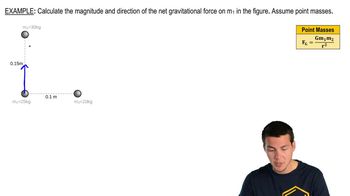
The gravitational force between a star and a planet provides the centripetal force necessary for the planet's circular motion. This relationship is described by Newton's law of universal gravitation, which states that the force is proportional to the product of the two masses and inversely proportional to the square of the distance between them. Understanding this helps in calculating the mass of the star based on the planet's orbit.
추천 영상:
가이드 코스
05:41
Gravitational Forces in 2D

Mass of the Sun as a Reference

The mass of the sun is often used as a reference unit in astrophysics, known as the solar mass (M☉). It provides a convenient way to express the mass of other stars in a comparative manner. Knowing the mass of HD 68988 in terms of solar masses allows for easier comparison and understanding of its size relative to our sun.
추천 영상:
가이드 코스
14:10
Inertial Reference Frames
관련 실천
교과서 질문

The dwarf planet Pluto has an elliptical orbit with a semimajor axis of 5.91 × 10¹² m and eccentricity 0.249. During Pluto's orbit around the sun, what are its closest and farthest distances from the sun?

3031
views

교과서 질문

A uniform, spherical, 1000.0 kg1000.0\(\text{ kg}\) shell has a radius of 5.00 m5.00\(\text{ m}\). Sketch a qualitative graph of the magnitude of the gravitational force this sphere exerts on a point mass m as a function of the distance rr of mm from the center of the sphere. Include the region from r=0r = 0 to rr\(\to\]\infty\).

1751
views
교과서 질문

In 2004 astronomers reported the discovery of a large Jupiter-sized planet orbiting very close to the star HD 179949 (hence the term 'hot Jupiter'). The orbit was just 1/9 the distance of Mercury from our sun, and it takes the planet only 3.09 days to make one orbit (assumed to be circular). How fast (in km/s) is this planet moving?

2803
views
교과서 질문

A uniform, solid, 1000.0-kg sphere has a radius of 5.00 m. Find the gravitational force this sphere exerts on a 2.00-kg point mass placed at the following distances from the center of the sphere: (i) 5.01 m, (ii) 2.50 m.

1256
views
교과서 질문

A uniform, spherical, 1000.0-kg shell has a radius of 5.00 m. Find the gravitational force this shell exerts on a 2.00-kg point mass placed at the following distances from the center of the shell: (i) 5.01 m, (ii) 4.99 m, (iii) 2.72 m.

1767
views
교과서 질문

In March 2006, two small satellites were discovered orbiting Pluto, one at a distance of 48,000 km and the other at 64,000 km. Pluto already was known to have a large satellite Charon, orbiting at 19,600 km with an orbital period of 6.39 days. Assuming that the satellites do not affect each other, find the orbital periods of the two small satellites without using the mass of Pluto.

2108
views