

Ch 14: Periodic Motion
Young & Freedman Calc - University Physics 14th Edition
Young & Freedman Calc14th EditionUniversity PhysicsISBN: 9780321973610당신이 사용하는 게 아니라요?교과서 변경
14장, 문제 5

A machine part is undergoing SHM with a frequency of 4.00 Hz and amplitude 1.80 cm. How long does it take the part to go from x = 0 to x = -1.80 cm ?

검증된 단계별 안내
1
Start by understanding the concept of Simple Harmonic Motion (SHM). SHM is a type of periodic motion where the restoring force is directly proportional to the displacement and acts in the direction opposite to that of displacement.
Identify the given parameters: frequency (f) = 4.00 Hz and amplitude (A) = 1.80 cm. The displacement we are interested in is from x = 0 to x = -1.80 cm.
Use the formula for the period of SHM, which is the reciprocal of frequency: \( T = \frac{1}{f} \). Calculate the period using the given frequency.
The displacement in SHM can be described by the equation \( x(t) = A \cos(\omega t + \phi) \), where \( \omega = 2\pi f \) is the angular frequency. Since the motion starts from x = 0, the phase angle \( \phi \) is \( \frac{\pi}{2} \).
Determine the time it takes to reach x = -1.80 cm by solving the equation \( x(t) = A \cos(\omega t + \phi) \) for t, using the known values of A, \( \omega \), and \( \phi \).

비슷한 문제에 대한 검증된 영상 답변:

이 영상 해법은 위 문제에 도움이 된다고 튜터들이 추천한 것입니다.
영상 길이:
3m
도움이 되었나요?

주요 개념

질문에 올바르게 답하기 위해 반드시 이해해야 하는 핵심 개념들은 다음과 같습니다.

Simple Harmonic Motion (SHM)

Simple Harmonic Motion is a type of periodic motion where an object oscillates back and forth through an equilibrium position. The motion is characterized by a restoring force proportional to the displacement, often described by sine or cosine functions. Understanding SHM is crucial for analyzing the motion of the machine part in the problem.
추천 영상:
가이드 코스
07:52
Simple Harmonic Motion of Pendulums

Frequency and Period of SHM

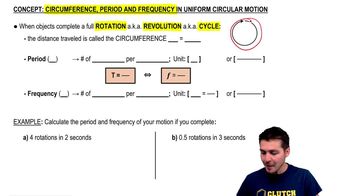
Frequency, measured in Hertz (Hz), is the number of oscillations per second in SHM. The period is the time taken for one complete cycle of motion and is the inverse of frequency. In this problem, the frequency is given as 4.00 Hz, which helps determine the period and subsequently the time taken for specific displacements.
추천 영상:
가이드 코스
05:08
Circumference, Period, and Frequency in UCM

Phase and Displacement in SHM

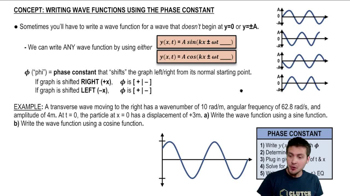
In SHM, the phase determines the position and direction of motion at any given time. The displacement is the distance from the equilibrium position. For this problem, understanding how the phase relates to displacement allows us to calculate the time taken for the part to move from x = 0 to x = -1.80 cm, considering the amplitude and frequency.
추천 영상:
가이드 코스
08:59
Phase Constant of a Wave Function
관련 실천
교과서 질문

A 2.40-kg ball is attached to an unknown spring and allowed to oscillate. Figure E14.7 shows a graph of the ball's position x as a function of time t. What are the oscillation's (a) period, (b) frequency, (c) angular frequency, and (d) amplitude? (e) What is the force constant of the spring?

1569
views
교과서 질문

The displacement of an oscillating object as a function of time is shown in Fig. E14.4. What is (c) the period? (d) the angular frequency of this motion?

2745
views
교과서 질문

A 2.40-kg ball is attached to an unknown spring and allowed to oscillate. Figure E14.7 shows a graph of the ball's position x as a function of time t. What are the oscillation's (a) period, (b) frequency, (c) angular frequency, and (d) amplitude? (e) What is the force constant of the spring?

1998
views
교과서 질문

The wings of the blue-throated hummingbird (Lampornis clemenciae), which inhabits Mexico and the southwestern United States, beat at a rate of up to 900 times per minute. Calculate (a) the period of vibration of this bird's wings, (b) the frequency of the wings' vibration, and (c) the angular frequency of the bird's wing beats.

1151
views
교과서 질문

Music. When a person sings, his or her vocal cords vibrate in a repetitive pattern that has the same frequency as the note that is sung. If someone sings the note B flat, which has a frequency of 466 Hz, how much time does it take the person's vocal cords to vibrate through one complete cycle, and what is the angular frequency of the cords?

1215
views
교과서 질문

The displacement of an oscillating object as a function of time is shown in Fig. E14.4. What is (a) the frequency? (b) the amplitude?

2419
views