Ch 14: Periodic Motion
Young & Freedman Calc - University Physics 14th Edition
Young & Freedman Calc14th EditionUniversity PhysicsISBN: 9780321973610당신이 사용하는 게 아니라요?교과서 변경
14장, 문제 4ab

The displacement of an oscillating object as a function of time is shown in Fig. E14.4. What is (a) the frequency? (b) the amplitude?
Graph depicting the displacement of an oscillating object over time in simple harmonic motion.

검증된 단계별 안내
1
To find the amplitude, observe the maximum displacement from the equilibrium position on the graph. The amplitude is the distance from the center line to the peak of the wave.
To determine the period, identify the time it takes for the wave to complete one full cycle. This can be measured by finding the time interval between two consecutive peaks or troughs.
The frequency is the reciprocal of the period. Use the formula \( f = \frac{1}{T} \), where \( T \) is the period.
The angular frequency can be calculated using the formula \( \omega = 2\pi f \), where \( f \) is the frequency.
Verify each calculation by cross-referencing the values obtained from the graph to ensure consistency and accuracy.

비슷한 문제에 대한 검증된 영상 답변:

이 영상 해법은 위 문제에 도움이 된다고 튜터들이 추천한 것입니다.
영상 길이:
3m
도움이 되었나요?

주요 개념

질문에 올바르게 답하기 위해 반드시 이해해야 하는 핵심 개념들은 다음과 같습니다.

Frequency

Frequency is the number of complete cycles of oscillation that occur in a unit of time, typically measured in hertz (Hz). In the context of the graph, it can be determined by identifying the time period of one complete oscillation and taking the reciprocal of that period. For example, if one cycle takes 10 seconds, the frequency would be 0.1 Hz.
추천 영상:
가이드 코스
05:08
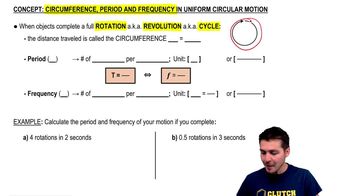
Circumference, Period, and Frequency in UCM

Amplitude

Amplitude refers to the maximum displacement of an oscillating object from its equilibrium position. In the provided graph, the amplitude can be identified as the maximum value of displacement, which is the peak height of the wave. For instance, if the graph reaches a maximum of 10 cm and a minimum of -10 cm, the amplitude is 10 cm.
추천 영상:
가이드 코스
04:24
Amplitude Decay in an LRC Circuit

Simple Harmonic Motion (SHM)

Simple Harmonic Motion is a type of periodic motion where the restoring force is directly proportional to the displacement from the equilibrium position and acts in the opposite direction. This motion is characterized by a sinusoidal displacement-time graph, like the one shown. Understanding SHM is crucial for analyzing the frequency and amplitude of oscillating systems.
추천 영상:
가이드 코스
07:52
Simple Harmonic Motion of Pendulums