Ch 23: Electric Potential
Young & Freedman Calc - University Physics 14th Edition
Young & Freedman Calc14th EditionUniversity PhysicsISBN: 9780321973610당신이 사용하는 게 아니라요?교과서 변경
23장, 문제 5a

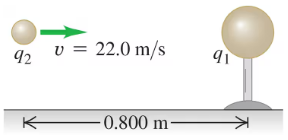
A small metal sphere, carrying a net charge of q1=2.80q_1 = -2.80 μC, is held in a stationary position by insulat­ing supports. A second small metal sphere, with a net charge of q2=7.80q_2 = -7.80 μC and mass 1.501.50 g, is projected toward q1q_1. When the two spheres are 0.8000.800 m apart, q2q_2, is moving toward q1q_1 with speed 22.022.0 m/s (Fig. E23.523.5). Assume that the two spheres can be treated as point charges. You can ignore the force of gravity. What is the speed of q2q_2 when the spheres are 0.4000.400 m apart?

검증된 단계별 안내
1
Identify the problem as a conservation of energy problem involving electric potential energy and kinetic energy. The initial and final states of the system need to be considered.
Write the expression for the initial total energy of the system when the spheres are 0.800 m apart. This includes the initial kinetic energy of q_2 and the initial electric potential energy between the two charges. Use the formula for kinetic energy: Ki=12mv2 and the formula for electric potential energy: Ui=kq1q2r, where k is Coulomb's constant and r is the distance between the charges.
Write the expression for the final total energy of the system when the spheres are 0.400 m apart. This includes the final kinetic energy of q_2 and the final electric potential energy between the two charges. Use the same formulas for kinetic and potential energy as in the previous step, but with the updated distance.
Apply the conservation of energy principle, which states that the initial total energy is equal to the final total energy. Set the initial energy expression equal to the final energy expression: Ki+Ui=Kf+Uf.
Solve the equation for the final speed of q_2, vf. Rearrange the equation to isolate vf and substitute the known values for mass, initial speed, charges, and distances to find the final speed.

비슷한 문제에 대한 검증된 영상 답변:

이 영상 해법은 위 문제에 도움이 된다고 튜터들이 추천한 것입니다.
영상 길이:
11m
도움이 되었나요?

주요 개념

질문에 올바르게 답하기 위해 반드시 이해해야 하는 핵심 개념들은 다음과 같습니다.

Coulomb's Law

Coulomb's Law describes the electrostatic force between two point charges. It states that the force is directly proportional to the product of the magnitudes of the charges and inversely proportional to the square of the distance between them. This law is essential for calculating the force acting on the charges as they move closer together.
추천 영상:

Conservation of Energy

The principle of conservation of energy states that the total energy in an isolated system remains constant. In this scenario, the kinetic energy and electric potential energy of the system must be considered. As the spheres move closer, potential energy is converted into kinetic energy, affecting the speed of the moving charge.
추천 영상:
가이드 코스
06:24
Conservation Of Mechanical Energy

Electric Potential Energy

Electric potential energy is the energy a charge possesses due to its position in an electric field. It is calculated using the formula U = k * q1 * q2 / r, where k is Coulomb's constant, q1 and q2 are the charges, and r is the distance between them. Understanding this concept is crucial for determining how the potential energy changes as the distance between the charges decreases.
추천 영상:
가이드 코스
07:51
Electric Potential Energy
관련 실천
교과서 질문

Two protons, starting several meters apart, are aimed directly at each other with speeds of 2.00×1052.00\(\times\)10^5 m/s, measured relative to the earth. Find the maximum electric force that these protons will exert on each other.

2471
views
1
rank

교과서 질문

Two protons are released from rest when they are 0.7500.750 nm apart. What is the maximum acceleration they will achieve and when does this acceleration occur?

3694
views
1
rank
1
comments
교과서 질문

A small particle has charge 5.00-5.00 μμC and mass 2.00×1042.00\(\times\)10^{-4} kg. It moves from point AA, where the electric potential is VA=+200V_A = +200 V, to point BB, where the electric potential is VB=+800V_B = +800 V. The electric force is the only force acting on the particle. The particle has speed 5.005.00 m/s at point AA. What is its speed at point BB? Is it moving faster or slower at BB than at AA? Explain.

3734
views
교과서 질문

How much work would it take to push two protons very slowly from a separation of 2.00×10102.00\(\times\)10^{-10} m (a typical atomic distance) to 3.00×10153.00\(\times\)10^{-15} m (a typical nuclear distance)? If the protons are both released from rest at the closer distance in part (a), how fast are they moving when they reach their original separation?

4214
views
교과서 질문

A point charge q1=+2.40q_1=+2.40 μμC is held stationary at the origin. A second point charge q2=4.30q_2=-4.30 μμC moves from the point x=0.150x=0.150 m, y=0y=0 to the point x=0.250x=0.250 m, y=0.250y=0.250 m. How much work is done by the electric force on q2q_2?

3488
views
1
rank