

Ch 18: Thermal Properties of Matter
Young & Freedman Calc - University Physics 14th Edition
Young & Freedman Calc14th EditionUniversity PhysicsISBN: 9780321973610당신이 사용하는 게 아니라요?교과서 변경
18장, 문제 35

At what temperature is the root-mean-square speed of nitrogen molecules equal to the root-mean-square speed of hydrogen molecules at 20.020.0°C? (Hint: Appendix D shows the molar mass (in g/mol) of each element under the chemical symbol for that element. The molar mass of H2 is twice the molar mass of hydrogen atoms, and similarly for N2.)

검증된 단계별 안내
1
First, understand the concept of root-mean-square speed (v_rms) for gas molecules, which is given by the formula: 3kTm, where k is the Boltzmann constant, T is the temperature in Kelvin, and m is the mass of a molecule.
Next, convert the given temperature of hydrogen molecules from Celsius to Kelvin using the formula: T=TC+273.15. For hydrogen at 20.0°C, this becomes 293.15 K.
Determine the molar mass of nitrogen (N2) and hydrogen (H2) using Appendix D. The molar mass of nitrogen atoms is approximately 14 g/mol, so for N2 it is 28 g/mol. The molar mass of hydrogen atoms is approximately 1 g/mol, so for H2 it is 2 g/mol.
Set up the equation for the root-mean-square speed equality: 3kTNmN = 3k293.15mH, where TN is the temperature of nitrogen molecules, mN is the mass of a nitrogen molecule, and mH is the mass of a hydrogen molecule.
Solve for TN by equating the expressions and simplifying: TN=mNmH×293.15. Substitute the known values for mN and mH to find the temperature at which the root-mean-square speeds are equal.

비슷한 문제에 대한 검증된 영상 답변:

이 영상 해법은 위 문제에 도움이 된다고 튜터들이 추천한 것입니다.
영상 길이:
4m
도움이 되었나요?

주요 개념

질문에 올바르게 답하기 위해 반드시 이해해야 하는 핵심 개념들은 다음과 같습니다.

Root-Mean-Square Speed

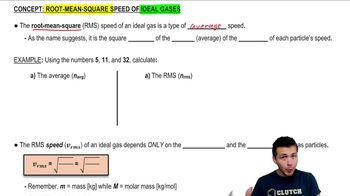
The root-mean-square speed is a measure of the average speed of particles in a gas, derived from the kinetic theory of gases. It is calculated using the formula v_rms = sqrt(3kT/m), where k is the Boltzmann constant, T is the temperature in Kelvin, and m is the mass of a molecule. This concept helps compare the speeds of different gas molecules at varying temperatures.
추천 영상:
05:21
Root-Mean-Square Speed of Ideal Gases

Molar Mass

Molar mass is the mass of one mole of a substance, typically expressed in grams per mole (g/mol). It is crucial for calculating the mass of individual molecules, which is needed to determine their root-mean-square speed. For diatomic molecules like H2 and N2, the molar mass is twice that of the individual atoms, reflecting the combined mass of the two atoms in the molecule.
추천 영상:
20:32
Mass Spectrometers

Temperature Conversion

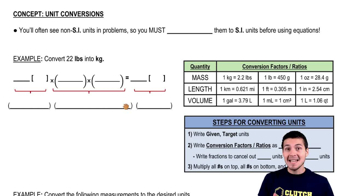
Temperature conversion is essential for calculations involving the kinetic theory of gases, as temperatures must be in Kelvin. To convert from Celsius to Kelvin, add 273.15 to the Celsius temperature. This conversion ensures that the temperature is in the correct unit for use in the root-mean-square speed formula, allowing for accurate comparisons between different gases.
추천 영상:
07:46
Unit Conversions
관련 실천
교과서 질문

Smoke particles in the air typically have masses of the order of 101610^{-16} kg. The Brownian motion (rapid, irregular movement) of these particles, resulting from collisions with air molecules, can be observed with a microscope. Find the root-mean-square speed of Brownian motion for a particle with a mass of 3.00×10163.00\(\times\)10^{-16} kg in air at 300300 K.

2797
views
교과서 질문

Oxygen (O2) has a molar mass of 32.0 32.0 g/mol. Suppose an oxygen molecule traveling at this speed bounces back and forth between opposite sides of a cubical vessel 0.100.10 m on a side. What is the average force the molecule exerts on one of the walls of the container? (Assume that the molecule's velocity is perpendicular to the two sides that it strikes.)

1904
views
교과서 질문

Oxygen (O2) has a molar mass of 32.032.0 g/mol. How many oxygen molecules traveling at this speed are necessary to produce an average pressure of 11 atm?

2794
views
교과서 질문

How much heat does it take to increase the temperature of 1.801.80 mol of an ideal gas by 50.050.0 K near room temperature if the gas is held at constant volume and is diatomic?

2051
views
교과서 질문

How much heat does it take to increase the temperature of 1.801.80 mol of an ideal gas by 50.050.0 K near room temperature if the gas is held at constant volume and is monatomic?

1663
views
교과서 질문

Calculate the mean free path of air molecules at 3.50×10133.50\(\times\)10^{-13} atm and 300300 K. (This pressure is readily attainable in the laboratory; see Exercise 18.2318.23.) As in Example 18.818.8, model the air molecules as spheres of radius 2.0×10102.0\(\times\)10^{-10} m.

3012
views