
Ch 18: Thermal Properties of Matter
Young & Freedman Calc - University Physics 14th Edition
Young & Freedman Calc14th EditionUniversity PhysicsISBN: 9780321973610당신이 사용하는 게 아니라요?교과서 변경
18장, 문제 37b

How much heat does it take to increase the temperature of 1.801.80 mol of an ideal gas by 50.050.0 K near room temperature if the gas is held at constant volume and is monatomic?

검증된 단계별 안내
1
Identify the formula for calculating the heat required to change the temperature of an ideal gas at constant volume. The formula is: Q = nCvΔT, where Q is the heat added, n is the number of moles, Cv is the molar heat capacity at constant volume, and ΔT is the change in temperature.
Determine the molar heat capacity at constant volume for a monatomic ideal gas. For a monatomic gas, Cv = rac{3}{2}R, where R is the universal gas constant, approximately 8.314 J/(mol·K).
Substitute the given values into the formula. You have n = 1.80 mol, ΔT = 50.0 K, and Cv = rac{3}{2}R. The equation becomes: Q = 1.80 imes rac{3}{2} imes 8.314 imes 50.0.
Perform the multiplication step by step. First, calculate rac{3}{2} imes 8.314, then multiply the result by 1.80, and finally multiply by 50.0.
Ensure the units are consistent throughout the calculation. The result will be in joules (J), as the universal gas constant R is in J/(mol·K) and the temperature change is in Kelvin (K).

비슷한 문제에 대한 검증된 영상 답변:

이 영상 해법은 위 문제에 도움이 된다고 튜터들이 추천한 것입니다.
영상 길이:
1m

주요 개념

질문에 올바르게 답하기 위해 반드시 이해해야 하는 핵심 개념들은 다음과 같습니다.

Ideal Gas Law

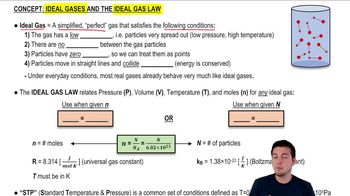
The Ideal Gas Law is a fundamental equation in thermodynamics that relates the pressure, volume, temperature, and number of moles of an ideal gas. It is expressed as PV = nRT, where P is pressure, V is volume, n is the number of moles, R is the ideal gas constant, and T is temperature. This law helps in understanding the behavior of gases under different conditions.
추천 영상:
가이드 코스
07:21
Ideal Gases and the Ideal Gas Law

Specific Heat Capacity at Constant Volume (Cv)

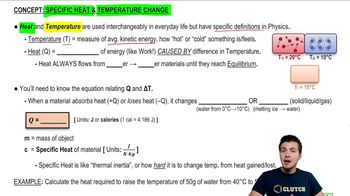
Specific heat capacity at constant volume (Cv) is the amount of heat required to raise the temperature of a unit quantity of a substance by one degree Celsius while keeping the volume constant. For a monatomic ideal gas, Cv is given by (3/2)R, where R is the ideal gas constant. This concept is crucial for calculating the heat needed to change the temperature of a gas at constant volume.
추천 영상:
가이드 코스
06:50
Specific Heat & Temperature Changes

Heat Transfer in Thermodynamics

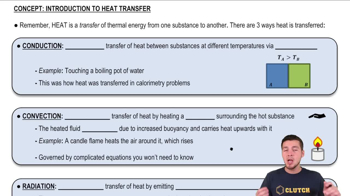
Heat transfer in thermodynamics refers to the process of energy exchange between systems due to temperature difference. In the context of gases, the heat transferred can be calculated using the formula Q = nCvΔT, where Q is the heat added, n is the number of moles, Cv is the specific heat capacity at constant volume, and ΔT is the change in temperature. This formula is essential for determining the heat required to change the temperature of a gas.
추천 영상:
가이드 코스
05:14
Overview of Heat Transfer