Ch 19: The First Law of Thermodynamics
Young & Freedman Calc - University Physics 14th Edition
Young & Freedman Calc14th EditionUniversity PhysicsISBN: 9780321973610당신이 사용하는 게 아니라요?교과서 변경
19장, 문제 6b

A gas undergoes two processes. In the first, the volume remains constant at 0.2000.200 m3 and the pressure increases from 2.00×1052.00\(\times\)10^5 Pa to 5.00×1055.00\(\times\)10^5 Pa. The second process is a compression to a volume of 0.1200.120 m3 at a constant pressure of 5.00×1055.00\(\times\)10^5 Pa. Find the total work done by the gas during both processes.

검증된 단계별 안내
1
Understand that work done by a gas is given by the formula \( W = P \Delta V \), where \( P \) is the pressure and \( \Delta V \) is the change in volume. For a process at constant volume, \( \Delta V = 0 \), so the work done is zero.
In the first process, since the volume remains constant at 0.200 m^3, the work done by the gas is zero because \( \Delta V = 0 \).
In the second process, the gas is compressed at a constant pressure of 5.00 * 10^5 Pa from a volume of 0.200 m^3 to 0.120 m^3. Calculate the change in volume: \( \Delta V = V_{final} - V_{initial} = 0.120 \text{ m}^3 - 0.200 \text{ m}^3 \).
Substitute the values into the work formula for the second process: \( W = P \Delta V = 5.00 \times 10^5 \text{ Pa} \times (0.120 \text{ m}^3 - 0.200 \text{ m}^3) \).
Add the work done in both processes to find the total work done by the gas. Since the work done in the first process is zero, the total work done is just the work from the second process.

비슷한 문제에 대한 검증된 영상 답변:

이 영상 해법은 위 문제에 도움이 된다고 튜터들이 추천한 것입니다.
영상 길이:
6m
도움이 되었나요?

주요 개념

질문에 올바르게 답하기 위해 반드시 이해해야 하는 핵심 개념들은 다음과 같습니다.

Work Done by a Gas

In thermodynamics, the work done by a gas during a process is calculated using the formula W = PΔV, where W is the work, P is the pressure, and ΔV is the change in volume. For processes at constant volume, the work done is zero because there is no change in volume. Understanding this concept is crucial for calculating work in different thermodynamic processes.
추천 영상:
가이드 코스
03:47
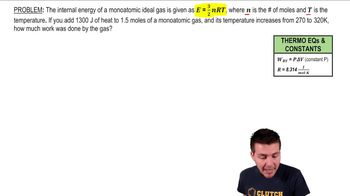
Calculating Work Done on Monoatomic Gas

Isobaric Process

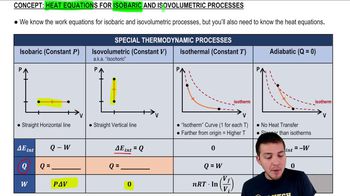
An isobaric process is a thermodynamic process in which the pressure remains constant. During such a process, the work done by or on the gas can be calculated using the formula W = P(V2 - V1), where V2 and V1 are the final and initial volumes, respectively. This concept is essential for determining the work done during the compression phase of the question.
추천 영상:
가이드 코스
06:44
Heat Equations for Isobaric & Isovolumetric Processes

Isochoric Process

An isochoric process is a thermodynamic process where the volume remains constant. In this type of process, no work is done by the gas because work is a function of volume change (W = PΔV), and ΔV is zero. Understanding this concept helps in recognizing that the first process in the question does not contribute to the total work done.
추천 영상:
가이드 코스
08:45
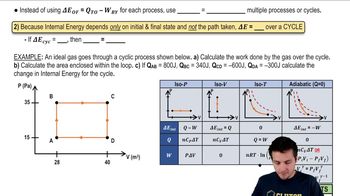
Properties of Cyclic Thermodynamic Processes
관련 실천
교과서 질문

A gas in a cylinder expands from a volume of 0.1100.110 m3 to 0.3200.320 m3 . Heat flows into the gas just rapidly enough to keep the pressure constant at 1.65×1051.65\(\times\)10^5 Pa during the expansion. The total heat added is 1.15×1051.15\(\times\)10^5 J. Find the work done by the gas.

1752
views

교과서 질문

The graph in Fig. E19.419.4 shows a pVpV-diagram of the air in a human lung when a person is inhaling and then exhaling a deep breath. Such graphs, obtained in clinical practice, are normally somewhat curved, but we have modeled one as a set of straight lines of the same general shape. (Important: The pressure shown is the gauge pressure, not the absolute pressure.) The process illustrated here is somewhat different from those we have been studying, because the pressure change is due to changes in the amount of gas in the lung, not to temperature changes. (Think of your own breathing. Your lungs do not expand because they've gotten hot.) If the temperature of the air in the lung remains a reasonable 20 20°C, what is the maximum number of moles in this person's lung during a breath?

2075
views
교과서 질문

Figure E19.819.8 shows a pVpV-diagram for an ideal gas in which its absolute temperature at bb is one-fourth of its absolute temperature at aa. Did heat enter or leave the gas from aa to bb? How do you know?

2562
views
교과서 질문

In Fig. 19.719.7a, consider the closed loop 132411 → 3 → 2 → 4 → 1. This is a cyclic process in which the initial and final states are the same. Find the total work done by the system in this cyclic process, and show that it is equal to the area enclosed by the loop.

3816
views
교과서 질문

A gas undergoes two processes. In the first, the volume remains constant at 0.2000.200 m3 and the pressure increases from 2.00×1052.00\(\times\)10^5 Pa to 5.00×1055.00\(\times\)10^5 Pa. The second process is a compression to a volume of 0.1200.120 m3 at a constant pressure of 5.00×1055.00\(\times\)10^5 Pa. In a pVpV-diagram, show both processes.

1457
views
교과서 질문

The graph in Fig. E19.419.4 shows a pVpV-diagram of the air in a human lung when a person is inhaling and then exhaling a deep breath. Such graphs, obtained in clinical practice, are normally somewhat curved, but we have modeled one as a set of straight lines of the same general shape. (Important: The pressure shown is the gauge pressure, not the absolute pressure.) How many joules of net work does this person's lung do during one complete breath?

410
views