

Ch 25: Current, Resistance, and EMF
Young & Freedman Calc - University Physics 14th Edition
Young & Freedman Calc14th EditionUniversity PhysicsISBN: 9780321973610당신이 사용하는 게 아니라요?교과서 변경
25장, 문제 33a

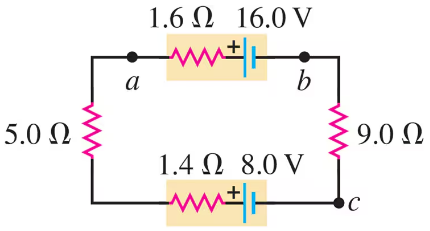
The circuit shown in Fig. E25.3325.33 contains two batteries, each with an emf and an internal resistance, and two resistors. Find the current in the circuit (magnitude and direction).
Circuit diagram with two batteries, internal resistances, and resistors: 1.6Ω, 16V; 1.4Ω, 8V; 5Ω; 9Ω.

검증된 단계별 안내
1
Identify the components in the circuit: two batteries with emfs of 9.5 V and 4.5 V, internal resistances of 1.8 Ω and 1.2 Ω, and two external resistors of 6.5 Ω and 5.5 Ω.
Apply Kirchhoff's loop rule to the circuit. Start at one point in the loop and move around the circuit, adding the potential differences across each component. The sum of the potential differences in a closed loop is zero.
Write the equation for the loop: 9.5 V - I(1.8 Ω) - I(6.5 Ω) - 4.5 V - I(1.2 Ω) - I(5.5 Ω) = 0, where I is the current in the circuit.
Combine the terms to simplify the equation: 9.5 V - 4.5 V - I(1.8 Ω + 6.5 Ω + 1.2 Ω + 5.5 Ω) = 0.
Solve for the current I by isolating it on one side of the equation: I = (9.5 V - 4.5 V) / (1.8 Ω + 6.5 Ω + 1.2 Ω + 5.5 Ω). This will give you the magnitude of the current. The direction of the current is determined by the direction of the net emf, which is from the 9.5 V battery to the 4.5 V battery.

비슷한 문제에 대한 검증된 영상 답변:

이 영상 해법은 위 문제에 도움이 된다고 튜터들이 추천한 것입니다.
영상 길이:
5m
도움이 되었나요?

주요 개념

질문에 올바르게 답하기 위해 반드시 이해해야 하는 핵심 개념들은 다음과 같습니다.

Kirchhoff's Loop Rule

Kirchhoff's Loop Rule states that the sum of the electromotive forces (emfs) and potential differences (voltage drops) around any closed loop in a circuit must equal zero. This principle is essential for analyzing circuits with multiple loops and components, allowing us to set up equations to solve for unknown quantities like current. In the given circuit, applying this rule helps determine the current by accounting for the emfs and resistances present.
추천 영상:
11:15
Intro to Kirchhoff's Loop Rule

Ohm's Law

Ohm's Law is a fundamental principle in electronics that relates voltage (V), current (I), and resistance (R) in a circuit through the equation V = IR. This law is crucial for calculating the voltage drop across resistors and understanding how current flows through the circuit. In the context of the given circuit, Ohm's Law helps determine the current by considering the total resistance and the net voltage provided by the batteries.
추천 영상:
가이드 코스
03:07
Resistance and Ohm's Law

Internal Resistance of Batteries

Internal resistance is the inherent resistance within a battery that affects its ability to deliver current. It causes a voltage drop inside the battery, reducing the effective voltage available to the external circuit. Understanding internal resistance is vital for accurately calculating the current in circuits with batteries, as it impacts the total resistance and the net voltage applied. In the given circuit, each battery's internal resistance must be considered to find the correct current magnitude and direction.
추천 영상:
가이드 코스
04:54
Total Internal Energy