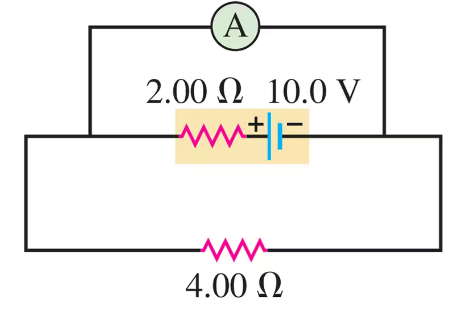
The circuit shown in Fig. E contains two batteries, each with an emf and an internal resistance, and two resistors. Find the current in the circuit (magnitude and direction).
Ch 25: Current, Resistance, and EMF
25장, 문제 28b
An idealized ammeter is connected to a battery as shown in Fig. E. Find the current through the - resistor.

검증된 단계별 안내1
Identify the components in the circuit: a 9.0 V battery, a 6.0 Ω resistor, a 10.0 Ω resistor, and an ideal ammeter. The ammeter is connected in parallel with the 10.0 Ω resistor.
Apply Ohm's Law, which states that V = I * R, to find the total current in the circuit. First, calculate the equivalent resistance of the circuit. Since the ammeter is ideal, it does not affect the circuit's resistance.
Calculate the equivalent resistance of the circuit. The 6.0 Ω resistor is in series with the parallel combination of the 10.0 Ω resistor and the ammeter. The equivalent resistance of the parallel section is the same as the 10.0 Ω resistor because the ammeter is ideal.
Add the resistance of the 6.0 Ω resistor to the equivalent resistance of the parallel section to find the total resistance in the circuit: R_total = 6.0 Ω + 10.0 Ω.
Use Ohm's Law to find the total current supplied by the battery: I_total = V / R_total, where V is the battery voltage (9.0 V) and R_total is the total resistance calculated in the previous step.

비슷한 문제에 대한 검증된 영상 답변:
이 영상 해법은 위 문제에 도움이 된다고 튜터들이 추천한 것입니다.
영상 길이:
2m도움이 되었나요?
주요 개념
질문에 올바르게 답하기 위해 반드시 이해해야 하는 핵심 개념들은 다음과 같습니다.
Ohm's Law
Ohm's Law is a fundamental principle in electronics and physics that relates voltage (V), current (I), and resistance (R) in an electrical circuit. It is expressed by the equation V = IR, indicating that the voltage across a resistor is the product of the current flowing through it and its resistance. This law is essential for calculating the current in the circuit when the voltage and resistance are known.
추천 영상:
가이드 코스
Resistance and Ohm's Law
Series and Parallel Circuits
In a series circuit, components are connected end-to-end, so the same current flows through each component. In a parallel circuit, components are connected across the same voltage source, allowing the current to divide among the paths. Understanding these configurations is crucial for analyzing the circuit in the image, as it helps determine how the total resistance and current are distributed.
추천 영상:
가이드 코스
Combining Capacitors in Series & Parallel
Kirchhoff's Voltage Law
Kirchhoff's Voltage Law states that the sum of the electrical potential differences (voltage) around any closed network is zero. This principle is used to analyze complex circuits by ensuring that the total voltage supplied by the battery is equal to the sum of the voltage drops across each component in the loop. It is vital for solving the circuit problem presented in the image.
추천 영상:
가이드 코스
Kirchhoff's Junction Rule
관련 실천
교과서 질문
1590
views
교과서 질문
A copper transmission cable km long and cm in diameter carries a current of A. How much electrical energy is dissipated as thermal energy every hour?
2090
views
교과서 질문
An idealized ammeter is connected to a battery as shown in Fig. E. Find the reading of the ammeter.
2581
views
교과서 질문
The circuit shown in Fig. E contains two batteries, each with an emf and an internal resistance, and two resistors. Find the potential difference of point with respect to point .
1974
views
교과서 질문
An idealized ammeter is connected to a battery as shown in Fig. E. Find the terminal voltage of the battery.
1813
views
교과서 질문
What is the resistance of a carbon rod at °C if its resistance is at °C?
1894
views