
Ch 20: The Second Law of Thermodynamics
Young & Freedman Calc - University Physics 14th Edition
Young & Freedman Calc14th EditionUniversity PhysicsISBN: 9780321973610당신이 사용하는 게 아니라요?교과서 변경
20장, 문제 12c

A Carnot engine is operated between two heat reservoirs at temperatures of 520520 K and 300300 K. What is the thermal efficiency of the engine?

검증된 단계별 안내
1
Understand the concept of a Carnot engine: A Carnot engine is an idealized heat engine that operates between two heat reservoirs and has the maximum possible efficiency. The efficiency of a Carnot engine depends only on the temperatures of the two reservoirs.
Identify the temperatures of the heat reservoirs: In this problem, the high-temperature reservoir (T₁) is at 520 K, and the low-temperature reservoir (T₂) is at 300 K.
Recall the formula for the thermal efficiency of a Carnot engine: The efficiency (η) is given by the equation η = 1 - (T₂/T₁), where T₁ is the temperature of the hot reservoir and T₂ is the temperature of the cold reservoir.
Substitute the given temperatures into the efficiency formula: Replace T₁ with 520 K and T₂ with 300 K in the equation η = 1 - (T₂/T₁).
Simplify the expression: Perform the division and subtraction to find the efficiency in decimal form, which can be converted to a percentage by multiplying by 100.

비슷한 문제에 대한 검증된 영상 답변:

이 영상 해법은 위 문제에 도움이 된다고 튜터들이 추천한 것입니다.
영상 길이:
4m
도움이 되었나요?

주요 개념

질문에 올바르게 답하기 위해 반드시 이해해야 하는 핵심 개념들은 다음과 같습니다.

Carnot Engine

A Carnot engine is a theoretical thermodynamic cycle that is considered the most efficient possible engine. It operates between two heat reservoirs, absorbing heat from the high-temperature reservoir and expelling heat to the low-temperature reservoir, while performing work. The efficiency of a Carnot engine depends solely on the temperatures of these reservoirs.
추천 영상:
가이드 코스
03:56
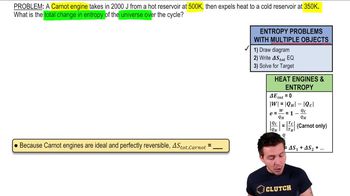
Entropy of Carnot Engine

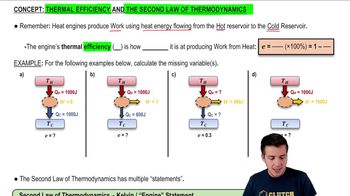
Thermal Efficiency

Thermal efficiency is a measure of how well an engine converts heat into work. For a Carnot engine, it is calculated using the formula: efficiency = 1 - (T_cold/T_hot), where T_cold and T_hot are the absolute temperatures of the cold and hot reservoirs, respectively. This formula shows that efficiency increases as the temperature difference between the reservoirs increases.
추천 영상:
가이드 코스
06:01
Thermal Efficiency & The Second Law of Thermodynamics

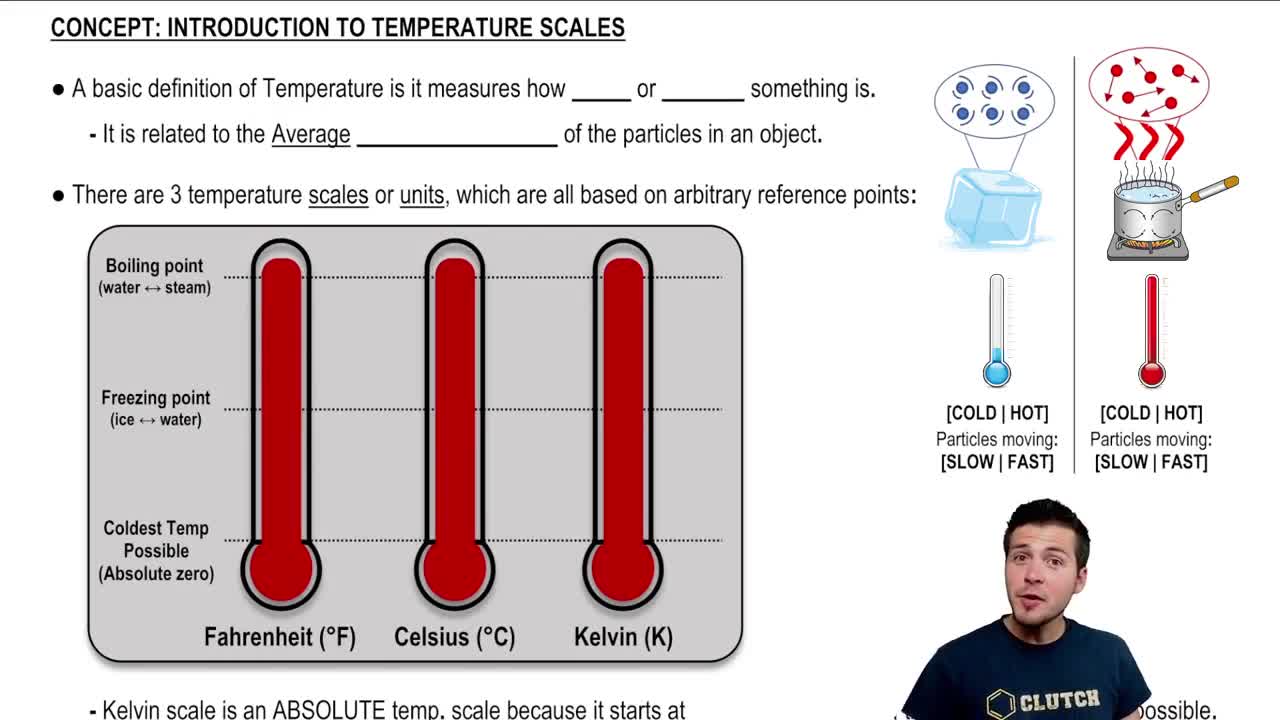
Absolute Temperature

Absolute temperature is measured in Kelvin, which is the SI unit for temperature. It starts at absolute zero, the point where all molecular motion ceases. In thermodynamics, using Kelvin is crucial because it allows for direct calculations of efficiency and other properties without negative values, ensuring accurate and meaningful results.
추천 영상:
가이드 코스
04:54
Introduction To Temperature Scales
관련 실천
교과서 질문

A Carnot refrigerator is operated between two heat reservoirs at temperatures of 320320 K and 270270 K. If in each cycle the refrigerator receives 415415 J of heat energy from the reservoir at 270270 K, how many joules of heat energy does it deliver to the reservoir at 320320 K?

1859
views
교과서 질문

A certain brand of freezer is advertised to use 730730 kWh of energy per year. What is the theoretical maximum amount of ice this freezer could make in an hour, starting with water at 20.020.0°C?

2790
views
교과서 질문

A Carnot engine is operated between two heat reservoirs at temperatures of 520520 K and 300300 K. How much mechanical work is performed by the engine during each cycle?

2225
views
교과서 질문

A Carnot engine is operated between two heat reservoirs at temperatures of 520520 K and 300300 K. If the engine receives 6.456.45 kJ of heat energy from the reservoir at 520520 K in each cycle, how many joules per cycle does it discard to the reservoir at 300300 K?

2949
views
교과서 질문

A certain brand of freezer is advertised to use 730730 kWh of energy per year. Assuming the freezer operates for 55 hours each day, how much power does it require while operating?

1923
views
교과서 질문

A refrigerator has a coefficient of performance of 2.252.25, runs on an input of 135135 W of electrical power, and keeps its inside compartment at 55°C. If you put a dozen 1.01.0-L plastic bottles of water at 3131°C into this refrigerator, how long will it take for them to be cooled down to 5 5°C? (Ignore any heat that leaves the plastic.)

3750
views