Ch 20: The Second Law of Thermodynamics
Young & Freedman Calc - University Physics 14th Edition
Young & Freedman Calc14th EditionUniversity PhysicsISBN: 9780321973610당신이 사용하는 게 아니라요?교과서 변경
20장, 문제 17a

A Carnot refrigerator is operated between two heat reservoirs at temperatures of 320320 K and 270270 K. If in each cycle the refrigerator receives 415415 J of heat energy from the reservoir at 270270 K, how many joules of heat energy does it deliver to the reservoir at 320320 K?

검증된 단계별 안내
1
Understand the concept of a Carnot refrigerator: A Carnot refrigerator is a theoretical model that operates on the Carnot cycle, which is the most efficient cycle possible for a heat engine or refrigerator. It involves two heat reservoirs at different temperatures.
Identify the given values: The temperatures of the reservoirs are 320 K (hot reservoir) and 270 K (cold reservoir). The heat energy received from the cold reservoir is 415 J.
Recall the formula for the efficiency of a Carnot refrigerator: The efficiency (η) is given by η = 1 - (T_cold / T_hot), where T_cold and T_hot are the temperatures of the cold and hot reservoirs, respectively.
Calculate the efficiency using the given temperatures: Substitute T_cold = 270 K and T_hot = 320 K into the efficiency formula to find the efficiency of the Carnot refrigerator.
Use the efficiency to find the heat energy delivered to the hot reservoir: The work done (W) by the refrigerator is the difference between the heat energy delivered to the hot reservoir (Q_hot) and the heat energy received from the cold reservoir (Q_cold). Use the relation Q_hot = Q_cold + W, and the efficiency formula to express W in terms of Q_cold and solve for Q_hot.

비슷한 문제에 대한 검증된 영상 답변:

이 영상 해법은 위 문제에 도움이 된다고 튜터들이 추천한 것입니다.
영상 길이:
3m
도움이 되었나요?

주요 개념

질문에 올바르게 답하기 위해 반드시 이해해야 하는 핵심 개념들은 다음과 같습니다.

Carnot Cycle

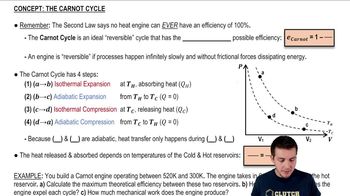
The Carnot cycle is a theoretical thermodynamic cycle that provides the maximum possible efficiency for a heat engine or refrigerator operating between two temperatures. It consists of two isothermal processes and two adiabatic processes. For a refrigerator, it describes the idealized process of transferring heat from a colder to a warmer reservoir.
추천 영상:
가이드 코스
06:28
The Carnot Cycle and Maximum Theoretical Efficiency

Coefficient of Performance (COP)

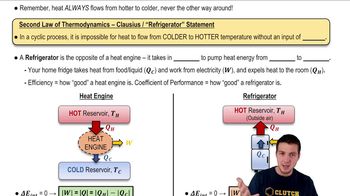
The Coefficient of Performance (COP) of a refrigerator is a measure of its efficiency, defined as the ratio of the heat removed from the cold reservoir to the work input required. For a Carnot refrigerator, the COP is given by the formula COP = T_c / (T_h - T_c), where T_c and T_h are the absolute temperatures of the cold and hot reservoirs, respectively.
추천 영상:

First Law of Thermodynamics

The First Law of Thermodynamics, also known as the law of energy conservation, states that energy cannot be created or destroyed, only transformed. In the context of a refrigerator, it implies that the work input plus the heat extracted from the cold reservoir equals the heat delivered to the hot reservoir. This principle is crucial for calculating energy exchanges in thermodynamic cycles.
추천 영상:
가이드 코스
08:04
The First Law of Thermodynamics