
Ch 20: The Second Law of Thermodynamics
Young & Freedman Calc - University Physics 14th Edition
Young & Freedman Calc14th EditionUniversity PhysicsISBN: 9780321973610당신이 사용하는 게 아니라요?교과서 변경
20장, 문제 1a

A diesel engine performs 22002200 J of mechanical work and discards 43004300 J of heat each cycle. How much heat must be supplied to the engine in each cycle?

검증된 단계별 안내
1
Understand the problem: We need to find out how much heat is supplied to the diesel engine in each cycle. We know the engine performs 2200 J of mechanical work and discards 4300 J of heat.
Recall the first law of thermodynamics, which states that the change in internal energy (ΔU) of a system is equal to the heat added to the system (Q) minus the work done by the system (W): ΔU = Q - W.
In a cyclic process, the change in internal energy (ΔU) over one complete cycle is zero because the system returns to its initial state. Therefore, we can set ΔU = 0 in the equation: 0 = Q - W.
Rearrange the equation to solve for the heat supplied (Q): Q = W + ΔU. Since ΔU = 0, the equation simplifies to Q = W.
Substitute the given values into the equation: Q = 2200 J (work done) + 4300 J (heat discarded). This will give you the amount of heat that must be supplied to the engine in each cycle.

비슷한 문제에 대한 검증된 영상 답변:

이 영상 해법은 위 문제에 도움이 된다고 튜터들이 추천한 것입니다.
영상 길이:
1m
도움이 되었나요?

주요 개념

질문에 올바르게 답하기 위해 반드시 이해해야 하는 핵심 개념들은 다음과 같습니다.

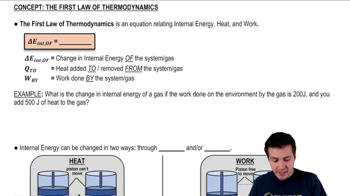
First Law of Thermodynamics

The First Law of Thermodynamics, also known as the law of energy conservation, states that energy cannot be created or destroyed, only transformed. In the context of engines, it implies that the energy input (heat supplied) equals the sum of the energy output (work done) and the energy discarded as waste heat.
추천 영상:
가이드 코스
08:04
The First Law of Thermodynamics

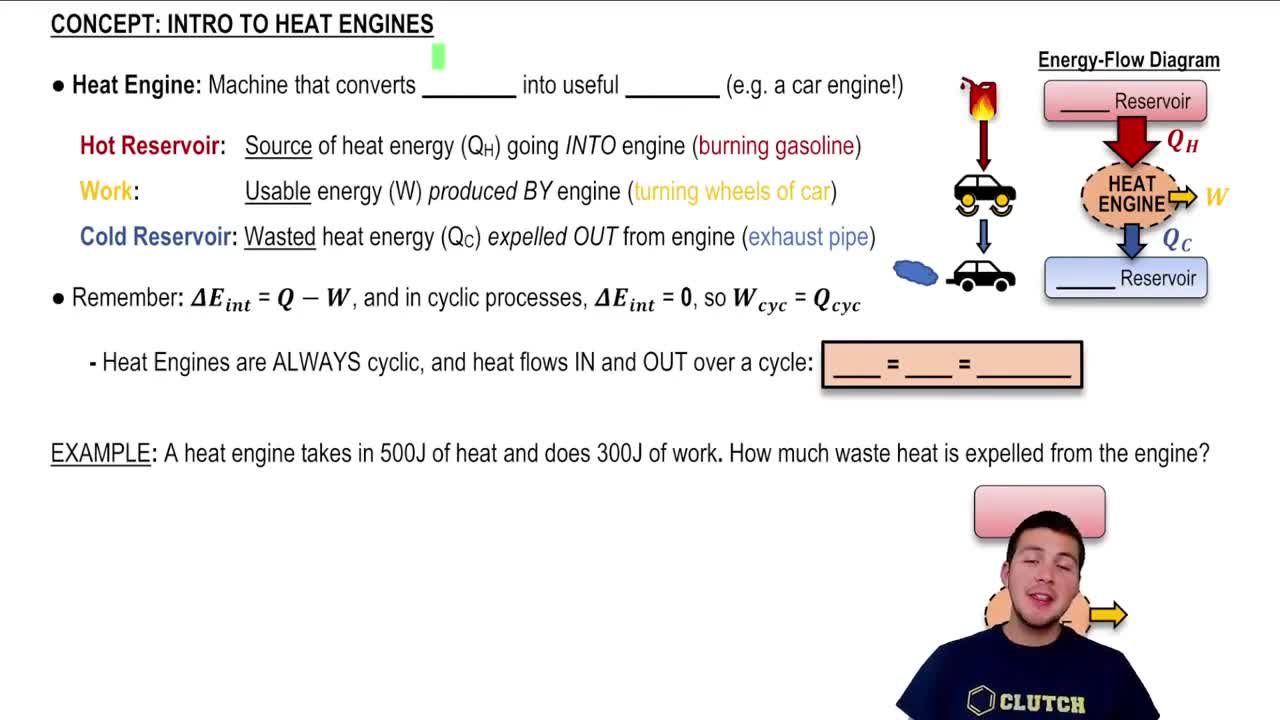
Heat Engine Efficiency

Heat engine efficiency is a measure of how well an engine converts heat into work. It is calculated by dividing the work output by the heat input. Understanding efficiency helps in determining the amount of heat required to perform a certain amount of work, considering the heat discarded.
추천 영상:
가이드 코스
07:35
Introduction to Heat Engines

Energy Balance in Cycles

Energy balance in cycles refers to the equilibrium between energy input, work output, and waste heat in a cyclic process. For a diesel engine, the energy supplied as heat must equal the sum of mechanical work done and heat discarded, ensuring the cycle adheres to the conservation of energy principle.
추천 영상: