
Ch 21: Electric Charge and Electric Field
Young & Freedman Calc - University Physics 14th Edition
Young & Freedman Calc14th EditionUniversity PhysicsISBN: 9780321973610당신이 사용하는 게 아니라요?교과서 변경
21장, 문제 37b

Two positive point charges qq are placed on the xx-axis, one at x=ax = a and one at x=ax = -a. Derive an expression for the electric field at points on the xx-axis. Use your result to graph the xx-component of the electric field as a function of xx, for values of xx between 4a-4a and +4a+4a.

검증된 단계별 안내
1
Start by considering the electric field due to a single point charge. The electric field \( E \) due to a point charge \( q \) at a distance \( r \) is given by \( E = \frac{kq}{r^2} \), where \( k \) is Coulomb's constant.
For the charge at \( x = a \), the distance to a point \( x \) on the x-axis is \( |x - a| \). The electric field due to this charge at point \( x \) is \( E_1 = \frac{kq}{(x - a)^2} \). The direction of this field is along the x-axis, pointing away from the charge if \( x > a \) and towards the charge if \( x < a \).
Similarly, for the charge at \( x = -a \), the distance to a point \( x \) on the x-axis is \( |x + a| \). The electric field due to this charge at point \( x \) is \( E_2 = \frac{kq}{(x + a)^2} \). The direction of this field is along the x-axis, pointing away from the charge if \( x > -a \) and towards the charge if \( x < -a \).
The net electric field at any point \( x \) on the x-axis is the vector sum of \( E_1 \) and \( E_2 \). Since both fields are along the x-axis, the net field \( E_x \) is \( E_x = E_1 - E_2 \) if \( x > 0 \) and \( E_x = E_2 - E_1 \) if \( x < 0 \). Substitute the expressions for \( E_1 \) and \( E_2 \) to get \( E_x = \frac{kq}{(x - a)^2} - \frac{kq}{(x + a)^2} \).
To graph the x-component of the electric field as a function of \( x \), evaluate \( E_x \) for values of \( x \) between \(-4a\) and \(+4a\). Note the symmetry and behavior of the field as \( x \) approaches \( a \) and \(-a\), where the field strength increases significantly.

비슷한 문제에 대한 검증된 영상 답변:

이 영상 해법은 위 문제에 도움이 된다고 튜터들이 추천한 것입니다.
영상 길이:
18m

주요 개념

질문에 올바르게 답하기 위해 반드시 이해해야 하는 핵심 개념들은 다음과 같습니다.

Electric Field

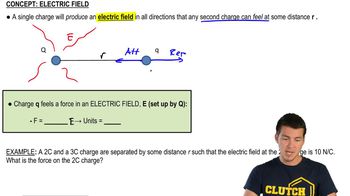
The electric field is a vector field around a charged particle that represents the force exerted per unit charge at any point in space. For a point charge, the electric field E at a distance r is given by E = k*q/r^2, where k is Coulomb's constant. Understanding how electric fields from multiple charges superpose is crucial for solving this problem.
추천 영상:
가이드 코스
03:16
Intro to Electric Fields

Superposition Principle

The superposition principle states that the total electric field due to multiple charges is the vector sum of the individual fields produced by each charge. This principle is essential for deriving the expression for the electric field at any point on the x-axis, as it involves calculating the contributions from both charges placed at x = a and x = -a.
추천 영상:
가이드 코스
03:32
Superposition of Sinusoidal Wave Functions

Graphing Electric Fields

Graphing the electric field involves plotting the x-component of the field as a function of position along the x-axis. This requires understanding how the field varies with distance and direction, and how the contributions from each charge affect the overall field. The graph provides a visual representation of the field's behavior between -4a and +4a.
추천 영상:
가이드 코스
03:16
Intro to Electric Fields
관련 실천
교과서 질문

A point charge is placed at each corner of a square with side length aa. All charges have magnitude qq. Two of the charges are positive and two are negative (Fig. E21.4221.42). What is the direction of the net electric field at the center of the square due to the four charges, and what is its magnitude in terms of qq and aa?

3269
views
1
rank
교과서 질문

A 4.00-4.00-nC point charge is at the origin, and a second 5.00-5.00-nC point charge is on the xx-axis at x=0.800x = 0.800 m. Find the electric field (magnitude and direction) at each of the following points on the xx-axis: (i) x=0.200x = 0.200 m; (ii) x=1.20x = 1.20 m; (iii) x=0.200x = -0.200 m.

3214
views
교과서 질문

A +8.75+8.75-mC point charge is glued down on a horizontal frictionless table. It is tied to a 6.50-6.50-mC point charge by a light, nonconducting 2.502.50-cm wire. A uniform electric field of magnitude 1.85×1081.85\(\times\)10^8 N/CN/C is directed parallel to the wire, as shown in Fig. E21.3421.34. What would the tension be if both charges were negative?

3310
views
교과서 질문

Two positive point charges qq are placed on the xx-axis, one at x=ax = a and one at x=ax = -a. Find the magnitude and direction of the electric field at x=0x = 0.

3488
views
교과서 질문

A +8.75+8.75-mC point charge is glued down on a horizontal frictionless table. It is tied to a 6.50-6.50-mC point charge by a light, nonconducting 2.502.50-cm wire. A uniform electric field of magnitude 1.85×1081.85\(\times\)10^8 N/CN/C is directed parallel to the wire, as shown in Fig. E21.3421.34. Find the tension in the wire.

2139
views
2
rank
교과서 질문

A 4.00-4.00-nC point charge is at the origin, and a second 5.00-5.00-nC point charge is on the xx-axis at x=0.800x = 0.800 m. Find the net electric force that the two charges would exert on an electron placed at each point in part (a). Note: Part (a) asked to find the electric field (magnitude and direction) at each of the following points on the xx-axis: (i) x=0.200x = 0.200 m; (ii) x=1.20x = 1.20 m; (iii) x=0.200x = -0.200 m.

4118
views