
Ch 21: Electric Charge and Electric Field
Young & Freedman Calc - University Physics 14th Edition
Young & Freedman Calc14th EditionUniversity PhysicsISBN: 9780321973610당신이 사용하는 게 아니라요?교과서 변경
21장, 문제 8c

Two small aluminum spheres, each having mass 0.02500.0250 kg, are separated by 80.080.0 cm. What fraction of all the electrons in each sphere does this represent?

검증된 단계별 안내
1
First, determine the number of aluminum atoms in each sphere. Use the formula for the number of moles: \( n = \frac{m}{M} \), where \( m \) is the mass of the sphere (0.0250 kg) and \( M \) is the molar mass of aluminum (approximately 27 g/mol or 0.027 kg/mol).
Convert the mass of the sphere from kilograms to grams to match the units of the molar mass: \( m = 0.0250 \text{ kg} \times 1000 \text{ g/kg} = 25 \text{ g} \).
Calculate the number of moles of aluminum in each sphere: \( n = \frac{25 \text{ g}}{27 \text{ g/mol}} \).
Determine the number of atoms in each sphere using Avogadro's number \( N_A = 6.022 \times 10^{23} \text{ atoms/mol} \): \( N = n \times N_A \).
Since each aluminum atom has 13 electrons, calculate the total number of electrons in each sphere: \( N_e = N \times 13 \). This gives the total number of electrons in one sphere, and you can compare this to the number of electrons involved in the interaction to find the fraction.

비슷한 문제에 대한 검증된 영상 답변:

이 영상 해법은 위 문제에 도움이 된다고 튜터들이 추천한 것입니다.
영상 길이:
12m

주요 개념

질문에 올바르게 답하기 위해 반드시 이해해야 하는 핵심 개념들은 다음과 같습니다.

Atomic Structure of Aluminum

Aluminum is an element with atomic number 13, meaning each atom has 13 protons and, typically, 13 electrons. Understanding the atomic structure is crucial for calculating the total number of electrons in a given mass of aluminum, as it allows us to determine the number of atoms present.
추천 영상:
가이드 코스
04:06
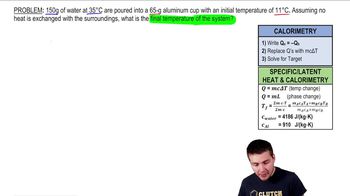
Pouring Hot Water in an Aluminum Cup

Avogadro's Number

Avogadro's Number, approximately 6.022 x 10^23, is the number of atoms or molecules in one mole of a substance. This concept is essential for converting the mass of aluminum spheres into moles, which then allows us to calculate the total number of electrons by multiplying the number of moles by Avogadro's Number and the number of electrons per atom.
추천 영상:
가이드 코스
07:19
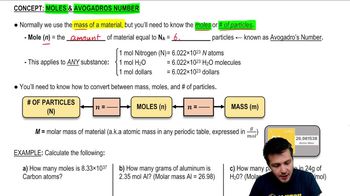
Moles & Avogadro's Number

Fraction Calculation

To find the fraction of electrons involved, one must compare the number of electrons in the interaction to the total number of electrons in the spheres. This involves calculating the total number of electrons using atomic and molecular data, and then determining what portion of these electrons are relevant to the problem at hand.
추천 영상:
가이드 코스
04:29
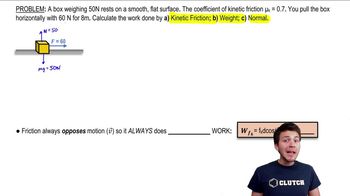
Work Done By Friction
관련 실천
교과서 질문

Suppose you had two small boxes, each containing 1.01.0 g of protons.

(a) If one were placed on the moon by an astronaut and the other were left on the earth, and if they were connected by a very light (and very long!) string, what would be the tension in the string? Express your answer in newtons and in pounds. Do you need to take into account the gravitational forces of the earth and moon on the protons? Why?

(b) What gravitational force would each box of protons exert on the other box?

1769
views
교과서 질문

Two small aluminum spheres, each having mass 0.02500.0250 kg, are separated by 80.080.0 cm. How many electrons does each sphere contain? (The atomic mass of aluminum is 26.98226.982 g/mol, and its atomic number is 1313.)

2612
views
교과서 질문

Two small spheres spaced 20.020.0 cm apart have equal charge. How many excess electrons must be present on each sphere if the magnitude of the force of repulsion between them is 3.33×10213.33\(\times\)10^{-21} N?

5866
views
5
rank
교과서 질문

Two small plastic spheres are given positive electric charges. When they are 15.015.0 cm apart, the repulsive force between them has magnitude 0.2200.220 N. What is the charge on each sphere if the two charges are equal?

2071
views
교과서 질문

Two small aluminum spheres, each having mass 0.02500.0250 kg, are separated by 80.080.0 cm. How many electrons would have to be removed from one sphere and added to the other to cause an attractive force between the spheres of magnitude 1.00×1041.00\(\times\)10^4 N (roughly 11 ton)? Assume that the spheres may be treated as point charges.

3194
views
1
rank
교과서 질문

Two small plastic spheres are given positive electric charges. When they are 15.015.0 cm apart, the repulsive force between them has magnitude 0.2200.220 N. What is the charge on each sphere if one sphere has four times the charge of the other?

4078
views