
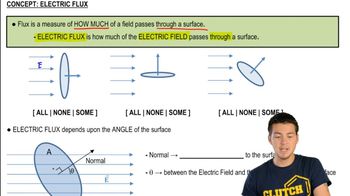


A flat sheet of paper of area m2 is oriented so that the normal to the sheet is at an angle of ° to a uniform electric field of magnitude N/C. For what angle between the normal to the sheet and the electric field is the magnitude of the flux through the sheet (i) largest and (ii) smallest? Explain your answers.
Ch 22: Gauss' Law
22장, 문제 1ab
A flat sheet of paper of area m2 is oriented so that the normal to the sheet is at an angle of ° to a uniform electric field of magnitude N/C.
(a) Find the magnitude of the electric flux through the sheet.
(b) Does the answer to part (a) depend on the shape of the sheet? Why or why not?
검증된 단계별 안내1
Step 1: Understand the concept of electric flux. Electric flux (Φ) through a surface is defined as the product of the electric field (E) and the area (A) of the surface, and the cosine of the angle (θ) between the field and the normal to the surface. The formula is Φ = E * A * cos(θ).
Step 2: Identify the given values from the problem. The electric field (E) is 14 N/C, the area (A) of the sheet is 0.250 m², and the angle (θ) between the normal to the sheet and the electric field is 60°.
Step 3: Calculate the cosine of the angle. Use the trigonometric function to find cos(60°), which is 0.5.
Step 4: Substitute the values into the electric flux formula. Plug in E = 14 N/C, A = 0.250 m², and cos(60°) = 0.5 into the formula Φ = E * A * cos(θ) to find the magnitude of the electric flux.
Step 5: Consider part (b) of the problem. The electric flux depends only on the area, the electric field, and the angle between them, not on the shape of the sheet. Therefore, the answer to part (a) does not depend on the shape of the sheet.

비슷한 문제에 대한 검증된 영상 답변:
이 영상 해법은 위 문제에 도움이 된다고 튜터들이 추천한 것입니다.
영상 길이:
5m주요 개념
질문에 올바르게 답하기 위해 반드시 이해해야 하는 핵심 개념들은 다음과 같습니다.
Electric Flux
Electric flux is a measure of the electric field passing through a given area. It is calculated as the product of the electric field magnitude, the area through which the field lines pass, and the cosine of the angle between the field and the normal to the surface. This concept helps quantify how much of the field penetrates the surface.
추천 영상:
가이드 코스
Electric Flux
Angle of Incidence
The angle of incidence in this context refers to the angle between the normal to the surface and the direction of the electric field. It is crucial for calculating electric flux, as the cosine of this angle determines how much of the field is effectively passing through the surface. A 60° angle means the field is not perpendicular, reducing the effective flux.
추천 영상:
가이드 코스
Critical Angle
Independence from Shape
The electric flux through a surface depends on the area and orientation relative to the electric field, not the shape of the surface. Whether the sheet is flat, curved, or any other shape, as long as the area and orientation remain constant, the flux calculation remains unchanged. This principle highlights the geometric nature of flux calculations.
추천 영상:
가이드 코스
Pressure Gauges: U-Shaped Tube
관련 실천
교과서 질문
1972
views
1
rank
교과서 질문
You measure an electric field of N/C at a distance of m from a point charge. There is no other source of electric field in the region other than this point charge.
(a) What is the electric flux through the surface of a sphere that has this charge at its center and that has radius m?
(b) What is the magnitude of this charge?
3788
views
교과서 질문
A hemispherical surface with radius in a region of uniform electric field has its axis aligned parallel to the direction of the field. Calculate the flux through the surface.
3370
views
