
Ch 22: Gauss' Law
Young & Freedman Calc - University Physics 14th Edition
Young & Freedman Calc14th EditionUniversity PhysicsISBN: 9780321973610당신이 사용하는 게 아니라요?교과서 변경
22장, 문제 40a

A very long conducting tube (hollow cylinder) has inner radius AA and outer radius bb. It carries charge per unit length +α, where αα is a positive constant with units of C/m. A line of charge lies along the axis of the tube. The line of charge has charge per unit length. Calculate the electric field in terms of αα and the distance rr from the axis of the tube for (i) r<ar < a; (ii) a<r<ba < r < b; (iii) r>br > b. Show your results in a graph of EE as a function of RR.

검증된 단계별 안내
1
Step 1: Understand the problem setup. We have a hollow conducting cylinder with inner radius A and outer radius B, carrying a charge per unit length +α. Additionally, there is a line of charge along the axis of the tube with the same charge per unit length +α. We need to find the electric field at different regions: inside the inner radius, between the inner and outer radius, and outside the outer radius.
Step 2: Apply Gauss's Law to find the electric field for r < A. Since the line of charge is along the axis, consider a cylindrical Gaussian surface of radius r and length L inside the inner radius. The enclosed charge is the line charge, which is αL. Using Gauss's Law, \( \Phi_E = \oint \mathbf{E} \cdot d\mathbf{A} = \frac{Q_{enc}}{\varepsilon_0} \), where \( Q_{enc} = \alpha L \). The electric field \( E \) is radial and constant over the surface, so \( E(2\pi rL) = \frac{\alpha L}{\varepsilon_0} \). Solve for \( E \) to get \( E = \frac{\alpha}{2\pi \varepsilon_0 r} \).
Step 3: Determine the electric field for A < r < B. In this region, the Gaussian surface encloses both the line charge and the charge on the inner surface of the cylinder. The inner surface of the cylinder has a charge per unit length of -α to ensure the cylinder is neutral overall. Thus, the enclosed charge is zero, leading to \( E = 0 \) in this region.
Step 4: Calculate the electric field for r > B. Here, the Gaussian surface encloses the line charge and the entire cylinder, which has a net charge of +α per unit length. The enclosed charge is \( 2\alpha L \). Using Gauss's Law, \( E(2\pi rL) = \frac{2\alpha L}{\varepsilon_0} \). Solve for \( E \) to get \( E = \frac{2\alpha}{2\pi \varepsilon_0 r} = \frac{\alpha}{\pi \varepsilon_0 r} \).
Step 5: Graph the electric field E as a function of r. For r < A, the electric field decreases as \( \frac{1}{r} \). For A < r < B, the electric field is zero. For r > B, the electric field decreases as \( \frac{1}{r} \) but with a different coefficient. This graph will show discontinuities at r = A and r = B, reflecting the changes in enclosed charge.

비슷한 문제에 대한 검증된 영상 답변:

이 영상 해법은 위 문제에 도움이 된다고 튜터들이 추천한 것입니다.
영상 길이:
6m
도움이 되었나요?

주요 개념

질문에 올바르게 답하기 위해 반드시 이해해야 하는 핵심 개념들은 다음과 같습니다.

Gauss's Law

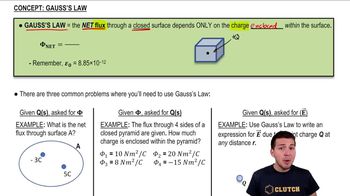
Gauss's Law relates the electric flux through a closed surface to the charge enclosed by that surface. It is essential for calculating electric fields in symmetric charge distributions, such as cylindrical geometries. The law states that the total electric flux is equal to the enclosed charge divided by the permittivity of free space, allowing us to determine the electric field at various distances from the axis.
추천 영상:

Electric Field in Cylindrical Coordinates

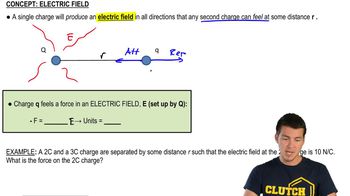
In cylindrical coordinates, the electric field due to a line of charge or a charged cylinder is radially symmetric. The field depends on the radial distance from the axis and is calculated using Gauss's Law. For a line of charge, the field decreases with distance, while for a charged cylinder, it varies based on the region considered (inside, between, or outside the cylinder).
추천 영상:
가이드 코스
03:16
Intro to Electric Fields

Superposition Principle

The superposition principle states that the total electric field due to multiple charges is the vector sum of the fields due to each charge individually. In this problem, the field at any point is the sum of the field due to the line of charge and the field due to the charged tube. This principle is crucial for determining the net electric field in regions where multiple charge distributions are present.
추천 영상:
가이드 코스
03:32
Superposition of Sinusoidal Wave Functions