
Ch 26: Direct-Current Circuits
Young & Freedman Calc - University Physics 14th Edition
Young & Freedman Calc14th EditionUniversity PhysicsISBN: 9780321973610당신이 사용하는 게 아니라요?교과서 변경
26장, 문제 26

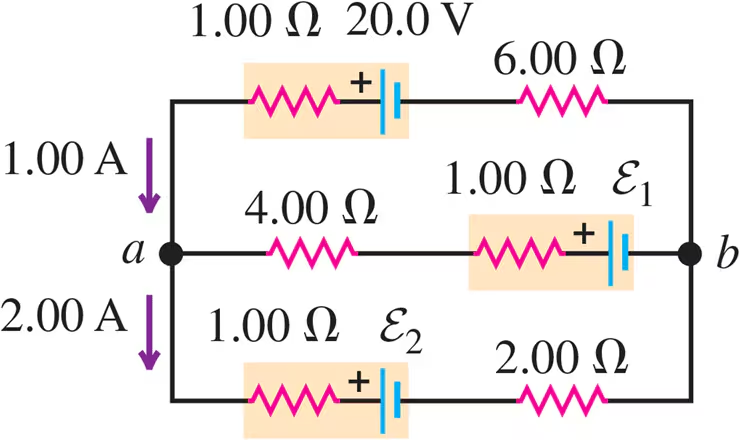
Find the emfs ε1ε_1 and ε2ε_2 in the circuit of Fig. E26.26, and find the potential difference of point bb relative to point aa.

검증된 단계별 안내
1
Step 1: Identify the components in the circuit diagram, including resistors, batteries, and their respective emfs (ε_1 and ε_2). Note the direction of current flow and the polarity of each battery.
Step 2: Apply Kirchhoff's loop rule to the circuit. This rule states that the sum of the emfs in any closed loop is equal to the sum of the potential drops (IR) across the resistors in that loop. Write down the equations for each loop in the circuit.
Step 3: Solve the system of equations obtained from Kirchhoff's loop rule to find the values of ε_1 and ε_2. This may involve algebraic manipulation and substitution to isolate the emfs.
Step 4: To find the potential difference between points b and a, use the concept of potential difference, which is the work done per unit charge to move a charge between two points. Calculate the potential difference using the equation V = IR for the resistors between points a and b.
Step 5: Consider the direction of current flow and the polarity of the batteries when calculating the potential difference. Ensure that the signs are correctly assigned based on the direction of current and the orientation of the batteries.

비슷한 문제에 대한 검증된 영상 답변:

이 영상 해법은 위 문제에 도움이 된다고 튜터들이 추천한 것입니다.
영상 길이:
10m
도움이 되었나요?

주요 개념

질문에 올바르게 답하기 위해 반드시 이해해야 하는 핵심 개념들은 다음과 같습니다.

Electromotive Force (EMF)

Electromotive force (EMF) is the energy provided by a cell or battery per coulomb of charge passing through it. It is the potential difference across the terminals of a source when no current is flowing. EMF is measured in volts and is a crucial factor in determining the behavior of electrical circuits.
추천 영상:

Kirchhoff's Voltage Law

Kirchhoff's Voltage Law (KVL) states that the sum of the electrical potential differences (voltage) around any closed network is zero. This principle is essential for analyzing circuits, as it allows us to set up equations based on the loop rule to solve for unknown voltages or EMFs in the circuit.
추천 영상:
가이드 코스
04:08
Kirchhoff's Junction Rule

Potential Difference

Potential difference, also known as voltage, is the difference in electric potential between two points in a circuit. It represents the work done to move a unit charge from one point to another. Understanding potential difference is key to determining how energy is distributed in a circuit and is measured in volts.
추천 영상:
가이드 코스
07:04
Potential Difference Between Two Charges